Incident Overview
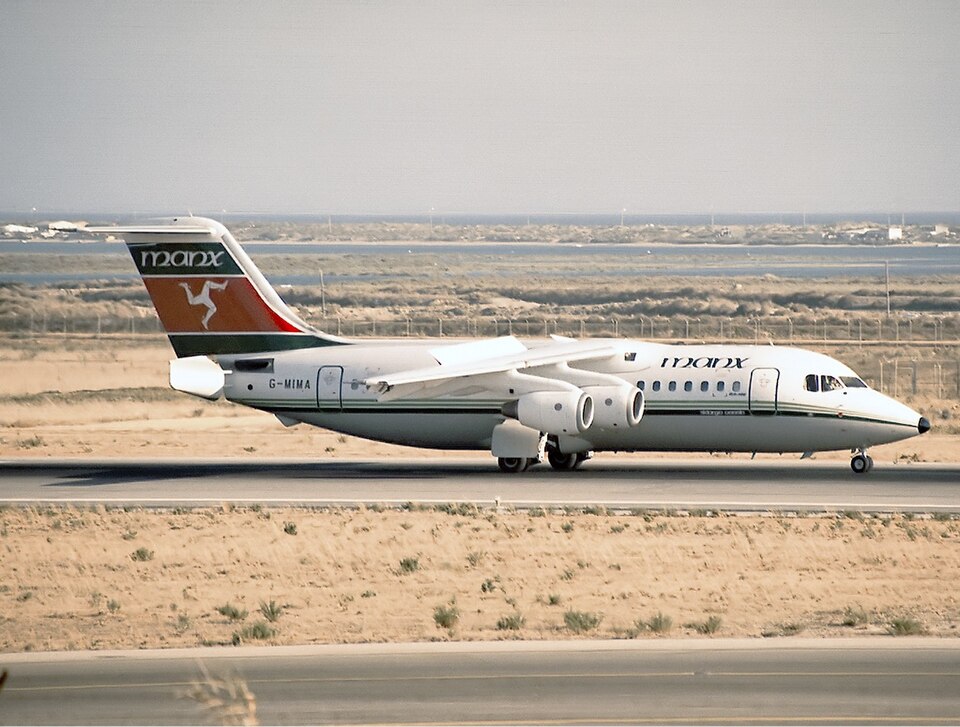
On 8 September 2003, a BAe 146-200, registration G-MIMA, operated a public transport passenger flight to Gatwick Airport. After an uneventful flight and landing, the aircraft was shut down on stand with ground power connected, and passengers began normal disembarkation. Shortly thereafter, the flight crew detected an odour in the flight deck. Within minutes, the first officer observed smoke emanating from beneath the commander's seat. The commander ordered an emergency evacuation via the public address system. The cabin crew, noticing odour and haze, armed and deployed the rear door slide, through which approximately eight passengers evacuated; another ten passengers left via the front left airstairs with increased haste. Two minor injuries occurred during the evacuation.
Checklists and Crew Actions
The crew reported that no specific checklist existed for smoke or fire at this stage of operation. They used the evacuation checklist as a guide but decided not to discharge fire extinguishers into the engines or APU, believing the smoke originated in the avionics bay. They also completely de-powered the aircraft, a step not included in the evacuation checklist. The commander checked that no persons remained on board, vacated the aircraft, and briefed the Airfield Fire Service.
Communication and Flight Deck Door
The flight deck door remained closed during disembarkation, as was standard practice due to its bulk, limiting cabin crew visibility along the aisle. A new door design, with a hinged decompression panel, was scheduled for introduction in April 2004 to reduce bulk and improve aisle space.
Post-Event Crew Debrief
After the incident, the cabin crew and flight deck crew returned to their home base separately, without a debrief. The company Operations Manual requires a debrief, but limited opportunity existed. The operating company later issued a Flight Operations Newsletter highlighting the requirement for a post-incident debrief.
APU and Engineering Investigation
The APU was a Honeywell Garrett 36-100M, started during descent at approximately 5,000 feet. On final approach and after landing, it supplied all air conditioning and electrical power. A few days before the incident, the APU had been replaced due to a hot section inspection. The replacement APU, serial number P-309, had been repaired in June 2003 after high oil consumption, including replacement of the main rotor bearing. It was fitted to G-MIMA on 3 September 2003 and operated for about one hour before the incident.
After removal, examination revealed no apparent oil leak but traces of oil in the intake plenum. The APU main rotor was partially seized. Teardown at the manufacturer's facility found more than two litres of oil (nominal capacity 2.5 US quarts), contaminated with metallic debris and carbon. Metallic debris was on the magnetic chip detector and speed sensor plugs. Further teardown showed compressor impeller/shroud and turbine rub marks, and a broken cage on the ball bearing locating the compressor and turbine shaft. Most cage fragments were found throughout the reduction gearing, causing gear damage. The balls had minor flats, but the bearing failure was at a relatively early stage when shut down. The cage failure led to loss of ball location, allowing the shaft to move against a carbon oil seal, which let hot APU oil enter the airstream and produce fumes/smoke in the cabin air supply.
The reason for the bearing failure was not determined, but it was fitted correctly and adequately lubricated. The bearing and associated parts were sent to the manufacturer's US base for further examination.