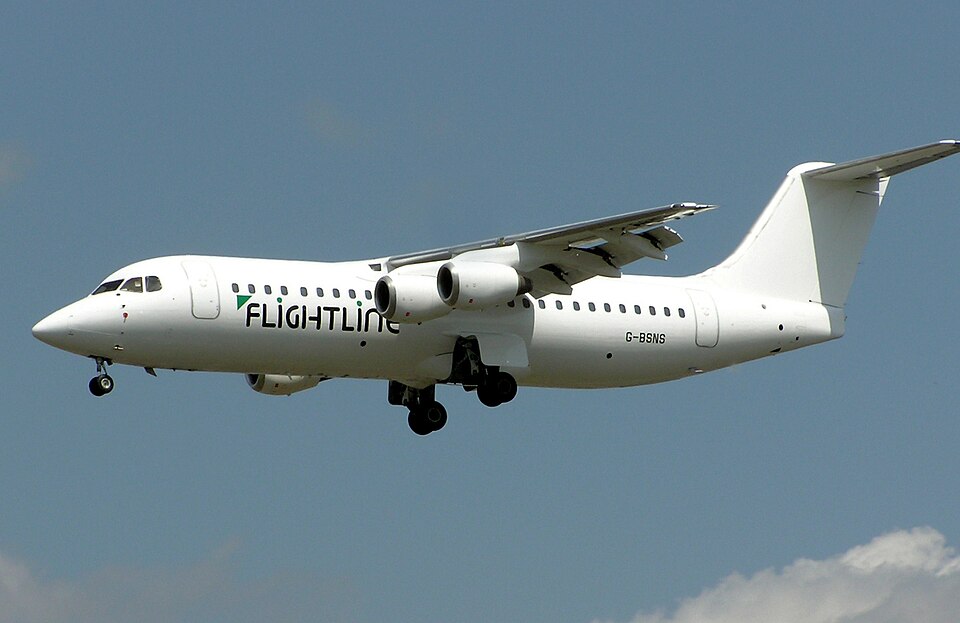
Incident Overview
On 13 July 1999 at 1718 UTC, a BAe 146-300 (registration G-BSNS) operated by an airline as a public transport passenger flight from Stansted Airport to Edinburgh experienced a sudden and violent yaw to the right while climbing through Flight Level 120 in a gentle right turn. The yaw damper disengaged, followed by the autopilot. The aircraft continued rolling right until the commander arrested the roll at a 50° bank angle. After regaining level flight, the aircraft handled normally with both systems disconnected. The disturbance caused a cabin trolley to tip and meal trays to slide. The commander returned to Stansted, using gentle bank angles, and landed normally.
Investigation
The operator initially tested the yaw damper and autopilot, which operated satisfactorily. They found aileron control circuit cable tensions and left spoiler deployment angles outside limits and adjusted them. The left spoiler actuator was leaking and replaced. After a flight test, the aircraft returned to service on 17 July. However, the cause remained unidentified, prompting the aircraft manufacturer to analyze Flight Data Recorder (FDR) data.
FDR data showed that at 10,500 feet and 275 knots indicated airspeed, with yaw damper and autopilot engaged, a 20° right turn was selected (from 300° to 320°), resulting in a 28° right bank. At that point, a 1.5° rudder step input to the left occurred, causing immediate yaw damper disconnect and a lateral acceleration of 0.1g. The autopilot remained engaged initially, applying corrective aileron, but disconnected about 6 seconds later, probably due to roll rate exceedance. The pilot then applied aileron and rudder inputs over approximately 30 seconds, during which lateral accelerations exceeded 0.2g. The aircraft had two short autopilot re-engagements before being flown manually back to Stansted.
Yaw Damper System
The BAe 146 yaw damper system has two independent channels, each with a yaw computer receiving inputs from a yaw rate gyro, lateral accelerometer, and a vertical reference unit (VRU). Each channel provides up to ±2° rudder authority, summed to ±4°. A comparator monitors both channels; if a difference of 1.5° or more occurs, it applies a brake and isolates both channels. VRU No 1 provides secondary output roll signals to the No 1 yaw damper computer, autopilot, and FDR. VRU No 2 provides secondary output to the No 2 yaw damper computer only.
Findings
The manufacturer inspected both VRUs. VRU No 1 had worn rotor (gyro) bearings; VRU No 2 showed fluid contamination on its secondary output circuit board. Since FDR roll attitude data appeared normal, VRU No 1's secondary output was satisfactory. The manufacturer concluded that VRU No 2's contamination caused incorrect roll attitude signals to the No 2 yaw damper computer, inducing the 1.5° rudder step input and subsequent yaw damper disconnect. A simulator test replicating the step input produced a good correlation with the aircraft's response.
The manufacturer also noted that after the disconnect, the pilot's aileron and rudder inputs may have temporarily aggravated Dutch roll, as they exceeded the minimum required. They commented that optimal crew reaction is difficult to simulate accurately.
Safety Actions
A Service Bulletin (SB 25-236-01143A Revision 2, 31 March 1993) for installing a protective splash cover on VRUs had not been embodied on this aircraft. It was subsequently incorporated. In January 2000, the manufacturer issued Service Information Letter SIL 25/23 reminding operators of the bulletin's availability.