History of the Flight
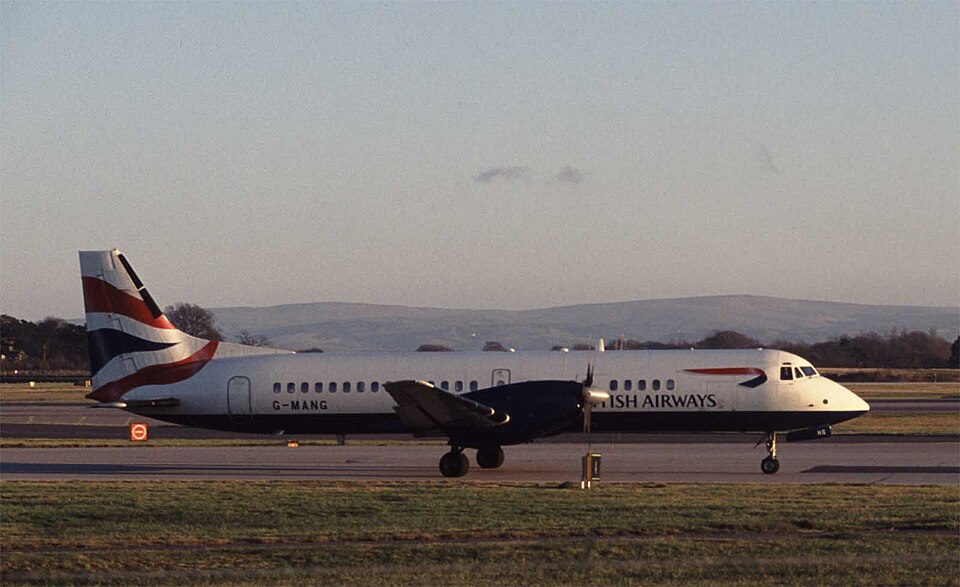
The aircraft, a BAe ATP registered G-MANG, was operating a scheduled public transport flight from Southampton to Manchester. The same crew and aircraft had previously operated the Manchester to Southampton service. Both flights were uneventful until the landing rollout at Manchester. Shortly before touchdown on Runway 24, the surface wind was reported as 300° at 13 knots. The co-pilot, who was handling the aircraft, applied left rudder to reduce drift during the flare and executed a gentle main wheel touchdown. After touchdown, the co-pilot lowered the nosewheels onto the runway, selected reverse thrust on both engines, and announced "you have control" to the commander. (The ATP has no nosewheel steering tiller on the co-pilot's side; the steering system is not connected to the rudder pedals, so the left-seat pilot always taxis.)
The rollout initially continued normally with little need for nosewheel steering or braking. However, approximately nine seconds after the commander took control, a vibration began that rapidly intensified. The vibration lasted about 15 seconds and was severe enough to cause items on the flight deck to become airborne and some overhead locker lids in the cabin, particularly near the nose, to burst open, ejecting contents. Believing a nose landing gear tyre had burst, the commander attempted to steer toward the nearest runway exit to park on the taxiway. Before he could do so, he lost nosewheel steering authority, and a few seconds later the nose leg collapsed. Both pilots immediately realized the leg had collapsed as the aircraft came to a halt on the runway with the forward fuselage resting on the nosewheel tyres. Air traffic control staff in the visual control room observed the aircraft stop with the nose landing gear collapsed and dispatched emergency services without a request from the flight crew.
Evacuation
As the aircraft stopped, the forward cabin attendant contacted the pilots via interphone to ask if there was a problem. The pilots were occupied with immediate actions, and she decided to wait. After the commander said "condition levers off, abandon the aircraft," she specifically asked whether to evacuate using the slides. The commander replied to evacuate using all available exits on both sides and informed her that the nosewheel had collapsed. The cabin attendant was unaware of a subsequent brief discussion between the pilots about the wisdom of using the rear slides due to the aircraft's nose-down attitude. The commander decided that priority was to evacuate quickly and that rear slides should be used. The pilots were about to action the evacuation checklist when the forward cabin crew member reported that the forward door slide would not inflate. She was instructed to use all other available doors including the overwing exits. Fire crews were approaching the aircraft, and the commander addressed passengers on the cabin address system, instructing them to abandon the aircraft because the nosewheel had collapsed but that there was no fire risk.
There was no panic in the cabin. The forward cabin attendant announced instructions to leave, but several passengers were seen retrieving belongings from lockers. An off-duty pilot from the airline instructed passengers to evacuate without belongings and removed one overwing exit. Another overwing exit was removed by a passenger. Fire service video showed that more people evacuated from the overwing exits than from the rear exits. The rear slides were steep but reached the ground. The rear cabin attendant and a fireman assisted people using the rear slides. One passenger was seriously injured when jumping off the leading edge of the wing instead of sliding off the trailing edge, fracturing both heel bones. Three other passengers were treated on site for minor cuts and bruises.
The evacuation checklist was discussed with the aircraft manufacturer, who agreed to revise it to ensure propellers have stopped rotating before evacuation and to add wing flaps to be lowered if time permits to assist sliding off the wing trailing edge. These revisions were with the CAA awaiting approval.
Flight Recorders
The aircraft was equipped with a Fairchild A100 30-minute recycling Cockpit Voice Recorder (CVR) and a 25-hour Plessey PV1584 Digital Flight Data Recorder (DFDR), both replayed after the accident. DFDR data showed a normal approach with an indicated airspeed at touchdown of 97 knots, pitch attitude of 3.4°, which decreased as nosewheels lowered. Three seconds after mainwheel touchdown, data became corrupted; the last sampled pitch attitude was 0.3°. No data was recovered during the subsequent landing roll. From the CVR, a loud vibration became audible about ten seconds after touchdown and continued until the aircraft stopped 34 seconds after touchdown. Six seconds before stop, the landing gear unsafe warning was heard. The corruption of DFDR data was due to tape speed fluctuations, a known issue with this recorder type in high vibration or high 'g' loading. The loss of data coincided with nosewheel contact, suggesting unusual vibration transmitted to the DFDR. No data loss occurred on the previous flight.
Nosewheel Oscillation (Shimmy)
Torsional oscillation of a nosewheel can occur on any castoring design. It may manifest as low-amplitude vibration sensed by the crew. Maintenance staff would typically check tyre pressures or wear in bushes and bearings. Designers usually call 'shimmy' the more potentially damaging modes where oscillation frequency approaches the natural frequency of the landing gear and mounting structure, leading to progressively violent vibration, often until part of the system breaks—in this case, the aircraft structure itself was compromised.
Description of the Nose Landing Gear Steering System
The nosewheels on ATP aircraft are steered from the left crew position using a tiller on the left side console. Rotary tiller movement is transmitted via a shaft to a quadrant in the nose gear bay, then through cables and pulleys to a second quadrant, which via a scissor linkage drives a shaft to the steering control valve. The valve ports hydraulic pressure to steering jacks to move the wheels. Design assumed fluid would always be present in steering jacks and valves to provide shimmy damping via a restrictor. A compensator in the return line maintained minimum 250 psi pressure in the circuit. The single hydraulic system de-pressurizes when landing gear is up and locked; upon gear down selection, system pressurizes. As the nose leg downlocks, a microswitch closes to inform the crew and prepare the steering system. If the pilot has selected steering, another microswitch on the nose leg, operated by torque link movement, must open before the steering selector valve solenoid opens to port fluid.
Description of the 'Weight-on-Wheels' Microswitch
The plunger assembly, which bears down on switch contacts as the oleo extends into air mode, includes a secondary spring for overtravel protection. Initial plunger movement causes primary and secondary plungers to move together against the main spring. As contacts are made, further movement compresses the secondary spring, preventing switch damage. The secondary plunger is made of mild steel and retained within the main plunger.
Damage
The nose landing gear attachment structure was torn from the fuselage, and the leg collapsed rearwards.