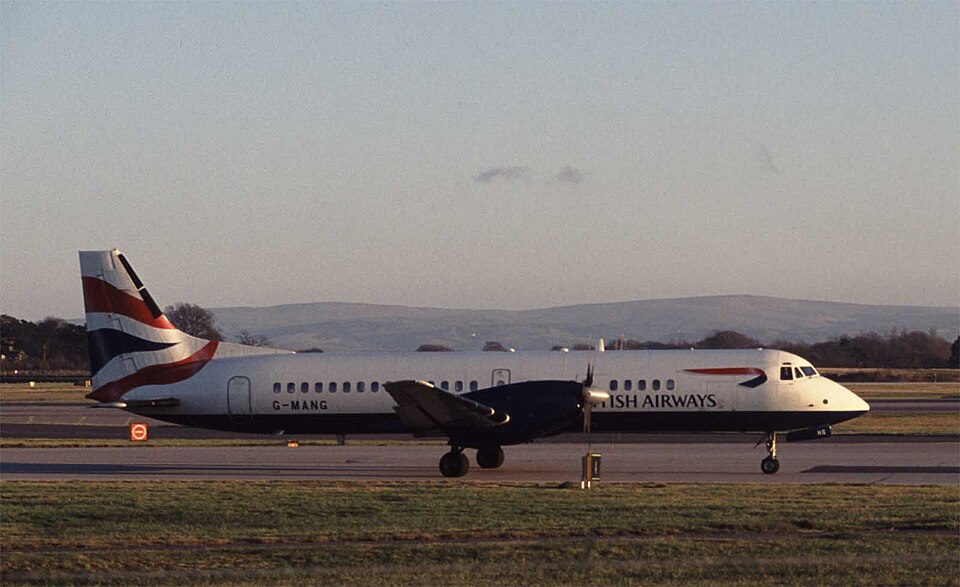
History of the Incident
On 20 August 2002, a BAe.ATP (registration G-MANG) departed Glasgow Airport for Belfast with a deferred defect for fuel seepage from the right wing. The aircraft was crewed by four and carried 39 passengers. While established in cruise at FL100, the 'RIGHT HAND LANDING GEAR BAY OVERHEAT' warning light illuminated. The crew followed the checklist, which required lowering the landing gear. The overheat warning extinguished after gear extension. The checklist then directed the crew to complete the 'ENGINE FIRE IN FLIGHT DRILL' for the affected side, resulting in the right engine being shut down. The crew transmitted a 'MAYDAY' call and diverted to Prestwick Airport, where a single-engine landing was made on Runway 31. At no time was there any warning of an engine fire. The senior cabin crew member visually inspected the engine from the cabin and reported nothing unusual.
After stopping on the runway with firm brake application, the airfield fire service (AFS) approached and reported small flames and smoke emanating from between the two right main wheels. The commander shut down the left engine and ordered an emergency evacuation, which proceeded without incident except for one elderly passenger requiring oxygen. Approximately 15 minutes later, the commander inspected the aircraft with the fire chief and saw no signs of physical damage. As there was no ATP tow-bar available at Prestwick, the flight crew, after advice from the airline's fleet manager and station engineer, restarted the left engine and taxied the aircraft clear of the runway.
Subsequent Events
The company station engineer from Glasgow attended the aircraft later that day. Although he could not find anything unusual, he believed that the location of the reported flames around the wheels was consistent with a heat pack fire. He arranged for replacement of both wheels and brake units and a full inspection of the landing gear bay and overheat detectors. The removed brake units were sent for a full strip examination and report. On 22 August 2002, the aircraft was ferried with its landing gear down to Glasgow for further investigation and rectification of the fuel seepage problem.
Four days later, as the aircraft departed Glasgow with four crew on board, the 'RIGHT HAND LANDING GEAR BAY OVERHEAT' warning illuminated again. The checklist was followed as before, and the aircraft returned to Glasgow Airport with the right engine shut down. During the landing roll, the 'RIGHT HAND INNER BRAKE OVERHEAT' warning illuminated, but there were no signs of fire.
Engineering Findings
Subsequent engineering investigation led to the replacement of the brake control valve and No 3 'maxaret' unit. Manipulation of the overheat sensors' electrical wiring loom was found to activate the overheat warning, and further checks detected a chafed and damaged cable. Replacement of this cable rendered the system fully serviceable.
Checklist Philosophy
The sensor used to detect a landing gear bay overheat is also used to detect flames from engine torching. The checklist assumes that if the caption disappears after landing gear lowering, it indicates an engine torching problem rather than a landing gear problem, thus requiring an engine shutdown. Service Bulletin ATP-71-12-10368A introduced a flame guard that allows a torching flame to be detected by a separate dual 'firewire' system instead of the landing gear bay overheat sensor. This modification, originally issued in May 1995, permits the use of a revised checklist procedure that does not involve an in-flight engine shutdown. The airline was in the process of introducing the modification across its fleet, but at the time of the incident this aircraft had not been modified.