History of the Flight
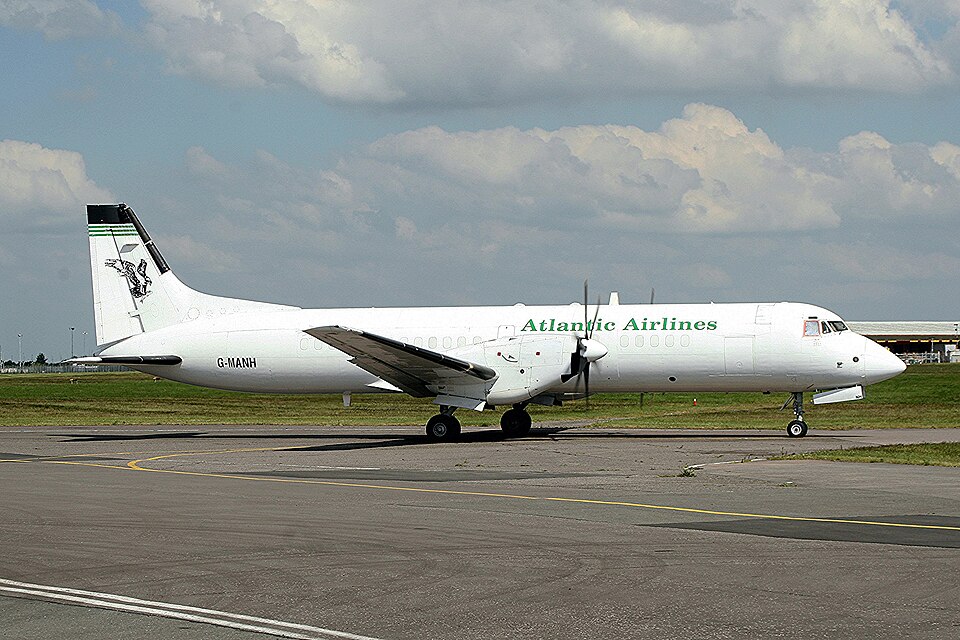
On 9 April 2011 at 0147 UTC, a BAe ATP aircraft, registration G-MANH, operated a night cargo flight from East Midlands Airport to Cardiff Airport. The flight was routine with the co-pilot acting as Pilot Flying (PF). The surface wind at Cardiff was from 060° at 9 knots, and Runway 12 was in use. Following a normal touchdown, the PF selected full reverse thrust, with the commander intending to take control at 60 knots. As the aircraft decelerated through about 80 knots, the crew noted an abnormal lateral vibration that appeared to be increasing. The commander took control and stopped the aircraft on the runway, suspecting a burst tyre. The crew informed ATC and shut down the engines using normal procedures.
Inspection by the crew and the Airport Fire and Rescue Service (AFRS) revealed damage to both tyres of the right main landing gear, including deflation, along with damage to gear leg components, hydraulic pipes, and flap/nacelle fairings. Two metal components were recovered from the runway: the apex pin and its castellated retaining nut. Approximately four hours later, the aircraft was unloaded and towed clear of the runway.
Examination of the Landing Gear
Initial examination of the aircraft showed that a temporary apex pin had been installed in the torque link assembly after the original pin was found missing. The tyres exhibited circular cutting of the sidewalls and tearing of the carcass structure. The upper torque link showed some damage. Runway inspections revealed unusual markings consistent with an oscillating motion of a double-wheeled axle in the horizontal plane, likely causing tyre skidding.
The landing gear leg, last overhauled in 2004, was removed and forwarded to the manufacturer for detailed examination. The apex pin and nut were retained by the AAIB. The chromium-plated bearing surface of the pin was in good condition, but the external threads on the pin and internal threads in the nut were extensively corroded. Thread forms near the bearing region retained correct diameters, while others were significantly reduced. The nut showed deep internal axial grooves and evidence of relative axial movement between the thread crests. The locking bolt was largely destroyed, with only the centre portion surviving.
Findings
The failure was attributed to corrosion-induced weakening of the threaded attachment between the apex pin and its castellated nut. This allowed the nut to move axially, leading to loss of engagement and subsequent overload fracture of the locking bolt. Similar failures had occurred on two ATP aircraft in 1999, though without corrosion. Following those events, a mandated Service Bulletin (SB) required periodic inspection and measurement of the thread engagement. In response to this incident, the landing gear manufacturer is introducing a new SB to address corrosion and prevent surface damage during assembly that could initiate corrosion.