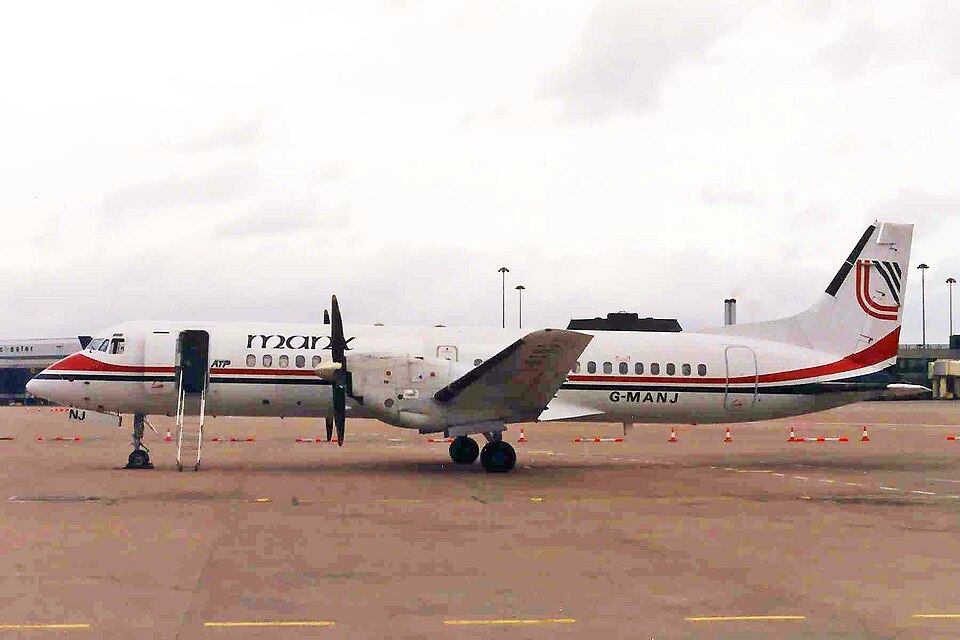
History of the Flight
The crew, consisting of two flight deck and two cabin crew members, began duty at 1240 hrs to operate two return flights from Manchester to Belfast. The first flight was completed without incident. For the second flight, the aircraft departed Manchester at 1707 hrs on a Wallasey 1R Standard Instrument Departure. As the aircraft passed 400 ft, the crew reported to Area Control that they needed to perform an after-takeoff check and might need to return, stating there was no emergency. At 1716 hrs, the crew informed Manchester Radar that the left gear would not come up. Four minutes later, they declared a PAN PAN, stating that only two undercarriage legs were locked down and the left leg was unsafe. They requested to hold at Wallasey VOR at 5,000 ft to consult checklists and contact the company.
Crew Actions and Checklists
The first officer, who was the pilot flying, selected the landing gear up after takeoff, but a red unsafe light indicated the left main landing gear was not locked up. The commander instructed the first officer to continue the SID, climb to 5,000 ft, engage the autopilot, and hold at Wallasey VOR. The crew initially consulted checklist 'Unable to raise landing gear' (Card 36) but deemed it inapplicable. They then selected the gear down to assess the situation, confirming a left main red indicator and green indications for the right main and nose gear. The No.1 cabin crew member inspected the mechanical indicators and confirmed the left MLG was not locked down.
The crew consulted three checklists: Card 34 (abnormal and emergency lowering), Card 34A (emergency lowering with changeover lever ineffective), and Card 35 (landing with gear not fully locked down). Actions on Card 34 were initiated; however, operating the landing gear changeover lever caused the right MLG indicator to turn red, prompting the crew to reverse actions. After consulting the company and the ATP Flight Manual, they completed Card 34, which included the commander taking control, the first officer operating mechanical up-lock releases, and acceleration to 175 kt with manoeuvring to force the left gear down. The No.1 reported the left MLG was not visible and the forward gear bay doors were slightly open. These actions did not resolve the situation. The commander then proceeded with Card 35.
Landing and Evacuation
The crew prepared the cabin, briefed passengers on emergency exits, and held for fuel burn and weather considerations. By 1835 hrs, they decided to land at Liverpool. After coordinating with ATC, the aircraft was vectored for a localiser DME approach to Runway 09. The commander landed manually, applying right roll control. As speed reduced, the left wing settled onto the runway. Sparks emanated from the trailing edge of flaps and left outer tailplane, and a brief flash fire appeared in the left MLG bay; both ceased as the aircraft stopped. The crew performed a precautionary evacuation via the forward main door and both rear doors. No injuries occurred. Emergency services were on scene promptly.
Flight data recorder and cockpit voice recorder data were analysed. The aircraft touched down at 89 kt with 1.18g normal acceleration. After touchdown, roll left reached -10.5°, yawing right. The CVR recorded the approach and landing; the FDR stopped as engines were shut down.
The landing gear extension/retraction mechanism is conventional tricycle gear with hydraulic power. This incident shares features with a previous accident to BAE ATP G-BUUP, detailed in AAIB Bulletin 9/98.