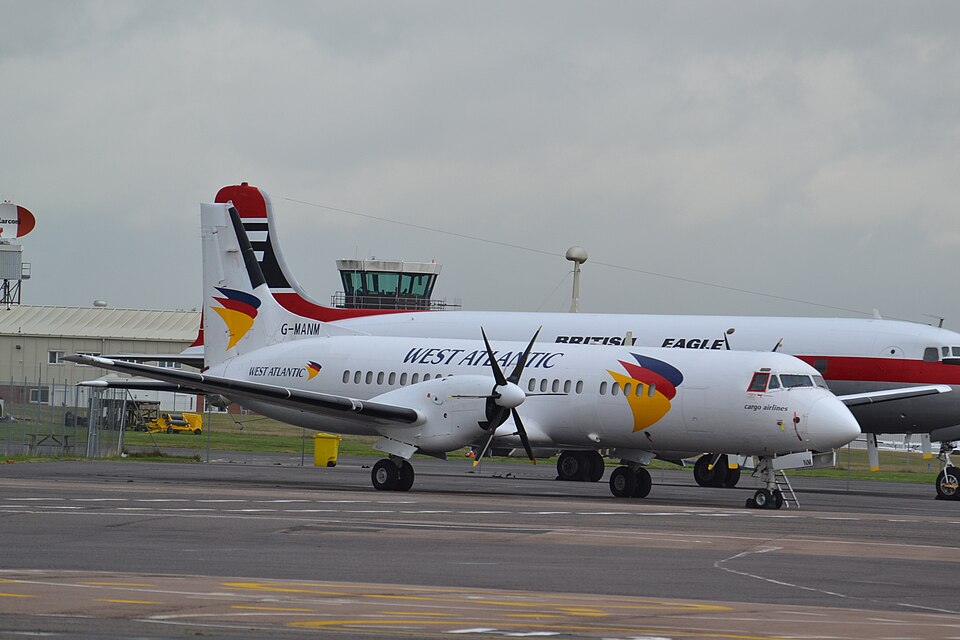
History of the Flight
Following an uneventful flight, the aircraft made a normal touchdown at Jersey Airport with 29° of flap. Deceleration was normal until the speed dropped to approximately 60 knots, at which point a severe vibration began. The landing roll was completed, and the aircraft taxied clear of the runway. The engines were shut down, and passengers disembarked by bus to the terminal.
Examination of Aircraft
Inspection on the taxiway revealed that the apex pin from the right main landing gear torque links was missing, and the wheels were misaligned by about 20° to the right. The pin was later found on the runway along with the sheared center portion of the locking bolt, which was retained in the pin end. Neither the ends of the locking bolt nor the pin retaining nut were located. Engineering examination showed the apex pin threads were severely worn and distorted in shear toward the free end, indicating that the nut had stripped off the threads, leading to shearing of the locking bolt.
Service History of the Right Main Landing Gear
At the time of the incident, the main landing gear had completed 10,389 landings since overhaul in 1993. The failed apex bolt had last been adjusted on 19/20 November 1998, following reports of mainwheel shimmy. At that time, the gear had 9,666 landings. Since adjustment, the aircraft had undergone two 600-hour routine checks.
Action Following the Incident
The operator consulted the landing gear manufacturer regarding additional inspections. On 19 May 1999, a fleet-wide inspection was instituted to check the end float of all main landing gear apex joints and replace assemblies if necessary. During this inspection, one apex pin was found with severely worn threads and a loose-fitting nut. These components were sent to the manufacturer, who determined that the thread forms had insufficient residual strength to withstand loads from wheel shimmy, which would increase with greater joint clearances due to thread wear.
Background on Torque Link Joint Design
The ATP main landing gear torque link joint design requires an apex pin end float of 0 to 0.05 mm, achieved by shimming. The nut is not axially clamped, leaving it free to rattle on the threads, which can increase wear as the joint loosens over time. The scheduled overhaul life was 12,000 landings, but by July 1993 the manufacturer introduced a "half-life" check every 6,000 landings due to observed wear rates. After discussions with operators, an inspection interval of 6,000 hours or 9,000 landings was considered acceptable. A Service Letter issued in July 1995 referred to the 6,000-landing inspection but did not mention a 9,000-landing limit or highlight thread wear risks.
Previous Similar Incident
In 1998, a similar pin failure occurred on a foreign-registered aircraft overseas. The manufacturer concluded that stripped threads resulted either from overload via the torque links or overtightening of the nut.
Manufacturer's Response
Following the G-MANM incident, the manufacturer instigated a one-time inspection of all ATP main landing gear apex joints, which uncovered four additional severely worn pin/nut combinations. A Service Bulletin and maintenance manual amendments were being formulated but had not been implemented before a second similar incident occurred on another of the operator's aircraft, G-MANH.