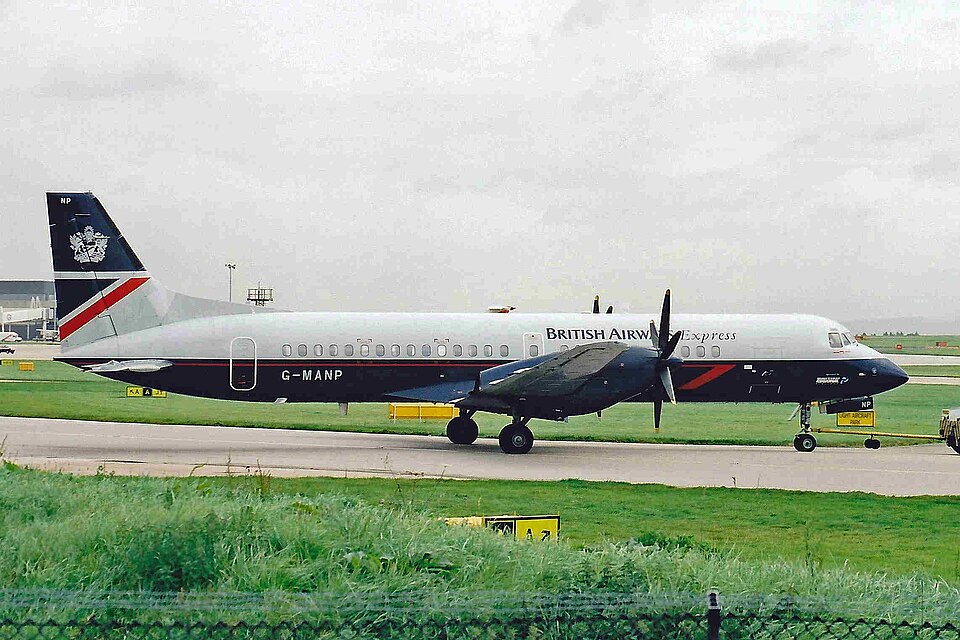
History of the Incident
The aircraft, a BAe ATP registered as G-MANP, was parked on Stand 9 at Jersey Airport. Clearance to start engines was given at 1656 hrs. Normal procedure dictated that the commander start the No 2 engine prior to pushback and the No 1 engine during the pushback.
The No 2 engine was started, and pushback was requested at 1659 hrs. After a slight delay, the aircraft was cleared to pushback at 1702 hrs. The aircraft faced north on the stand and was pushed back to align on the taxiway facing west. The No 1 engine started about 1½ minutes later, as the aircraft heading passed approximately 305°, and it had stabilised by the time the aircraft was aligned with the taxiway.
Shortly after alignment, the aircraft began to push the tug, the towbar failed, the aircraft moved forward, and the right propeller struck the tug. A series of 'bumps' was heard on the Cockpit Voice Recorder (CVR) area microphone channel, similar to the sound of a nosewheel running over raised centreline lighting. These increased in frequency until, 11 seconds later, a loud 'crack' was heard, followed 5 seconds later by a crashing impact. During this sequence, a noise similar to a live headset being dropped was heard.
The Tower controller saw the collision and immediately informed the Airport Fire Service (AFS), declaring a Ground Incident at about 1705 hrs. The commander shut down both engines and closed the LP cocks. The crew realised the aircraft had rolled forward and the right propeller had struck the tug. After liaising with the cabin attendant, the commander briefed the passengers and prepared for disembarkation.
Evacuation and Response
About 1½ minutes after impact, the first officer noticed a small amount of smoke on the flight deck. The commander decided to start evacuation immediately, instructing passengers via the PA to evacuate via the forward steps. He then told the cabin crew to arm the rear door, deploy the chute, and start evacuating passengers through that door as well. Despite several elderly and infirm passengers and some who attempted to take cabin baggage, the cabin crew evacuated the aircraft in an orderly manner. The flight deck crew made the aircraft safe and switched off power about 2½ minutes after impact.
The commander left the aircraft to assist but returned when AFS personnel and two cabin attendants from a nearby aircraft arrived. The AFS arrived at 1708 hrs, laid a foam blanket over the area of the No 2 engine and tug, and noted that the forward passenger door was open with steps deploying. Passengers began disembarking; the rear door then opened and a full evacuation commenced. A head count was completed, and passengers were marshalled away. At 1812 hrs, AFS personnel boarded to ensure all passengers were evacuated and to secure the aircraft.
Ground Crew Accounts
The headset operator reported that the pushback appeared normal until the aircraft was being straightened. The tug seemed to struggle, and before he could alert the flight crew, the towbar snapped. The aircraft shot forward about twenty feet, and the right propeller struck the left side of the tug cab. His headset came off as he ran to safety. He was physically uninjured but treated for shock.
The tug driver felt resistance as if the aircraft was pulling power. He felt the front of the tug lift, losing steering ability, and the aircraft seemed to push forward, causing the tug to jack-knife. The right propeller struck the left side of the cab, ripping off the door. He did not recall escaping. He was physically uninjured but later stated he was suffering from post-traumatic stress.
The third man noticed the tug was out to the right as the aircraft straightened. The tug stopped, and the aircraft moved forward. He shouted a warning and ran toward the terminal. He saw the right propeller strike the tug.
A witness, an airline station engineer, had a clear view. He initially noticed louder than normal engine noise from the ATP. He observed what appeared to be a standard pushback except for the louder noise. He heard the No 1 engine come up to speed about halfway through the turn. When he looked again, the tug was at about 45° to the centreline, and the aircraft suddenly moved forward and struck the tug.
Flight Crew Account
The flight crew were unaware of anything abnormal until shortly before the impact. They heard 'graunching' noises but thought them typical of pushback. When informed of FDR data showing higher than normal power on all four starts that day, both crew members were genuinely surprised and could offer no explanation. They said the higher engine noise level would have been immediately obvious if anything were abnormal, but they could not recall any of the starts being other than normal.
Flight Data Recorder Analysis
The FDR indicated that the No 2 engine stabilised at 15% torque after start and remained at that level until impact. The No 1 engine stabilised at 10% after start and remained until shutdown. Normally, torque is set at 7 to 8% after start by positioning rollover levers at or about a white Minimum Torque mark. The thrusts associated with 10% and 15% torque are 300 kg (662 lbf) and 713 kg (1,571 lbf) respectively.
Examination of the three previous starts that day, all by the same crew, showed similar higher than normal torque levels on both engines. FDR data from earlier days showed torque levels consistently between 7 and 8% on both engines.
As part of the investigation, an ATP aircraft was videotaped during pushback from Stand 9. The commander was asked to apply 10% and 15% torque to the No 1 and No 2 engines respectively after tug disconnection and then release the brakes. The louder than normal engine noise was very noticeable, and the speed at which the aircraft moved forward from stationary was indicative of significant power.
Damage Assessment
The aircraft's right propeller blades, made of forged aluminium spars with fibreglass shells and polyurethane foam, were severely damaged. The engine nacelle, fuselage (multiple debris strikes, outer skin and a cabin window penetrated but debris not entering cabin), and wing trailing edge aft of the rear spar were also damaged. Witness marks indicated contact between the right nose wheel door and the left front mudguard of the tractor.
The tug had a robustly constructed steel-framed cab. The top left rear corner was struck by the propeller, penetrating the engine air intake below the propeller hub. The cab structure was only moderately distorted, though the left door was lost. The right front tyre was deflated due to a split inner tube, likely from excessive load. Tyre scrape marks were consistent with lateral dragging across an abrasive surface; similar marks were present on the left front tyre.
The towbar, originally manufactured for heavier DC9 aircraft, was fitted with a shear pin for use with the lighter ATP and had a modified towing eye constructed from heavy rectangular section material. The weld attaching the towing eye to a flange plate failed in shear out around the fillet weld on the bar side. The fracture occurred progressively by a very low cycle, high stress fatigue mechanism, estimated at 12.5 to 13.5 stress cycles from crack initiation to final fracture, corresponding well with the series of 'bumps' recorded on the CVR.