History of the Flight
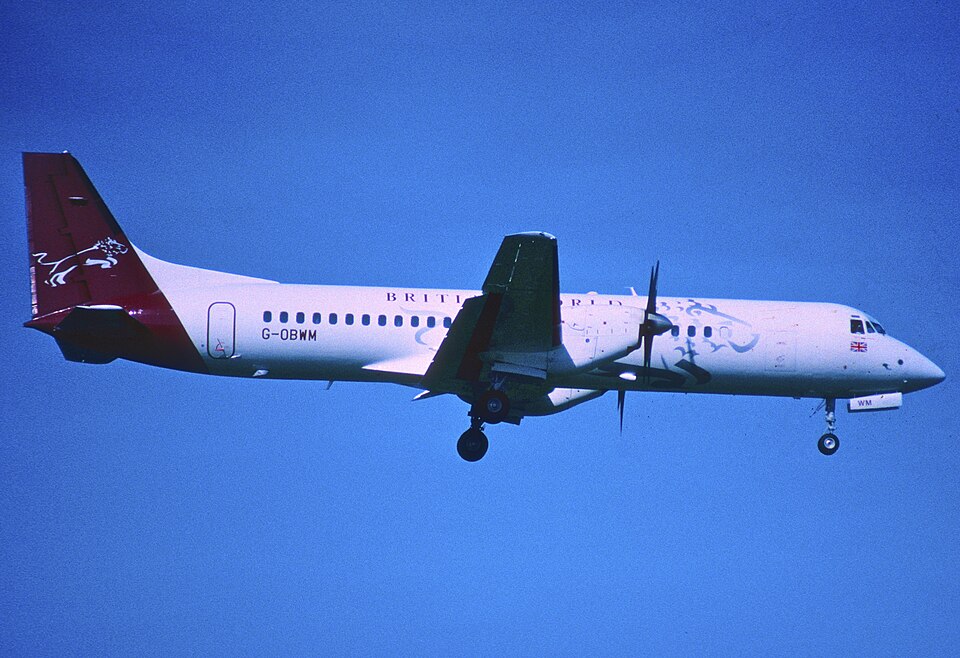
On 20 June 2000 at 1015 hrs, a BAe ATP aircraft, registration G-OBWN, was conducting a public transport flight from Stansted Airport. During the take-off roll at an estimated speed of 55 kt, the aircraft began an uncommanded deviation to the right. The commander, who was steering via the tiller, eased the deviation to the left, whereupon the aircraft departed violently to the left, concurrent with a severe vibration. He called 'STOP' to the co-pilot, but the vibration worsened. Despite differential braking and power, the aircraft continued leftward. The commander was able to bring the aircraft to a halt and shut it down on the runway.
Upon entering the cabin, the commander became aware that two passengers had been slightly injured by some of the many detached trim panels. First aid was given by a Medic who attended with the Airport Fire Service. As there appeared to be no imminent danger, the passengers remained on board until a bus arrived to transport them to the terminal.
Damage and Examination
The aircraft was towed to a maintenance facility where representatives of the manufacturers and the operator examined it. Both nose landing gear (NLG) tyres remained inflated but showed signs of distress. Detailed inspection revealed no evidence of structural damage to either the NLG or the airframe. Tests on the nosewheel steering system showed the NLG weight-on-wheels switch to be unserviceable.
Investigation Findings
The weight-on-wheels switch failure was investigated by the manufacturer. Green coloured deposits associated with the wire attachments to the switch were found, which effectively shorted the switch to continuously signal the AIR position. As a result, the steering selector valve would have been signalled to OFF. The deposits appeared to be associated with the ingress of moisture. Switches from the same batch have been withdrawn from stock/service.
The Flight Data Recorder (FDR), a Plessey PV1584, was replayed. Data showed the aircraft accelerate to a maximum speed of 54 kt, then decelerate, but data was lost below 45 kt, probably due to vibration transmitted to the FDR during the shimmy. A similar loss of data occurred in a previous shimmy accident involving ATP G-MANG.
Nosewheel Oscillation (Shimmy)
Torsional oscillation of a nosewheel can occur on designs with castoring systems. It can manifest as low-amplitude vibration. In more damaging modes, termed 'shimmy', the forced oscillation frequency approaches the natural frequency of the landing gear and mounting structure, leading to progressively violent vibration until a component fails.
NLG Steering System
The ATP nosewheels are steered from the left crew position using a tiller. Three switches in series are required for steering pressure: the nosewheel steering selector switch (set to ON by crew), the NLG weight-on-wheels switch, and the NLG downlock switch. Rotary movement of the tiller is transmitted to a hydraulic steering control valve on the NLG, powered by a single hydraulic system. A compensator in the circuit retains fluid in the steering jack to provide shimmy damping in the event of hydraulic pressure loss. Prior to this event, it was recognised that internal leakage could bleed away pressure, and a modification to fit a non-return valve was prepared in 1996 but not fitted to G-MANG or G-OBWN. Consequently, in both cases, when the weight-on-wheels switch failed to signal the steering selector valve to open, pressure and fluid were absent from the steering jack, and both steering and shimmy damping were lost.