Incident
The aircraft, one of three Nimrod reconnaissance variants, had recently undergone a major servicing at the Nimrod Major Servicing Unit (NMSU) at RAF Kinloss by RAF maintenance personnel. On a routine post-servicing airtest, registration XW666 departed and flew for approximately 35 minutes. During a test of the aircraft's anti-icing system, the No 4 engine fire warning illuminated. While the crew executed the fire drill, the No 3 engine fire warning also illuminated. A rear crew member confirmed the aircraft was on fire and reported that panels were falling away from the starboard wing.
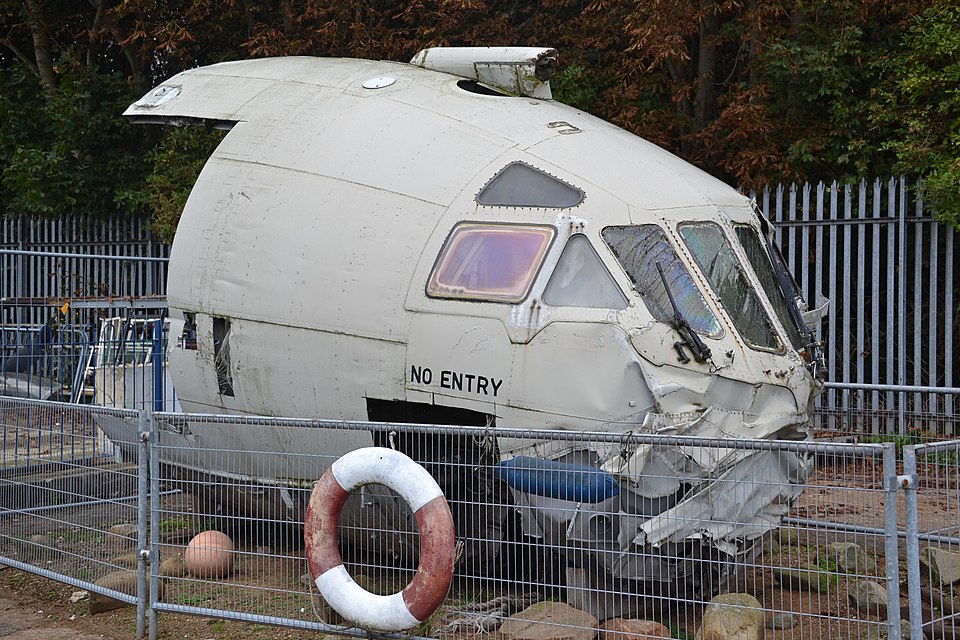
After two explosions, the captain feared for the structural integrity of the aircraft and decided to ditch before losing control authority. Without the aid of flaps—which failed to operate due to a fire or associated hydraulic failure—the captain performed a controlled ditching into the Moray Firth. The aircraft bounced twice onto the sea before settling. The fuselage broke into two, and the aircraft subsequently sank. Parts were later salvaged, and the cockpit section is now on display at AeroVenture South Yorkshire Aircraft Museum in Doncaster.
Investigation and Probable Cause
The official inquiry, with assistance from the Department of Transport's Air Accident Investigation Branch, found that despite correct application of maintenance procedures, the DC electrical loom attached to No 4 engine had sustained mechanical damage. The exact origin of the damage could not be positively determined. Arcing occurred when the engine anti-icing system was switched on, initiating the air starter system. Since the No 4 engine was already running at idle during the airtest, there was no load on the starter turbine, which quickly ran up to high speed. The nut holding the turbine disk in place failed, allowing the disk to move back on its shaft and out of its protective housing. The disk then struck the engine bypass casing and the No 2 fuel tank, puncturing both. The resultant fuel leak was ignited either by electrical arcing within the faulty DC loom or by the heat of the engine. The fire spread rapidly to the wing area and forward to the engine intake area. The inquiry concluded that a sequence of technical difficulties led to the uncontained fire.