History of the Flight
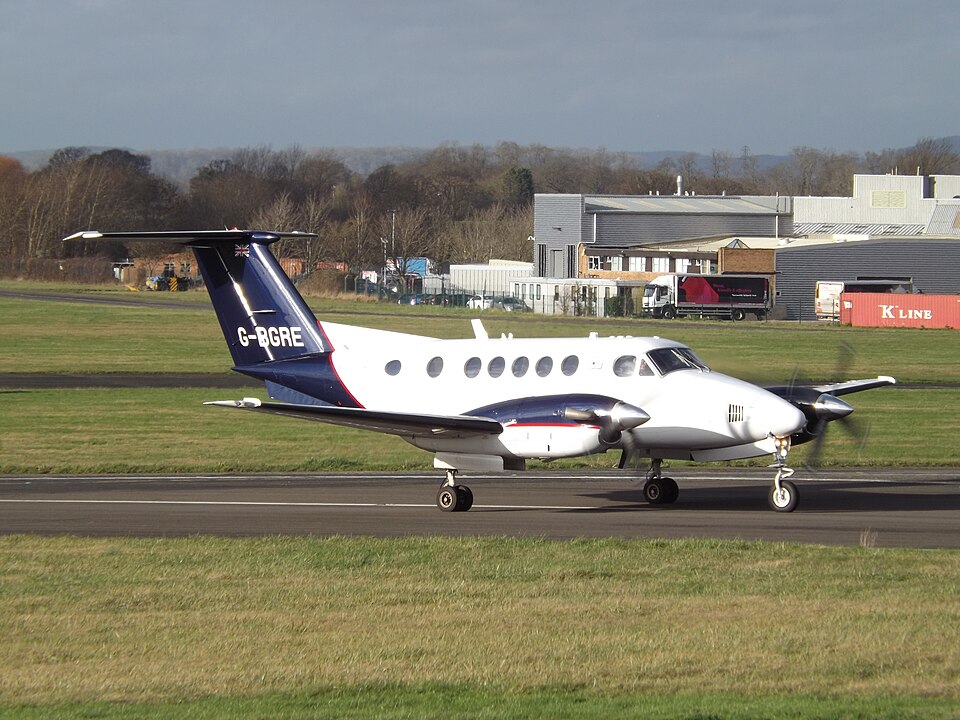
The aircraft was returning to Chalgrove from Langford Lodge in Northern Ireland. After takeoff, the landing gear was retracted, but the red gear unsafe warning light remained on. The crew flew the remainder of the flight with the gear retracted as a precaution. During the final stages, they selected the landing gear lever to the down position. Both main landing gear legs extended and locked, indicated by green lights, but the nose landing gear did not fully deploy; the green light remained off and the red unsafe light illuminated.
The pilot conducted a low pass over the airfield, and ground observers confirmed the nose gear was not fully extended. The pilot then executed a normal approach, shutting down both engines just before nose gear touchdown. During the landing roll, the nose gear leg collapsed, causing both propellers to strike the ground. The aircraft came to a stop resting on its nose, just off the runway centerline. Both occupants were uninjured and exited via the main passenger door.
Landing Gear System Description
The landing gear system includes a gearbox located below the cabin floor in the center of the fuselage. An electric motor, controlled by the landing gear lever, operates the gearbox. The gearbox has three outputs: spine drives for each main gear leg actuator and a sprocket driving a duplex chain for the nose gear actuator. The electric motor has a dynamic brake system triggered by microswitches to prevent over-travel. Emergency extension is via a manual handle in the cockpit, turning a separate chain to drive all three gear legs down.
Investigation Findings
After removing the cabin floor, it was evident that the nose gear chain had separated at a connecting master link. The pins, plates, and spring clip of this link had detached but were recovered. The chain was visually inspected per the manufacturer's Aircraft Maintenance Manual (AMM) and was within limits. Detailed inspection showed one pin had fractured at its midpoint, and two connecting plates were distorted upward, with a third distorted outward.
Metallurgical analysis of the failed pin via scanning electron microscope indicated the failure was due to overload, with no evidence of fatigue. Several other non-propagated cracks were found when the pin was sectioned. The pin's material composition and hardness met specifications.
Maintenance and Service History
The landing gear was last overhauled on 15 November 2005 (935.5 hours and 885 cycles prior). The operator stated that during this overhaul, the chain was refitted per the AMM. No subsequent removals of the chain occurred. The approved maintenance schedule requires four chain inspections over 800 flying hours or 2 years, with 200-hour intervals. The chain is an 'on condition' item replaced only when wear limits are exceeded; the gearbox and motor undergo overhaul every 8000 cycles or 6 years.
Manufacturer's Information and Previous Events
The chain manufacturer's website notes that shock loads exceeding approximately 55-60% of the chain's tensile strength can cause pin failure. The aircraft manufacturer's Model Communiqué No 16 (13 January 1978) advised replacing a 'slip-fit' plate on the master link with a 'press-fit' plate to retain the link if the spring lock detaches. This communiqué applied to aircraft serial numbers prior to BB-306; the accident aircraft was BB-568, suggesting the master link should have the press-fit arrangement. Examination indicated pins may not have been fully pressed through the rear cover plate, leaving insufficient gap for the front press-fit cover plate. A front cover plate was not recovered. The operator's maintenance staff were unaware of the press-fit plate requirement and noted that the AMM did not detail master link assembly or reference the communiqué.
The aircraft manufacturer reported one similar nose gear failure in March 2001, caused by a detached nose gear drive chain (same part number). That investigation attributed failure to incorrect reassembly. Another event (July 2007) involved a nose gear chain master spring link detachment with a slip-fit cover plate. In the current accident, it was not possible to determine if the missing front press-fit plate contributed to the pin failure, but full insertion of pins and fitting the press-fit plate would likely have prevented the link from completely detaching after fracture, possibly allowing the gear to extend.