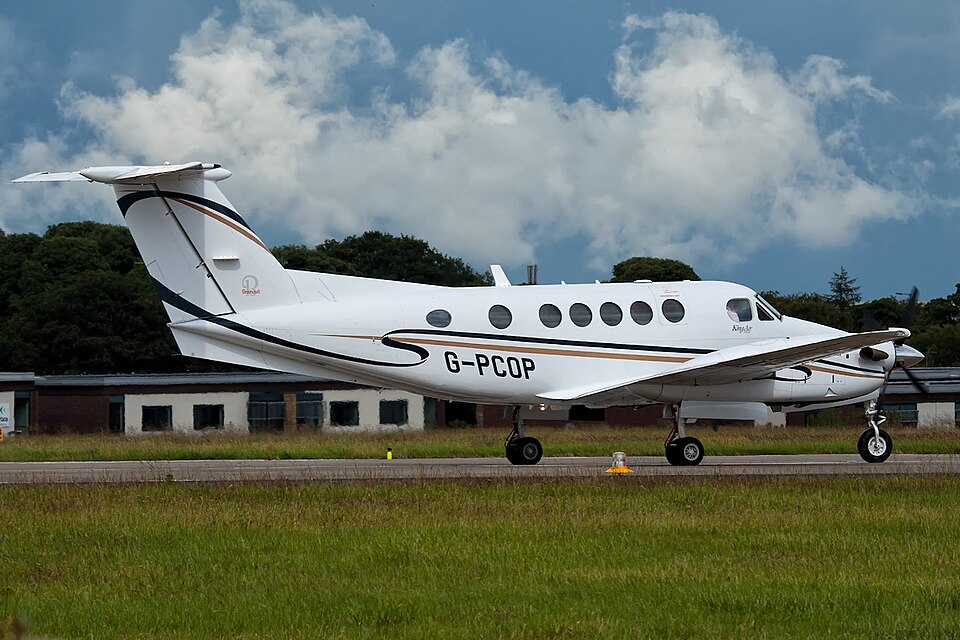
Aircraft Information
The aircraft, a Beech B200 King Air registered G-PCOP, was manufactured in 2004 and equipped with two Pratt & Whitney Canada PT6A-42 turbo-prop engines. It was fitted with Rockwell Collins Pro Line 21 avionics, including two electronic Primary Flight Displays (PFD) and a single Multi Function Display (MFD). Standby instrumentation was provided by a Goodrich Electronic Standby Instrument System (ESIS) displaying attitude, altitude, airspeed, and heading. The commander held an Airline Transport Pilot's Licence with 6,524 total flying hours, including 180 hours on type.
Background
The flight was a private transfer from Glasgow Airport to Peterborough (Conington) Aerodrome. The aircraft's Technical Log recorded one defect: the heading function of the ESIS was inoperative. The commander began engine start at 0815 hrs using battery power; both starts were uneventful. All after-start checks were normal, including voltage and generator load checks.
History of the Flight
After takeoff at 0831 hrs, the aircraft was transferred to Glasgow Approach and then to Scottish Radar. At 0836 hrs, G-PCOP was cleared to climb to FL150, which was acknowledged. Shortly after, the left EFIS display indicated a Flight Management System failure. The commander selected VOR as navigation source, but soon all three EFIS displays became intermittent and then blank. Radio communication was also lost. The commander assumed a major avionics failure and focused on the ESIS display while climbing to FL150.
At 0858 hrs, an RAF Tornado crew on a training flight was requested by ATC to assist. By 0910 hrs, the Tornado was alongside G-PCOP. The RAF pilot rocked wings to signal a follow; the G-PCOP pilot responded similarly but then turned north-east. The Tornado crew later indicated a descent. As G-PCOP entered cloud, the ESIS display began flashing, and the commander struggled to recover from a steep descent. He eventually reached straight and level flight above cloud, but the ESIS became inoperative.
After a period of straight and level flight, a passenger used a mobile phone to contact Edinburgh ATC, who coordinated landing at RAF Leuchars. The commander descended through cloud gaps, manually pumped down the landing gear, and landed at 1025 hrs. The aircraft was airborne for almost two hours and without electrical power for at least 90 minutes.
Post-Incident Examination
On the ground, the commander noted low battery voltage and reset passenger oxygen masks. External electrical power restored all systems to normal. The next day, engineers replaced both batteries and tested the electrical system successfully. No defects were found in the electrical generation and distribution systems. The aircraft was ferried to Blackbushe Airport on 31 March. There, inspection revealed wrinkling and bulging of the outer wing skins, and engine removal showed overstress damage characteristic of abnormally high flight loads. The outer wing panels were replaced.
Recommendations
Recommendations were made relating to information in the Airplane Flight Manual and to the certification standards of the aircraft.