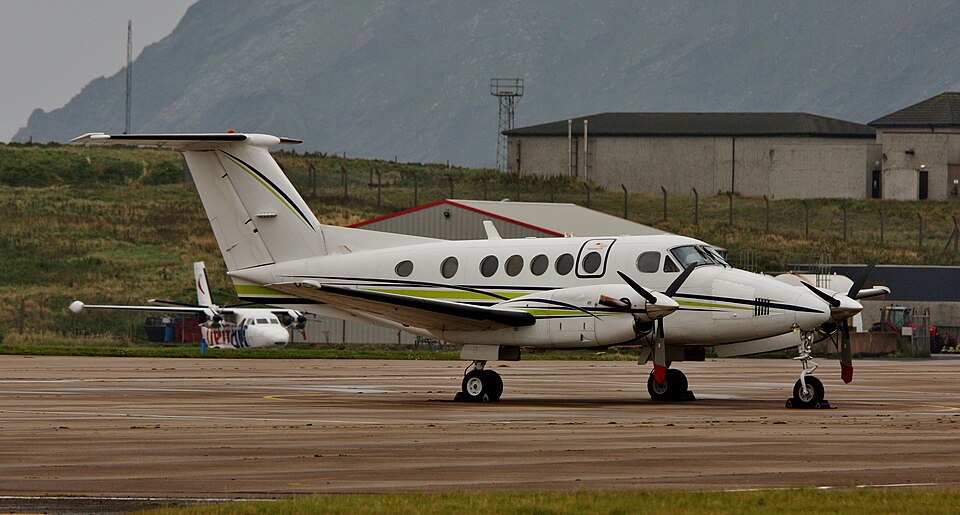
History of the Flight
The aircraft, a Beech B200 Super King Air registered G-BYCP, departed Caen Airport, France, for Stapleford Aerodrome, Essex, with two crew and five passengers. After takeoff, the crew heard an unusual noise from the nose landing gear bay and saw the red 'gear unsafe' light illuminated. The main gear retracted, but the nose gear remained extended at a slight angle. Selecting the gear down yielded two green lights for the main gear but no nose gear indication; recycling the gear failed to change the nose position.
The crew diverted to Southend Airport, the operator's maintenance base, and notified their company and ATC. At 10-15 nm from Southend, they again selected gear down with no success, and the emergency manual extension system also failed. ATC held the aircraft overhead while emergency services were alerted. The commander briefed the co-pilot and passengers on landing and evacuation procedures.
The aircraft was vectored for a Surveillance Radar Approach to Runway 06. Weather was a 10 kt northerly wind, broken cloud at 600 ft, and 5,000 m visibility in haze. The crew became visual at 600 ft and 2 nm. A normal main gear touchdown was made; the commander then feathered the propellers and shut down both engines. He kept the nose raised until at about 65 kt it lowered and contacted the runway. After stopping, the aircraft rested in a nose-down attitude on the main gear and nose gear doors. The co-pilot descended from the integral stairs (now 2.5-3 ft above ground) and adult passengers passed the children to him before all evacuated. Emergency services arrived promptly.
Landing Gear System Description
The tricycle landing gear is electrically operated via a 28V motor/gearbox. The nose gear actuator is driven by duplex chains rotating an input shaft, which turns a steel screw inside a lubricated aluminium bronze alloy nut. Internal friction holds the gear retracted; an over-centre drag brace provides mechanical downlock. Landing gear position indication uses three green GEAR DOWN annunciators and two red lights in the control handle. A manual emergency extension system uses a ratchet handle to drive all three gears down simultaneously.
Aircraft Examination
The aircraft was examined in a hangar on jacks. Damage was limited to fuselage skin around the nose, nose landing gear doors, and propeller blade tips. The nose gear actuator was free to move and would not lock. A contaminated liquid (grease and water mix) was present.
Actuator Examination
Disassembly revealed stripped internal threads of the aluminium bronze nut assembly. Compacted grease between the steel screw threads contained aluminium bronze debris. Corrosion pitting was found on the screw, more extensively at the ends, and also inside the aluminium housing.
Actuator Maintenance
Before 2005, the manufacturer specified an overhaul life of 7,500 cycles or 6 years, later changed to a 6-year calendar backstop and 8,000-cycle limit. A check for screw-nut end play (maximum 0.01 inch) is required every 1,000 cycles or 30 months, but no routine lubrication is required unless grease leaks are evident.
Actuator History
The actuator (part no 50-820208-5, serial ALG6591) was overhauled in the USA and fitted to G-BYCP on 11 April 2005 with a new nut (part no GMD90-820015-1B, an FAA PMA replacement part). At the time of the accident, it had 1,449 cycles since overhaul; a satisfactory end play check had been performed 532 cycles earlier. The Hawker Beechcraft Corporation noted that their design uses a welded aluminium bronze plug, not the threaded assembly found in this actuator.
Previous Events
Another B200 from the same operator, G-FRYI, experienced landing gear problems in March 2007 when the gear failed to retract. The gear was locked down using the emergency system and the aircraft landed safely. The actuator was replaced and a strip examination revealed corrosion; that actuator had been fitted in 2001.