Incident Overview
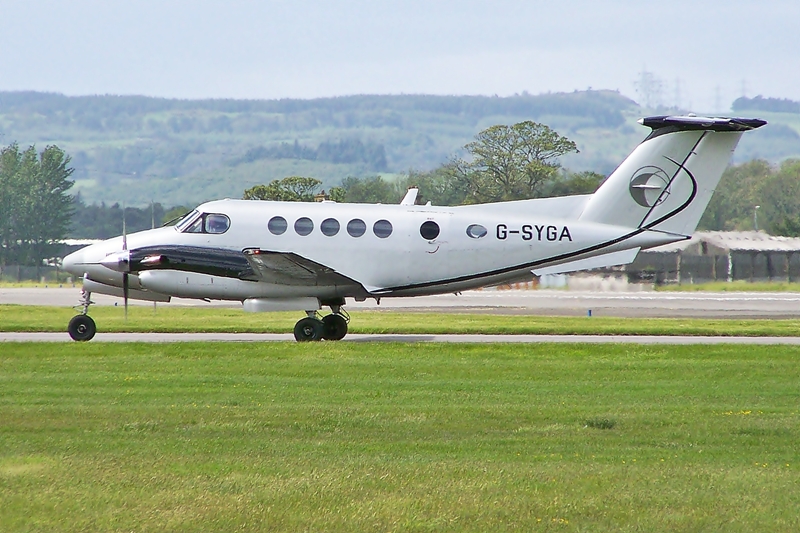
On 15 September 2012, at 0500 UTC, a Beech B200 Super King Air (registration G-SYGA) operating a non-revenue commercial medical flight from Wick Airport to Glasgow Airport experienced a descent below its cleared altitude during the approach. The aircraft was carrying two pilots and three passengers (a pregnant woman, a paramedic, and a medical escort). No injuries or damage were reported. The incident occurred at night in instrument meteorological conditions (IMC).
Flight History
The flight was the second sector of the day; the first was a positioning leg from Glasgow to Wick. During the initial approach into Glasgow, the co-pilot was flying from the right seat with the autopilot engaged in IAS (indicated airspeed) and HDG (heading) modes, and with ALT SEL (altitude select) and APP (approach) modes armed. The aircraft was vectored onto an ILS approach for Runway 23 and, at 18 nm from touchdown, cleared to intercept the localiser and descend to 3,500 ft. To reduce speed, the co-pilot selected VS (vertical speed) mode and reduced power. As the aircraft approached the cleared altitude, the co-pilot reduced power again, which activated the landing gear warning horn. Attempting to silence the horn, the co-pilot accidentally pressed the GO-AROUND button on the left power lever instead of the GEAR HORN SILENCE button. This caused a fly-up indication on the left flight director, the autopilot to disengage, and all engaged flight director modes to disengage.
Cockpit Configuration and Crew Experience
G-SYGA was equipped with conventional electromechanical flight instruments. The left attitude indicator included a flight director, while the right had none. The autopilot and flight director mode selector panel was located on the centre console, and mode annunciators were positioned above the left attitude indicator only; there were no annunciators on the co-pilot's side. The WARN HORN SILENCE button was on the lower main panel in front of the commander's left knee. The GO-AROUND button protruded from the left power lever knob, with the GEAR HORN SILENCE button on the left side of the same lever. The pilots were more familiar with Pro Line 21 electronic flight instrument systems (EFIS) on other B200s; they had leased G-SYGA when those aircraft were unavailable. The co-pilot had recently joined the operator and completed type rating training on a Pro Line 21 simulator, followed by line training on Pro Line 21 aircraft. He had flown five sectors on Pro Line 21 aircraft before receiving a ground briefing on G-SYGA from a non-instructor pilot and expressing contentment to fly the mechanical-instrument variant.
Autopilot Disengagement and Recovery
The commander immediately noticed the mode disengagement and informed the co-pilot, intending to re-engage the modes. He pressed the WARN HORN SILENCE button and then directed his attention to the centre console to re-engage HDG, APP, and ALT SEL modes. His initial attempt to re-engage ALT SEL was unsuccessful, and while looking back at the centre console, he saw that the aircraft had descended below 3,000 ft with the altimeter decreasing rapidly. He instructed the co-pilot to climb. The co-pilot, who had looked at the annunciator panel but could not read the modes clearly due to the angle, was initially unaware of the autopilot disengagement. He was distracted by the gear warning horn, by looking across the cockpit, and by the commander's actions. Upon the commander's alert, he applied full power, rotated the aircraft into a climb attitude, and manually flew back to 3,500 ft. The air traffic control officer (ATCO) observed the height loss and alerted the crew. The GPWS generated a "TERRAIN TERRAIN PULL UP" warning after the recovery had begun. The ATCO later cleared the crew to descend to 3,000 ft and to fly the ILS, and the subsequent landing was uneventful.
Recorded Information
Glasgow radar data captured the aircraft's Mode S altitude (corrected to QNH 1012 hPa). As the aircraft descended through 3,500 ft, the rate of descent increased to approximately 3,000 ft per minute for about 16 seconds. The aircraft reached a minimum altitude of 2,273 ft before climbing back to 3,500 ft over 40 seconds, then continuing the approach. The minimum terrain clearance during this manoeuvre was 1,484 ft.
Probable Cause
The AAIB determined that the crew inadvertently activated the go-around mode on approach. The distraction of this event, combined with their lack of experience on this type of B200, caused a breakdown in crew situational awareness and a descent below the cleared altitude.