Sequence of Events
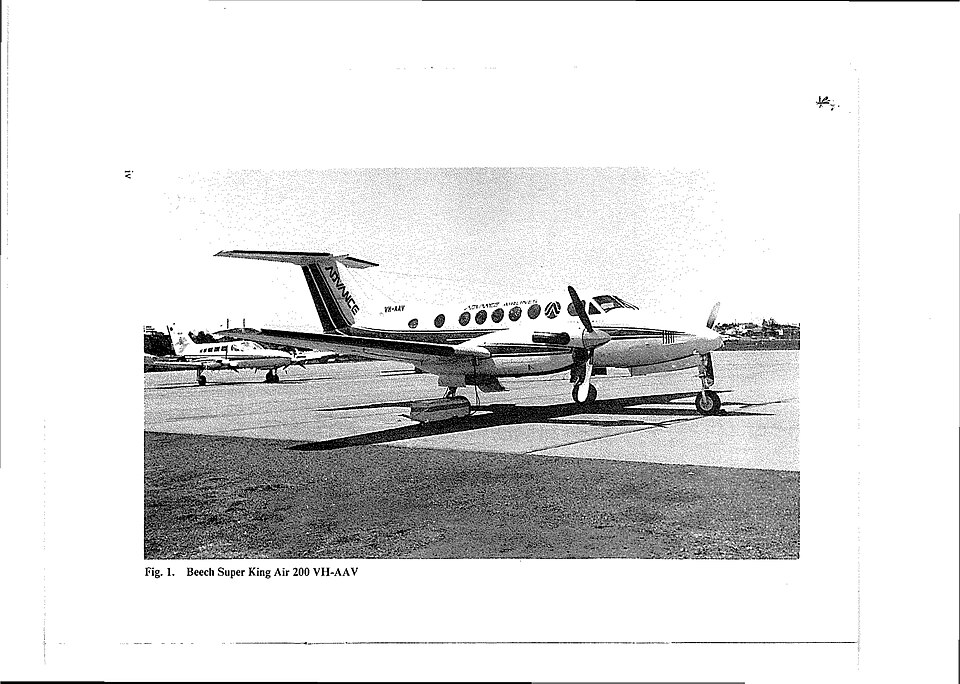
Flight DR 4210, a scheduled service from Sydney to Temora and Condobolin, was operated by VH-AAV. The pilot requested taxi at 1848 hours and was cleared for takeoff on Runway 25 at 1907 hours, following a Standard Instrument Departure (SID) "25 Katoomba Two". After becoming airborne, the aircraft crossed the intersection with Runway 16/34 at about 100 feet above ground level (AGL) at 1908:19 hours. The landing gear was retracted. Observers noted the aircraft level off at about 150 feet AGL and commence a shallow left turn.
At 1908:33 hours, the pilot reported losing the left engine and requested landing on Runway 34. Air Traffic Control cleared the aircraft for a visual approach to a left base for Runway 34. During the turn, the left propeller was probably feathering. Shortly after, the pilot acknowledged seeing a Boeing 727 (VH-RMO) on short final for the same runway.
VH-AAV descended, leveled off just above the water, and continued its left turn, converging towards the western side of the sea wall enclosing the extension of Runway 16/34. At 1908:50 hours, ATC asked if the approach would be normal; the pilot responded negatively eight seconds later. The crash alarm was activated at 1909:08 hours. ATC directed the Boeing 727 to expedite its landing.
At 1909:20 hours, VH-AAV was cleared to land but did not acknowledge. The final segment was at extremely low altitude with a nose-high attitude. The right propeller probably contacted the water, and the tail furrowed the water. The aircraft struck the sea wall nose-up, banking left and skidding right. The left wing disintegrated, and fuel spillage ignited, causing a fireball. The right engine and outboard section of the right wing separated. The remainder of the aircraft bounced over the sea wall, landed inverted on a taxiway, and slid backwards. The accident occurred at 1909:22 hours in daylight. The aircraft was totally destroyed by impact and post-crash fire, and all 13 occupants were killed.
Probable Cause
The official investigation stated that the cause of the accident has not been determined, but the most likely explanation is that the aircraft was operated in a reduced power configuration which, under the prevailing conditions, rendered its single-engine performance critical in respect to aircraft handling. The following findings were reported:
- At a height of about 100 feet AGL, the left engine failed, probably due to the ingestion of water-contaminated fuel.
- The source of water contamination of the left fuel system was not established, but elemental analyses indicated the water had been present for some time.
- It could not be determined where the water accumulated or how it traveled to the left engine.
- It was not established whether the pilot had carried out a fuel drain check prior to the flight.
- At the time of engine failure, a high cockpit workload situation existed.