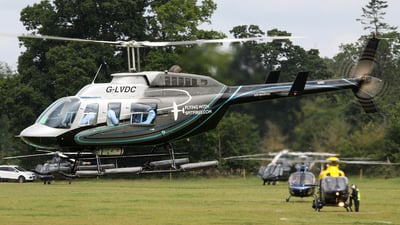
History of the Flight
On 8 July 2012 at 1000 hrs, a Bell 206L-3 Longranger III helicopter, registration G-LVDC, was operating a commercial air transport flight near Silverstone, Northampton. The pilot had dropped passengers at Silverstone Circuit and was taking off to return to a feeder site approximately 12 km to the east. During the climb, at about 300 ft, the low rotor rpm warning horn sounded. The pilot immediately lowered the collective lever to enter autorotation and carried out a forced landing into a field. The warning horn remained on throughout the autorotation but the landing was successful with a short run-on, although the pilot noticed some rocking.
After landing, the pilot lowered the collective and closed the throttle to idle. He then re-opened the throttle and lifted into a hover, watching the engine gauges. All appeared normal, so he transitioned out of the field and returned to the feeder site without further incident. After shutdown, he noticed that the vertical fins on the horizontal stabilisers were damaged and that there was associated damage to the main rotor blades.
Damage and Examination
The damage to the vertical fins and main rotor blades was linked to the forced landing. The engine, fuel, fuel system, and associated controls were examined by a maintenance company and no faults were found. Additionally, the engine was run on a test bed at an engine test facility, but again no faults were detected.
Pilot's Report
In his report, the pilot linked the damage to the landing in the field but was unsure of the reason for the low rotor rpm. He concluded that there was either a transient reduction in engine power or that the throttle was not fully open on departure.