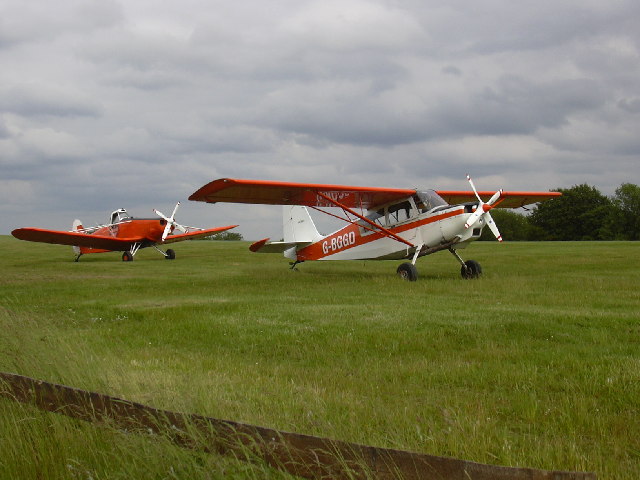
Propeller strike during ground handling of Bellanca 8GCBC

Casualties unknown • Nympsfield Gliding Club, Gloucestershire, GB

A Bellanca 8GCBC experienced a nose-over during a power check after the right wheel brake failed to release, resulting in propeller damage.

What happened

On 23 July 2001, a Bellanca 8GCBC, registration G-BGGD, was being prepared for glider towing duties at Nympsfield Gliding Club in Gloucestershire. During initial ground handling, the pilot encountered an issue where the right hydraulic brake failed to release after the parking brake was disengaged. Although the pilot managed to clear this initial malfunction by cycling the parking brake button and applying pedal pressure, the problem recurred during subsequent operations.

After starting the engine and taxiing to the north side of the airfield, the pilot performed an engine power check while stationary on the grass. During the magneto checks, an excessive drop in RPM was noted. The pilot decided to taxi toward the glider launch point to seek advice from the duty tug pilot. Upon releasing the parking brake and advancing the throttle, the pilot discovered that the right wheel was skulegging across the grass rather than rotating freely.

In an attempt to free the locked wheel, the pilot applied short bursts of the brake pedal while the aircraft was in motion and cycled the parking brake button. During these maneuvers, the aircraft's tail rose, causing the propeller to strike the ground. The aircraft came to rest with the tail elevated. The pilot, who was uninjured, shut down the engine and exited the aircraft.

The investigation

The investigation focused on the mechanical operation of the hydraulic braking system and the pilot's handling of the aircraft during the power check. The braking system on this aircraft utilizes hydraulic actuation via toe pressure on the pedals, with a button-operated parking brake mechanism. Investigators examined the sequence of events leading to the propeller strike, specifically looking at the interaction between engine thrust, the drag from the stuck brake, and the pilot's control inputs.

Findings

  • The accident resulted in propeller damage.
  • The primary cause was the failure to stop and address the stuck brake before continuing the taxi.
  • The nose-over was likely caused by a combination of forward momentum, the high thrust line of the engine, and the significant drag produced by the locked right wheel.
  • A lack of sufficient back-stick input and the pilot's distraction—looking down at the wheel to monitor the brake—likely contributed to the tail rising.
  • At the time of the accident, the pilot had recently been approved as a tug pilot but did not meet the club's then-existing guidelines regarding specific gliding certificate levels and recent gliding experience.

Probable cause

The propeller strike was caused by the pilot's decision to continue taxiing while the right wheel brake remained locked, combined with high engine thrust and insufficient elevator input to counteract the drag and resulting nose-over.

Frequently asked questions

What happened in the 2001-07-23 BELLANCA 8GCBC accident near Nympsfield Gliding Club, Gloucestershire, GB?

A Bellanca 8GCBC experienced a nose-over during a power check after the right wheel brake failed to release, resulting in propeller damage.

What aircraft was involved and where did it happen?

The accident on 2001-07-23 involved a BELLANCA 8GCBC, registration G-BGGD, at Nympsfield Gliding Club, Gloucestershire, GB.

What was the probable cause of the accident?

The propeller strike was caused by the pilot's decision to continue taxiing while the right wheel brake remained locked, combined with high engine thrust and insufficient elevator input to counteract the drag and resulting nose-over.

Loading the flight search…

What you can do on Flight Finder

  • Search flights between any two airports with live fares.
  • By aircraft — pick a plane model (e.g. Boeing 787, Airbus A350) and see every route it flies from your origin.
  • Route map — click any airport worldwide to explore its destinations, or draw a radius to find nearby airports.
  • Global aviation safety — aviation accident database, 40,000+ records since 1980, with map and rankings by aircraft and operator.
  • NTSB safety feed — recent U.S. aviation accidents and incidents from the official NTSB CAROL database, updated daily.