History of the Flight
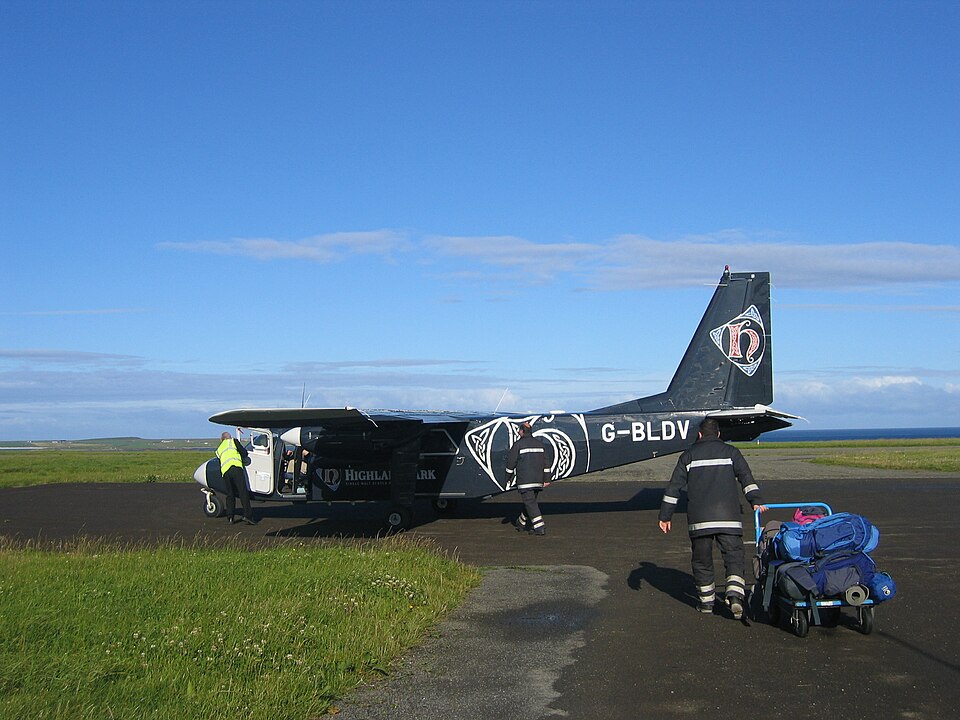
On 18 March 2000 at 2125 UTC, a BN2B-26 Islander (G-BLDV) departed Glasgow for Campbeltown. After leveling at 3,000 feet, the pilot heard a noise like hailstones striking the windscreen, though no hail was present. About one second later, the right engine lost power. The propeller windmilled until the pilot successfully feathered it. He transmitted a 'Mayday' call to Prestwick Approach, who offered a return to Glasgow or diversion to Prestwick. The pilot chose Glasgow due to better weather, elected not to increase left engine power, and made a gradual descent. The aircraft landed without further incident with fire service attendance. No injuries occurred among the one pilot and one passenger.
Examination of the Right Engine
A subsequent inspection revealed that the propeller could be rotated while the engine remained stationary. The crankcase had a hole in its lower forward face, exposing a crankshaft failure near the No 1 journal bearing. The No 4 inlet valve push rod tube was bent, the No 4 cylinder rocker cover was holed, and the No 1 connecting rod end cap, along with crankcase debris, was found in the lower cowling. Removal of rocker covers showed that the No 4 inlet valve spring upper seat had fractured, causing loss of valve stem retention and valve entry into the cylinder. A similar fracture occurred on the No 6 cylinder but did not result in valve loss. The engine had 8,564 hours since new and 1,453 hours since its last overhaul in November 1997.
Metallurgical Examination
The crankshaft failed at the No 1 connecting rod crank pin due to a fatigue crack that developed across about 75% of the cross-section before overload failure. The fracture was inclined and passed through the lubrication supply hole, likely causing progressive oil pressure loss. Evidence of oil starvation included wear and overheating on rocker shafts and big end bearings. The crankshaft fatigue was long-term high-cycle tension fatigue. Severe mechanical damage during final separation removed fractographic evidence near the initiation site. Fluorescent magnetic particle inspection revealed pre-existing cracks in the No 2 and 3 crank pins. The No 2 main bearing was cracked due to torsional overload. All crankshaft journals were ground 0.006 inches undersize. Microhardness tests showed low hardness for a nitrided surface, indicating renitriding had not been performed after grinding. Textron Lycoming Service Bulletin 222D required renitriding of all reground crankshafts, though it had not been mandated by FAA or CAA. The failure to renitride, coupled with reduced surface hardness, was implied as a possible factor.
Probable Failure Sequence
Initial analysis suggested several sequences, but the most probable was that the crankshaft failure was the initial event, relieving the rear of the engine from propeller loads. The resulting overspeed likely caused the valve spring seat failures. The inclined fracture faces forced the aft section rearward, causing the oil pump gear shaft to friction-weld to the pump housing. The No 1 connecting rod end cap separated due to bolt overload, leaving the rod attached to its piston, which jammed in the No 1 cylinder.
Engine History and Records
The engine was overhauled at Lycoming in November 1988 with a re-worked crankshaft (Serial V2379, Part LW-17622). Installed on an Islander in early 1989, it was removed for overhaul in November 1992 after 2,394 hours. A UK company overhauled it, performing non-destructive testing on the crankshaft but not recording its serial number. The engine was again overhauled by the same company in January 1997; again no crankshaft serial number was recorded. No work was done on the crankshaft other than NDT. During that overhaul, main bearing bores were repaired in Texas, but records of that work were destroyed after two years per FAA requirements. The crankshaft found in the engine bore numbers inconsistent with Lycoming records, including '75040' and '75038', and the marking 'RN' suggesting renitriding, though hardness tests indicated otherwise. The possibility of accidental component exchange could not be ruled out.
Probable Cause
The engine failure occurred as a result of a catastrophic fatigue failure of the crankshaft, which was of uncertain provenance.