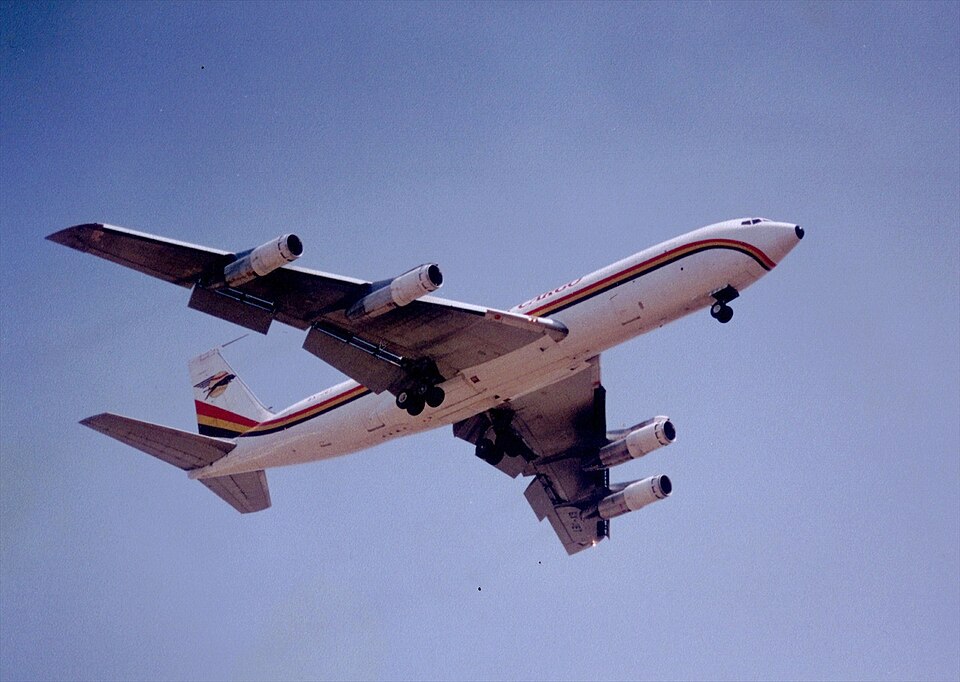
Incident Overview
On 4 January 1999, a Boeing 707-351C, registration 5X-JET, operated a positioning flight from Lagos, Nigeria, to Manston, UK, for maintenance including fitment of an Airborne Collision Avoidance System. The aircraft, manufactured in 1966 and powered by four Pratt & Whitney JT3D-3B turbofan engines, carried 4 crew and 2 passengers. No injuries were reported and no damage occurred.
Initial Landing Gear Problem
The flight initially departed Lagos at 1245 hrs, but the landing gear would not retract normally. The commander elected to return to Lagos, landing at 1312 hrs. The crew determined that the right main landing gear truck levelling deboost valve lever was outside its normal operating range. The flight engineer attempted to rectify the fault with the company's maintenance agency; however, no entries regarding this issue were made in the aircraft's Technical Log prior to the incident flight.
Second Departure and Fuel Considerations
The aircraft departed Lagos again at 1552 hrs. On this occasion, the landing gear retracted except for the right main landing gear, which remained down. The commander noted that he departed with 120,000 lbs of fuel in anticipation of such an event, well in excess of the minimum fuel requirement indicated on the flight plan. The flight plan had been prepared for another similar aircraft (registration 5N-ARQ) and did not account for flight with landing gear extended. The planned cruise true air speed was 465 to 446 kt at FL390 and FL370. The trip distance was 2,733 nm, estimated elapsed time 6 hours 22 minutes, with London Gatwick Airport shown as the alternate. Total flight plan fuel requirement, including 30-minute holding contingency and 25 minutes reserve, was 79,912 lbs, giving endurance of 7 hours 38 minutes.
Flight Progress and Route Changes
The aircraft initially followed the planned route. After one hour, it was 13 minutes behind planned progress, increasing to 28 minutes behind after three hours, a delay maintained until landing. At 2057 hrs, while passing Valencia VOR (Spain), the crew noted 28,000 lbs fuel remaining, close to the planned 27,800 lbs. This was the last fuel check recorded on the flight log.
The aircraft entered French airspace along UN863, passing ANETO at 2123 hrs at FL310. ATC requested a routing via Cognac VOR instead of the original flight plan, leading to a slightly more westerly route. After Cognac, the aircraft was routed direct to BARLU near Cherbourg.
Fuel Emergency and Diversion
At 2213 hrs, the crew contacted Brest Radar Control, requesting diversion to London Gatwick for operational reasons, later stating the aircraft was running short of fuel. At 2218 hrs, the crew queried the availability of any nearby airport. The controller transferred them to London Control on 135.05 MHz. At 2220 hrs, the aircraft was given direct routing to Mayfield VOR for landing at Gatwick. The crew requested priority landing due to low fuel and declared a MAYDAY at 2222 hrs. They informed ATC that the aircraft was a ferry flight with the landing gear down. At 2226 hrs, the crew indicated fuel endurance of 15 minutes.
Approach and Landing
ATC offered a straight-in approach to Runway 08R to minimize distance, despite Runway 26L being in use. The aircraft was given radar vectors and progressive descent clearance. Landing clearance was passed at 2238 hrs. The aircraft turned onto final approach about 6 nm from touchdown but drifted north of the centerline. The Tower controller reported the Approach Monitoring Alarm triggered at about 2.5 nm, but visual contact was maintained. At 2242 hrs, the crew reported the runway in sight at about 850 feet and 2 nm. A normal landing followed at 2243 hrs. The aircraft was inspected by the Airport Fire Service before taxi to stand C7.
Post-Flight Findings
Actual flight time was 6 hours 50 minutes. After landing, the Technical Log recorded 4,400 lbs of fuel remaining. Defects entered included a gear/door red warning light, inoperative No. 4 fuel gauge, and FMS overheating after 4 hours. The engine monitoring log at approximately 1720 hrs showed total fuel flow of 16,600 lbs per hour. Departure fuel was variously recorded as 119,600 lbs by crew, 120,000 lbs ramp fuel on load sheet, and 117,900 lbs from tank quantities. The commander's report noted that after 305 minutes of flight, the aircraft was 29 minutes behind planned progress but had over 10,000 lbs fuel advantage. However, by the time the aircraft passed Valencia VOR, the excess fuel was consumed, and the remaining flight with landing gear down would incur greater fuel flow than planned. Following the incident, the operator reviewed and changed several procedures.