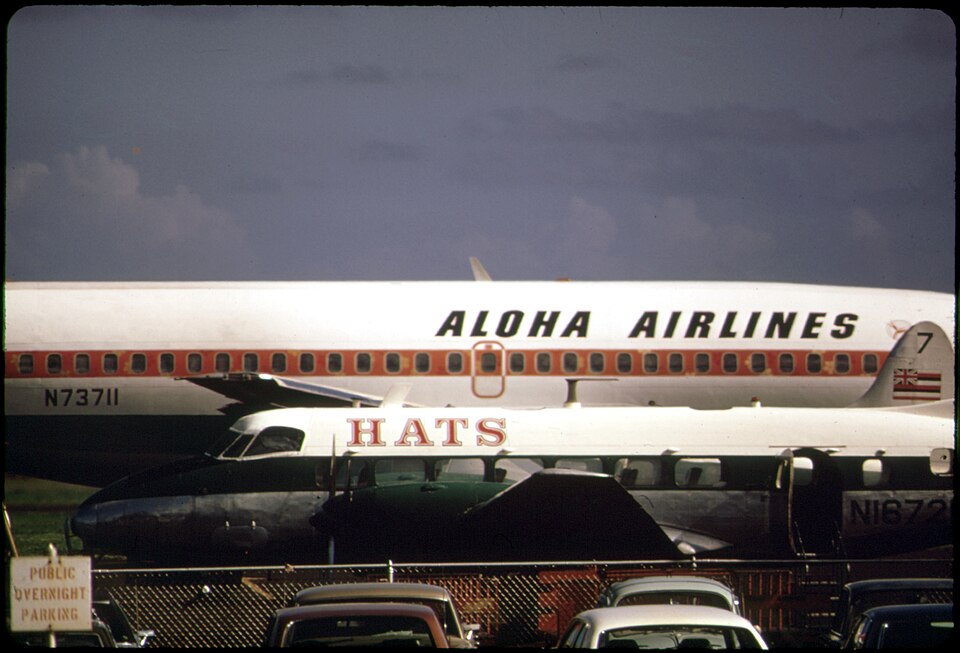
Incident
On April 28, 1988, an Aloha Airlines Boeing 737, registration N73711, was operating a series of interisland flights in Hawaii. After three uneventful roundtrip flights earlier that day, Flight 243 departed Hilo Airport at 13:25 en route to Honolulu. The first officer conducted the takeoff and climb to Flight Level 240 in visual meteorological conditions. As the airplane leveled at 24,000 feet, both pilots heard a loud "clap" or "whooshing" sound followed by wind noise. The first officer's head was jerked backward, and debris, including gray insulation, floated in the cockpit. The captain observed that the cockpit entry door was missing and "there was blue sky where the first-class ceiling had been."
Emergency Response
The captain took over controls, noting the airplane rolled slightly left and right with "loose" flight controls. Both pilots and the air traffic controller in the observer seat donned oxygen masks. The captain initiated an emergency descent, extending speed brakes and descending at 280–290 knots indicated airspeed. The first officer observed a rate of descent of 4,100 feet per minute at one point. The passenger oxygen switch was actuated, but the manual tee handle was not. All passengers were seated with seat belt sign illuminated. During the decompression, the No. 1 flight attendant was reportedly swept out of the cabin through a hole in the left fuselage. The No. 2 flight attendant was thrown to the floor, sustaining minor bruises, and subsequently crawled to assist passengers. The No. 3 flight attendant was struck in the head by debris and suffered serious injuries.
The first officer set the transponder to emergency code 7700 and attempted to contact Honolulu Air Route Traffic Control Center (ARTCC), but cockpit noise prevented her from hearing transmissions. Honolulu ARTCC observed the emergency code about 23 nautical miles south-southeast of Kahalui Airport, Maui. The controller attempted communication without success until the aircraft descended through 14,000 feet, when the first officer switched to Maui Tower frequency. At 13:48:35, she reported the rapid decompression, declared an emergency, and requested emergency equipment. The local controller assigned a new transponder code. At 13:50:58, the controller requested a frequency change to approach control, but Flight 243 continued transmitting on the local frequency. At 13:53:44, the first officer requested assistance for passengers upon landing; no ambulance was initiated from this call.
Landing
As the flight approached 10,000 feet, the captain retracted speed brakes, removed his oxygen mask, and turned toward Maui's runway 02. At 210 knots, the crew could communicate verbally. Flaps were extended to 5; further extension caused reduced controllability, so flaps 5 were used. The captain maintained 170 knots for approach and landing due to reduced controllability below that speed. The first officer attempted to contact flight attendants via PA and interphone with no response. The landing gear was lowered: main gear indicated down and locked, but the nose gear indicator light did not illuminate. Manual extension was attempted; the green light remained off, but the red unsafe light was not illuminated. A second manual attempt was made. The captain did not use the nose gear downlock viewer because the center jumpseat was occupied and he believed an immediate landing was urgent. At 13:55:05, the first officer advised the tower, "We won't have a nose gear," and at 13:56:14, "We'll need all the equipment you've got." While maneuvering, the captain sensed a yaw and determined the No. 1 (left) engine had failed. He attempted to restart the engine by placing the start switch to "flight" with no response. A normal descent profile was established 4 miles out. The captain described the airplane as "shaking a little, rocking slightly and felt springy." Flight 243 landed on runway 02 at Kahului Airport at 13:58:45. The captain made a normal touchdown and rollout, using the No. 2 engine thrust reverser and brakes. During rollout, flaps were extended to 40° for evacuation, which was then accomplished on the runway.
Probable Cause
The failure of the Aloha Airlines maintenance program to detect the presence of significant disbonding and fatigue damage, which ultimately led to failure of the lap joint at S-10L and the separation of the fuselage upper lobe. Contributing to the accident were the failure of Aloha Airlines management to supervise properly its maintenance force as well as the failure of the FAA to evaluate properly the Aloha Airlines maintenance program and to assess the airline's inspection and quality control deficiencies. Also contributing to the accident were the failure of the FAA to require Airworthiness Directive 87-21-08 inspection of all the lap joints proposed by Boeing Alert Service Bulletin SB 737-53A1039 and the lack of a complete terminating action (neither generated by Boeing nor required by the FAA) after the discovery of early production difficulties in the 737 cold bond lap joint, which resulted in low bond durability, corrosion and premature fatigue cracking.