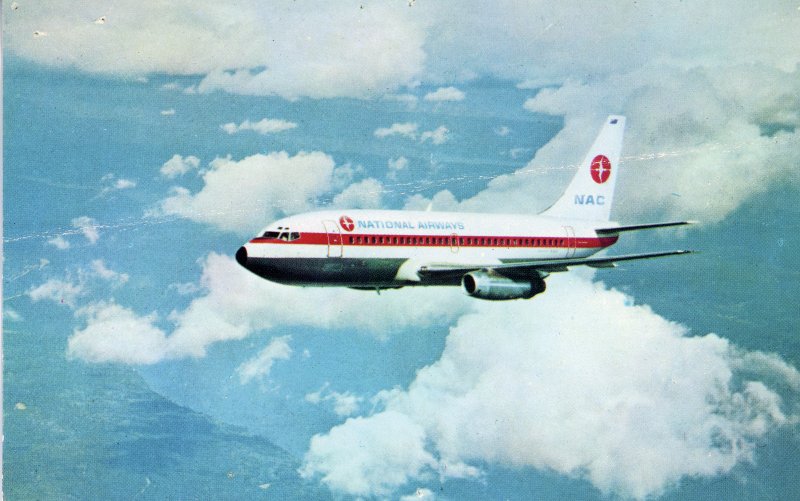
On January 2, 1995, a Boeing 737-200 (registration 9Q-CNI) operated by Air Zaïre was involved in an aviation accident near Kinshasa-N'Djili, Democratic Republic of Congo during landing or approach. No fatalities were reported. Investigators recorded the probable cause as: The aircraft suffered a nose gear collapse due to a heavy, nose-first impact during landing in poor weather. This summary draws on records from the Bureau of Aircraft Accidents Archives (B3A); 6 related events involving the same aircraft type or operator are linked below.
Photo: San Diego Air & Space Museum Archives / Public domain, via Wikimedia Commons
An aircraft sustained significant damage after a hard landing at Kinshasa-N'Djili Airport during adverse weather conditions.
What happened
During an approach to Kinshasa-N'Djili Airport, the aircraft encountered unfavorable weather conditions. As the flight progressed toward the runway, the aircraft experienced a heavy impact upon touchdown, striking the ground in a nose-first orientation. This forceful landing caused the immediate collapse of the nose landing gear.
The aircraft eventually came to a complete stop following the impact. While the incident resulted in no fatalities or injuries, the structural damage sustained during the event was severe enough that the aircraft was declared a total loss.
Findings
The landing occurred amidst poor meteorological conditions.
The primary factor in the structural failure was a hard, nose-first impact during the landing phase.
Probable cause
The aircraft suffered a nose gear collapse due to a heavy, nose-first impact during landing in poor weather.
A SkyWalk Join't 3 paraglider crashed into the ground near Las Vizcachas, Chile, on September 1, 2024. The pilot and passenger sustained serious spinal…
PARAPENTE (ULTRALIVIANO NO MOTORIZADO)·2024-09-01DGAC Chile
A Cessna 172N struck electrical cables while on final approach to land at Aucó Aerodrome in Chile. The pilot was uninjured, but the aircraft sustained damage…
A Bombardier DHC-8-402 suffered a tail strike during landing at Puerto Williams on September 9, 2024. All 76 occupants were unharmed, but the aircraft…
A MYD JS-MD 3 glider veered off the runway and struck a wall at Vitacura Aerodrome on January 6, 2025. The pilot was uninjured, but the aircraft sustained…
A recreational paraglider flight in Puchuncaví, Chile, ended with the pilot sustaining serious injuries after a rapid descent and impact with a hillside on…
PARAPENTE (ULTRALIVIANO NO MOTORIZADO)·2025-03-29DGAC Chile
A Tecnam P2006T landed on its belly at an aerodrome in Poland after the crew failed to confirm landing gear deployment. The incident resulted in no injuries…