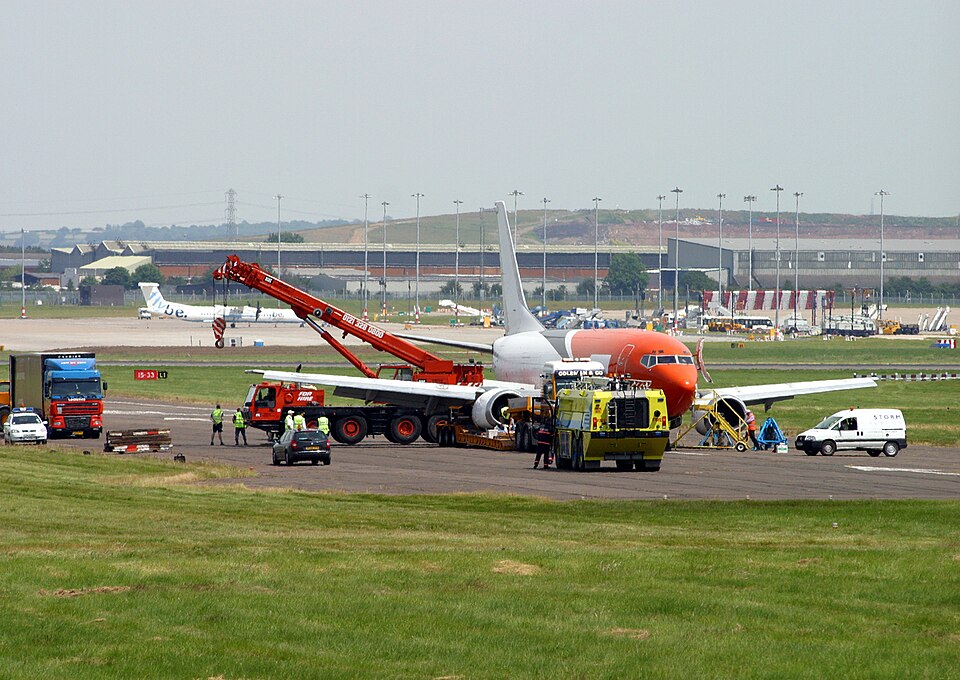
Incident Overview
A scheduled cargo flight operating from Liège Airport to London Stansted Airport diverted to Nottingham East Midlands Airport (EMA) after encountering unexpectedly poor weather conditions at Stansted. The weather at EMA required a Category IIIA instrument approach and landing.
Sequence of Events
During the approach, at approximately 500 feet above ground level, air traffic control transmitted a message to the crew, advising them of a company request to divert to Liverpool Airport. While attempting to reply, the commander inadvertently disconnected both autopilots. He then attempted to re-engage one autopilot to continue the approach. However, the aircraft deviated to the left of the runway centerline and developed a high rate of descent.
The commander initiated a go-around but was unable to prevent the aircraft from contacting the grass approximately 90 meters left of the runway centerline. The aircraft became airborne again, but the right main landing gear had broken off during the ground contact. The crew subsequently performed an emergency landing at Birmingham Airport (BHX).
Probable Cause
The official findings listed causal factors: 1) ATC inappropriately transmitted a company R/T message when the aircraft was at a late stage of a CAT III automatic approach; 2) The commander inadvertently disconnected the autopilots in attempting to respond to the R/T message; 3) The crew did not make a decision to go-around when it was required after the disconnection of both autopilots below 500 ft during a CAT III approach; 4) The commander lost situational awareness in the latter stages of the approach, following his inadvertent disconnection of the autopilots; 5) The co-pilot did not call ‘go-around’ until after the aircraft had contacted the ground. Contributory factors included: 1) The weather forecast gave no indication that mist and fog might occur; 2) The commander re-engaged one of the autopilots during a CAT III approach, following the inadvertent disconnection of both autopilots at 400 feet aal; 3) The training of the co-pilot was ineffective in respect of his understanding that he could call for a go-around during an approach.