Incident Overview
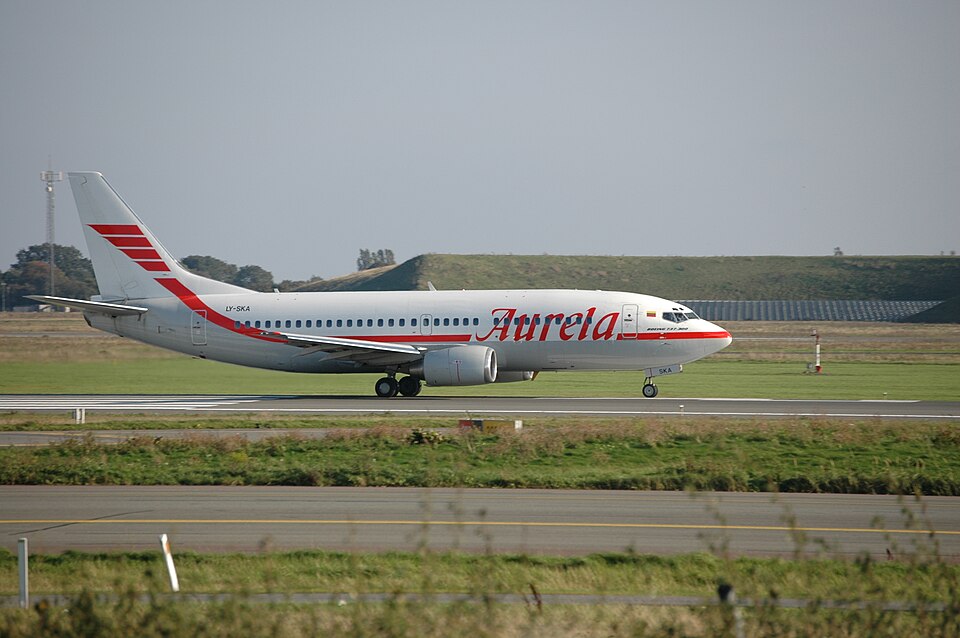
On 21 September 2012, a Boeing 737-35B, registration LY-SKA, was involved in a serious incident at Birmingham International Airport. The aircraft, operated by a UK carrier on a scheduled flight from Nice, France, left the paved surface of Taxiway Alpha and came to rest on the adjacent grass. The nosewheels and tyres sustained damage, but no injuries were reported among the 6 crew and 137 passengers.
Flight History
The commander, who was the pilot flying, planned to vacate Runway 33 at Taxiway Bravo after landing. The runway was wet, and the wind was from 010° at 6 kt. During the landing roll, with Autobrake 2 selected, the commander determined the aircraft would not decelerate sufficiently to exit at Taxiway Bravo without excessive braking. He disconnected the autobrake using the brake pedals, cancelled thrust reverse, released the brakes, and allowed the aircraft to coast to the end of the runway to vacate at Taxiway Alpha.
Commander's Actions
As the aircraft approached Taxiway Alpha at about 12 kt, the commander initiated a turn. Initially, the aircraft responded as expected, but during the turn it became uncontrollable and began skidding towards the left edge of the taxiway. The commander applied full brake pedals, but the aircraft departed the paved surface onto the grass and stopped. The commander stated he was reluctant to cause a following aircraft to go-around, having previously been admonished for slow runway vacation.
Examination Findings
An engineering examination revealed cuts in the tyre tread, likely from traveling over grass. The nosewheels and tyres were replaced. No hydraulic leaks were found, the brake system components were undamaged, and brake wear pins were within limits. A built-in test of the anti-skid system showed no faults. Main gear oleo extensions were symmetrical.
Friction Measurements
Birmingham International Airport conducted friction assessments of the runway and taxiway surfaces after the incident. Runway friction levels were generally satisfactory, with no points below the Maintenance Planning Level for more than 100 m. A non-standard assessment of Taxiway Alpha revealed a small area with friction below the Minimum Friction Level (MFL), but the nose and right main gear traversed only about 5 m in that area. The operator's operations manual recommended a ground speed of approximately 10 kt for turns onto non-high-speed taxiways in dry conditions, with a lower speed appropriate for wet surfaces. The aircraft commenced the turn above 20 kt.
Conclusion
The aircraft departed the paved surface of the taxiway because it turned to vacate the runway at a speed inappropriate for the conditions.