Incident
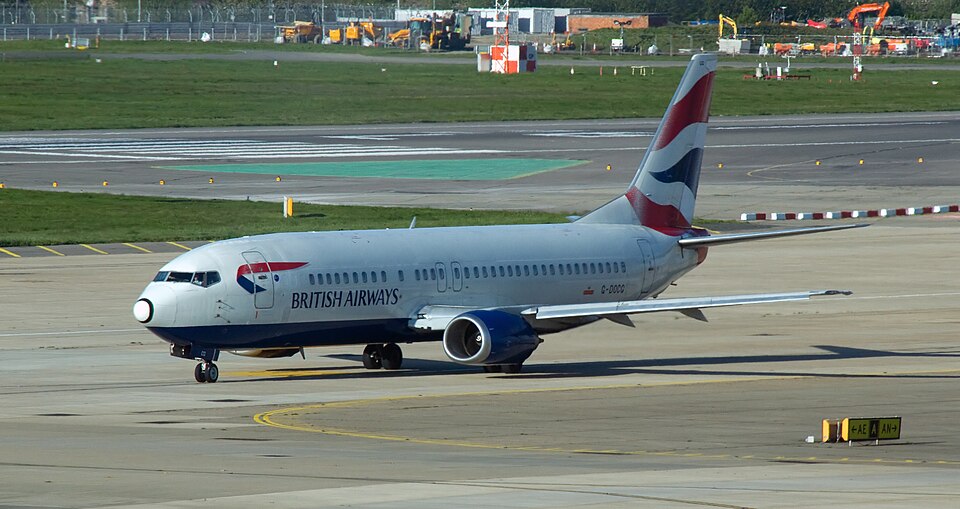
A Boeing 737-436 (registration G-DOCG) had completed a scheduled passenger flight and taxied to Stand B8 at London Heathrow Airport on 21 October 1997. After most passengers had disembarked, a passenger requiring a wheelchair remained on board with two colleagues. The passenger mobility assistant positioned himself with the wheelchair at the end of the airbridge, adjacent to the open aircraft door.
As he prepared to board, the airbridge suddenly began to lower and retract. Its canopy caught the open forward passenger door, creating a widening gap between the airbridge floor and the door sill. The lowering of the airbridge created a slope, making the situation dangerous. No airbridge movement warnings were heard, and no one was seen near the controls. The passenger mobility assistant warned a remaining passenger to vacate the airbridge immediately. A cabin crew member estimated the airbridge came to rest about 5 metres away and 2 to 3 metres below its correct position. The incident resulted in damage to the forward passenger door and its mechanism; no injuries were reported.
Airbridge Description and Operation
The airbridge was a telescopic tunnel mounted on a power-driven single-axle vehicle called a 'Mover'. The outer end of the tunnel was connected to a Bridgehead with a rotating vestibule and flexible hood. Controls were located in the vestibule. The unit could be set to MANUAL, AUTOMATIC, or OFF. In MANUAL, the operator could move the vestibule into position. Once against the aircraft, the controls were set to AUTOMATIC, allowing the bridge to rise and lower automatically to accommodate changes in aircraft door sill height. The system was electro-hydraulic, with an electric motor driving a pump to provide hydraulic pressure for movement. The automatic vertical movement was controlled by a position detector resting against the fuselage.
Investigation
The airbridge was taken out of service immediately after the incident. A full functional check by the airport operator found no problems. However, shortly afterward, the airbridge was observed to move without operator input or aircraft movement. Additionally, it was discovered that the same airbridge had caused concern two days earlier: after retracting it, the unit continued to retract after the operator released the knob, overshooting its parking position. The operator reported this to his supervisor, who contacted the airport operator's fault reporting number, but no record or action was taken.
The airport operator then arranged tests by the original manufacturer and the maker of the revised electronic control system. During tests, the airbridge raised when the raise valve was manually operated, even though the return valve should also have been required. Further testing showed that other valves also operated without the return valve. Disconnecting the return valve wiring did not stop the incorrect motions. While attempting to move the bridge forward, it suddenly retracted and was only stopped by the emergency stop. Electrical specialists presumed the return valve was jammed open, creating a dormant fault that allowed any spurious valve operation to cause undemanded movement.
Examination revealed heavy hydraulic fluid contamination, a partially blocked filter, a missing cover on valve assemblies, and badly corroded exposed valves. It was concluded that the fluid contamination would cause valves to fail to seat correctly, leading to possible uncommanded movement. The return valve appeared stuck open, allowing flow when any other valve was open.
The airbridge remained out of service until the hydraulic system was overhauled by the manufacturer, including flushing and replacing all valves, filter, and fluid.
Maintenance Procedures
The airport operator conducted six-monthly inspections, with the last one on 24 March 1997. This inspection did not include condition assessments that would detect the type of malfunction that occurred. Although functional checks were performed, none would identify the dormant fault. Other programmed checks at monthly, three-monthly, and yearly intervals included hydraulic reservoir checks and filter replacement, but no records of these were provided. The maintenance procedures did not address dormant faults in the hydraulic system; an independent check of the return valve function was not performed.