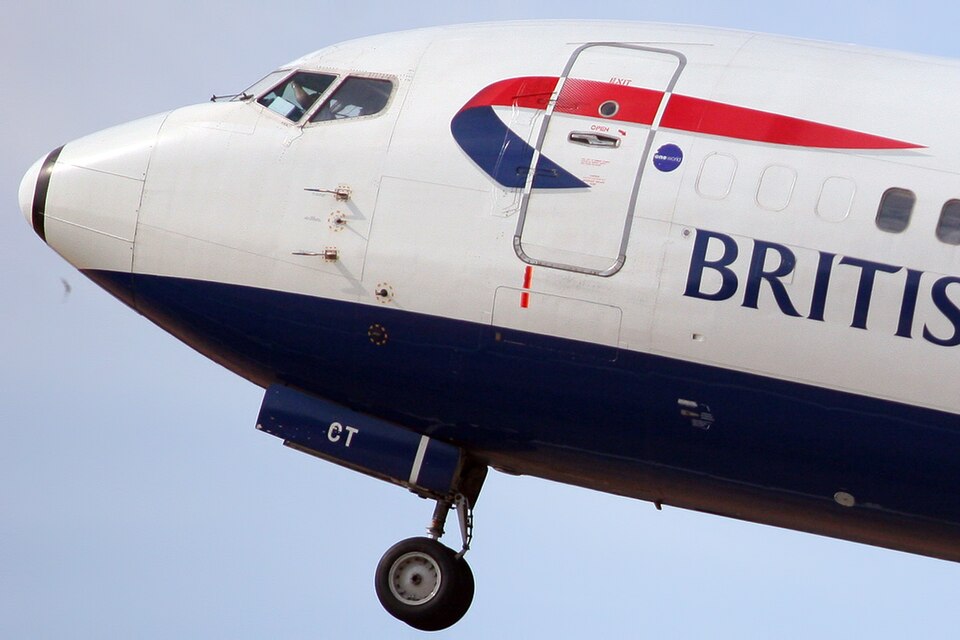
History of the Flight
The crew was operating the final sector from Aberdeen to Gatwick. Before start, they received performance figures for a reduced thrust takeoff at FLAP 15 due to performance limitations. The commander briefed the co-pilot that he would hold the aircraft on brakes while setting takeoff power. After pushback at 0956, the aircraft taxied to Runway 16 via Taxiway W. ATC cleared line-up and takeoff. The commander positioned the aircraft close to the threshold to maximize runway length. A following aircraft's commander observed G-DOCT turn left at holding point W5 then sharply right over 90° to line up. He stated the wheels remained on the runway and the tail was just in front of threshold lights.
The commander held brakes, set thrust to 40% N1, then pressed TO/GA for takeoff power at about 92% N1. At about 90% N1 he released brakes. The aircraft moved forward and he felt a jolt as if the nosewheel ran over a small bump. The crew continued takeoff. The following aircraft crew saw two large asphalt sections lift and disintegrate and reported to ATC, heard by the departing crew after airborne. The departing commander asked if damage was seen; negative reply. The aircraft appeared handling normally and flight continued to Gatwick, landing at 1114. After shutdown, the crew learned that an engineering inspection revealed tail damage.
Aircraft Damage
The left tailplane underside had a 2.4 m dent containing black bitumen. Skin torn, ribs buckled. A 0.9 m by 0.6 m section of left elevator detached, separating the outboard section including balance weights. Elevator underside peppered with bitumen. Damaged elevator sections found in grass behind threshold, farthest 132 m behind.
Blast Pad Damage
The blast pad at Runway 16 threshold was 8.4 m long, 72 m wide. Central section approximately 13 m wide completely detached. Most asphalt blown aft into grass, some found 20 m behind the pad. Largest piece approximately 1.8 m by 1.5 m, 6 cm thick, weighing about 340 kg. Exposed surface was stones and dirt; bitumen overband sealing detached.
Flight Recorder Data
FDR data showed aircraft stopped at holding point W5 for 8 seconds with brakes, then turned right 40° over 40 seconds onto heading 075°M, ground speed peak 8 kt. Then turned further 85° over 16 seconds onto runway heading 160°M, with left engine thrust up to 40% N1, turn rate max 8.6°/s, ground speed peak 2 kt. Stopped with brakes for one minute. Thrust increased to 45%/49% N1 22 sec before brake release, then to 95% N1 5 sec before release, then to 100% N1 2 sec before release. Brake pressure dropped to zero 2 sec after release. No asymmetric flight data anomalies during flight to Gatwick.
Blast Pad History and Construction
Runway 16/34 was built in 1952 without blast pads. Re-surfaced many times. No records of when blast pads constructed or specifications. Not in 1986 drawings; first noted in 1996 survey. Believed constructed early 1990s to prevent erosion. Blast pad not designed for weight of large airliners; behind threshold lights but not marked as unusable. CAA design guidelines CAP 168 does not contain guidelines for blast pads. Stopways are different.
Injuries and Damage
No injuries to crew or passengers. Aircraft damage to tailplane and elevator.