History of the Flight
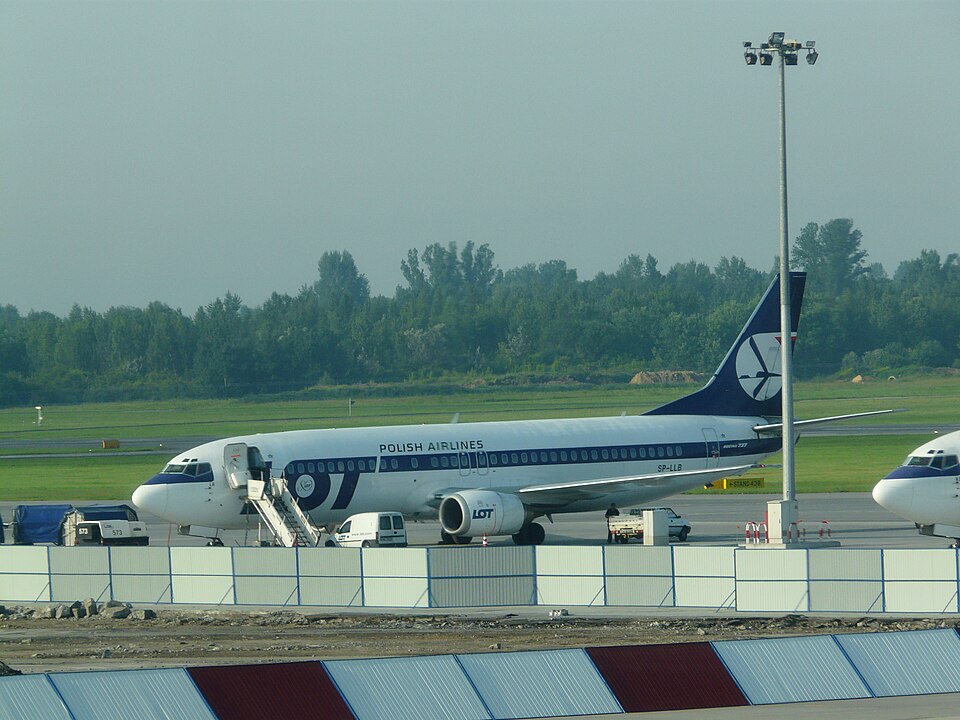
On 20 February 2006, at 1140 UTC, a Boeing 737-45D (registration SP-LLB) operating a scheduled passenger service from Warsaw to London Heathrow Airport collided with a stationary van while manoeuvring onto Stand 114. The aircraft, with six crew and 89 passengers on board, had departed Warsaw at 0758 UTC after a two-hour delay due to snow clearance. The commander and co-pilot considered themselves well rested, having started duty at 0545 UTC after rest periods of 15 and 48 hours, respectively. After landing at 1130 UTC, the aircraft followed instructions to Stand 114 at the head of the Kilo cul-de-sac of Terminal 1.
During the approach, the co-pilot observed a van parked on the right side of the stand, within an area marked with painted hatched lines, but did not consider it a hazard. The commander stated that he was aware of the confined nature of the stand, which may have caused him to commence the turn earlier than indicated by the yellow lead-in line painted on the taxiway. As a result, the aircraft did not achieve the centreline before turning. Shortly after crossing the stand threshold, and before reaching the normal stopping position adjacent to the jetty, the right wingtip struck the van. The commander, aware of the impact, shut down the aircraft and ordered a normal disembarkation using mobile steps.
Ground Crew Account
A dispatcher employed by another airline arrived at Stand 114 shortly before the aircraft. He checked that the stand was clear, activated the stand guidance system, and climbed to the jetty cab to manoeuvre the jetty. As he did so, he noticed a van had moved onto the right side of the stand. Once the aircraft entered the stand, he could no longer see the van's position. He observed handling agent employees attempting to signal the aircraft to stop by crossing their arms above their heads, but they were unsuccessful.
The van driver, a ramp agent employed by the handling agent, drove onto the stand from an adjacent airside road. He intended to park on the right side of the stand, facing away from the aircraft. As he did so, he saw other employees manoeuvring baggage trolleys into the same area and decided to reverse temporarily into the hatched area of the interstand clearway to avoid obstructing them. He kept the engine running and intended to return to the non-hatched area once the trolleys were in place, but was unable to do so before the collision.
Stand and Guidance
Stand 114 is located at the end of a cul-de-sac between Pier 3 and the Europier of Terminal 1. Due to its confined dimensions, it is restricted to Boeing 737 or smaller aircraft. A yellow lead-in line painted on the taxiway provides a safe approach course to the stand centreline. Guidance along the centreline is provided by an Azimuth Guidance for Nose-In Stands (AGNIS) system, viewed from the left pilot seat, which displays red and green light bars to indicate alignment. The correct stopping position is marked by a yellow line labelled 'B737' and a mirror system reflecting the nose wheel. An emergency stop light, activated by buttons in the jetty cab and at the head of the stand, was not used. Ground staff who saw the potential conflict were working to the right of the stand centreline, but could not alert the pilots.
Damage and Investigation
The aircraft's right wingtip struck the upper left corner of the van's rear, causing minor damage to the vehicle but crushing the wingtip fairing and destroying the navigation and strobe lights. Examination of the aircraft and vehicle before they were moved confirmed the contact. The aircraft was slightly right of the stand centreline, with the left nosewheel tyre just touching the right side of the line, and the heading a few degrees left, indicating it was still turning right. The crew reported no system or other malfunctions, so no technical examination was deemed necessary. The Cockpit Voice Recorder was recovered but had been overwritten; the Flight Data Recorder was not recovered as data were not required. Ground radar recordings provided no value as the event occurred in a radar shadow.
Safety Recommendations
The investigation resulted in three safety recommendations. The first (2006-138) recommends that the Civil Aviation Authority amend CAP 637 to clarify areas where parking is prohibited. The second (2006-139) recommends that BAA examine the practicability of requiring a member of ground crew to monitor aircraft arrival and be adjacent to the emergency stop button whenever ground crews are present during parking. The third (2006-140) is similar to the second.