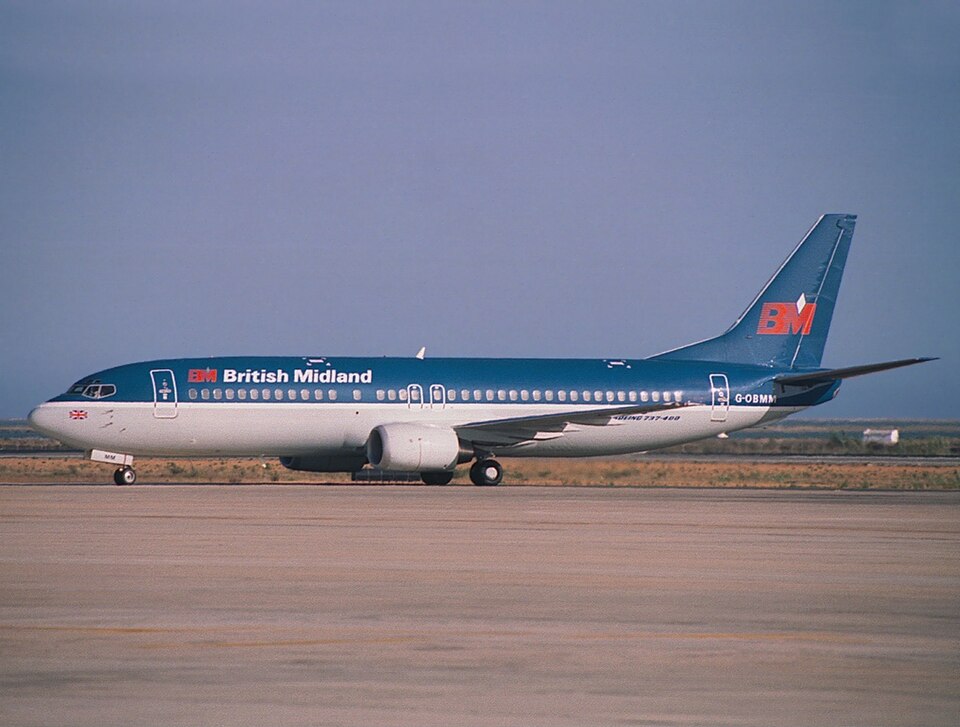
Aircraft and Crew Information
The aircraft involved was a Boeing 737-4Y0, registration G-OBMM, built in 1991 and powered by two CFM56-3C1 turbofan engines. The flight was a public transport passenger service from Edinburgh to London Heathrow. On board were 7 crew and 85 passengers; no injuries were reported. The commander, aged 28, held an Airline Transport Pilot Licence with 4,262 total flying hours, including 2,543 on type.
Incident Narrative
On 1 August 2001 at 1915 UTC, after an uneventful flight, the aircraft landed on Runway 09L and taxied to Stand D58L from the east on the Inner Taxiway. The No. 1 engine was shut down per company procedures. The commander, who was the handling pilot, observed a marshaller's vehicle parked in the centre of the stand. As the aircraft approached, the marshaller drove the vehicle to the top of the stand, exited, and stood at the end of the stand centreline.
The commander flashed the taxi light to signal he had seen the marshaller and was ready for guidance. The marshaller responded by repeatedly raising and lowering his bats, indicating 'continue straight ahead'. The commander complied. As the cockpit passed abeam the stand centreline, the commander expected a signal to turn right onto the stand, but the marshaller continued to signal 'straight ahead'.
Realising the marshaller would not provide the expected turn signal, the commander initiated a right turn without guidance. This turn was later than he would have made with a marshaller's assistance. The marshaller continued signalling 'straight ahead'.
Vehicle Position and Hazard
To the left of the stand, two large unattended catering vehicles were parked. The nearest vehicle faced the taxiway with its front wheels outside the stand edge markings, but its rear wheels were approximately six inches over the line. The commander noticed this hazard as he turned but assumed the marshaller would guide him away from it.
Commander's Observations and Decision
After aligning the nose wheel with the centreline, the commander continued taxiing onto the stand while watching the marshaller for instructions, who persisted with the 'straight ahead' signal. Twice during the final taxi, the commander looked out the left window to gauge the distance between the port wingtip and the vehicle. He found this difficult because the cockpit window distorted the view of the wingtip and the distance to it.
Contact and Outcome
Approximately two-thirds of the way onto the stand, the commander felt a vibration and heard a noise consistent with the port wingtip contacting the vehicle. He immediately stopped the aircraft, shut down the remaining engine, and asked passengers to remain seated via the public address system. The marshaller, also aware of the contact, signalled to stop (though the aircraft had already stopped) and radioed for assistance.
A company engineer who had witnessed the event on the stand assisted the commander until an airside operations vehicle arrived. The commander confirmed through his open cockpit window that passengers could disembark onto waiting coaches. The senior cabin attendant lowered the integral stairs, and passengers disembarked. Later investigation revealed the part of the vehicle contacted by the wingtip was outside the stand markings. The aircraft sustained minor damage: a broken wing tip light.
Commander's Conclusion
The commander concluded that his over-reliance and acceptance of the marshaller's signals to manoeuvre onto the stand, which the vehicle had partly infringed, led to the incident. Difficulty judging wingtip clearance distracted him from properly assessing the aircraft's tracking relative to the centreline, and the marshaller failed to provide proper signals.