Background
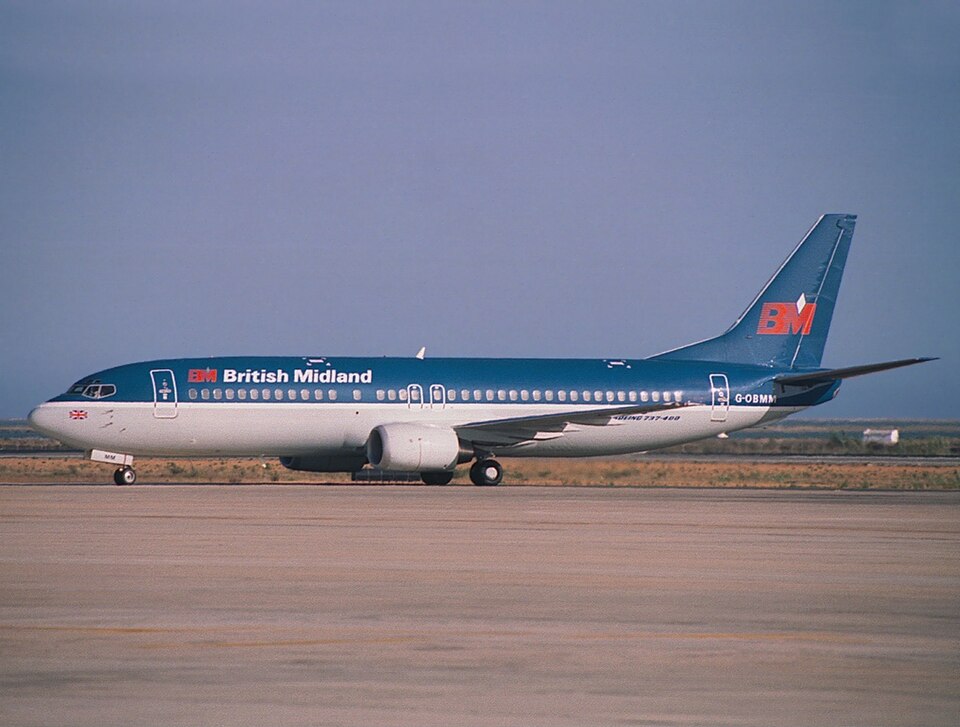
On 13 June 1999, a Boeing 737-4Y0, registration G-OBMM, was parked at its stand at London Heathrow Airport. The aircraft, manufactured in 1991 and powered by two CFM56-3C1 turbofan engines, was preparing for a public transport passenger flight. The crew consisted of 7 members, and approximately 30 to 40 passengers were on board.
Incident Description
During pre-departure checks, the first officer started the auxiliary power unit (APU). After about two minutes, he switched on one of the air conditioning packs. Two minutes later, he selected the APU to supply electrical power to the aircraft busses. Around the same time, cabin crew in the aft cabin heard a whining sound from behind the rear ovens. Approximately one minute after selecting APU electrical power, the APU dropped off line.
The commander immediately reinstated ground power and noted the APU exhaust temperature was decreasing rapidly. Shortly afterward, the APU fire warning activated. The ground engineer outside the aircraft indicated smoke and fire coming from the APU exhaust. The crew executed the APU fire drill, alerted the Airfield Fire Service, and instructed the senior cabin attendant to disembark the boarded passengers via the forward left exit. The commander exited the flight deck, observed the APU area, and briefed arriving fire service personnel. The first officer noted the fire warning light remained illuminated for 2 to 3 minutes after the fire extinguisher discharged.
Inspection and Findings
Initial inspection by a company maintenance engineer revealed no mechanical failure but found the electrical looms to the exhaust temperature thermocouples and exhaust firewire had burnt out. No rear fuselage structural damage was observed. The engineer tripped circuit breakers for the damaged wiring and APU starter, then released the aircraft with the APU placarded inoperative. Rectification was deferred until a base maintenance check four days later.
During the subsequent base check, no fire or scorching was found on airframe structure outside the APU shroud. The APU rotor could not be turned; compressor damage and metal fragments were present in the compressor inlet. The exhaust/muffler showed heat distress. No hard particle ingress was found in the intake duct. Borescope inspection revealed hard particle passage through both compressor stages, impeller vane rubs, and heat distress in the turbine area. The APU was returned to the overhaul company for strip examination.
Strip examination disclosed severe internal damage: metal particles in the oil filter and accessory gearbox sump, seized rotor shaft and powertrain, hard particle damage to intake structure, a broken shaft nut locking tab, and a fractured locking wire with a molten appearance. The front bearing had failed and disintegrated, with possible arc-burning damage near a bolt hole. Rotating guide vane sections of the first-stage impellers had heavy hard object damage; pieces had broken off. The second-stage impeller had rubbed on its volute, and metallic particles were embedded in the diffuser. Turbine nozzle guide vanes were severely burned, and turbine blade tips had melted away. The accessory gearbox had a seized input pinion support bearing.
APU Service History
The APU had been removed from another aircraft on 8 March 1999 for compressor overhaul and hot section inspection, accumulating 4,333 hours and 4,775 cycles. It was installed on G-OBMM on 27 May 1999 and had run 148 hours with 134 starts since. Two days before the incident, the APU could not be started due to a defective igniter high tension lead. After replacement, two successful test starts were made; the failure occurred on the third start.
Subsequent Actions
The operator, to minimise the possibility of arcing between the HT lead and the APU, instituted a pre-fitment inspection of igniter leads.
Conclusion
The overall assessment indicated that major damage to the first-stage compressors released metal fragments, which caused severe damage to the second-stage compressor, loss of airflow, and turbine overheat. Imbalance led to intense vibration and disintegration of the front bearing. Two possible initiating mechanisms were considered: foreign object ingestion or front bearing failure leading to impeller contact. However, no definitive cause was determined.