History of the event
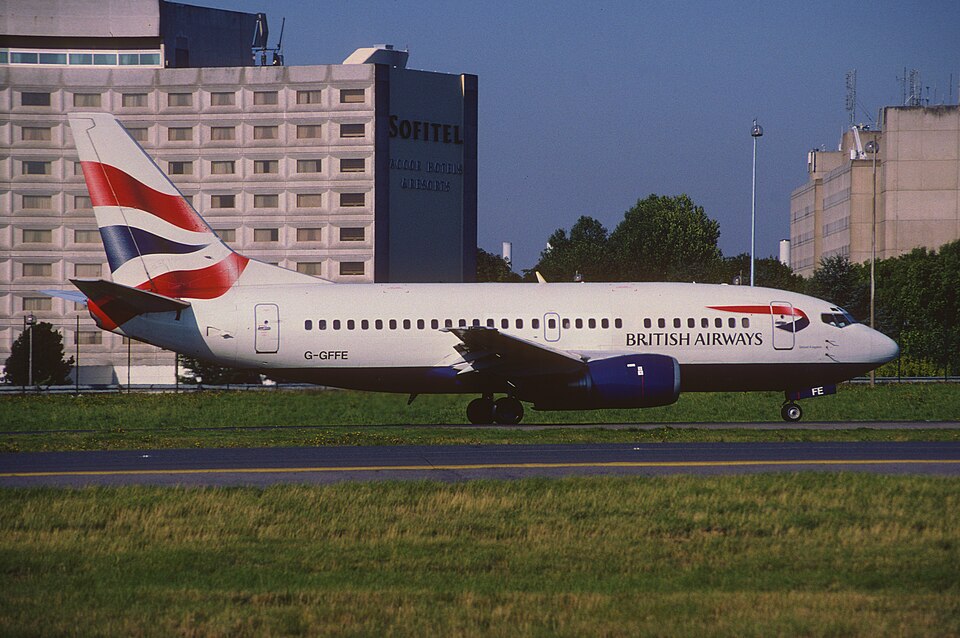
On 3 September 2005 at 0920 UTC, a Boeing 737-528 (registration G-GFFE) was parked on Stand 110 at London Gatwick Airport, facing north. The aircraft was being refuelled and prepared for departure with crew aboard but no passengers. The commander instructed the co-pilot to start the APU. Shortly after, the commander entered the cabin and the cockpit lights extinguished, prompting him to return to the flight deck, where he learned the APU had automatically shut down.
A cabin crew member reported a sound of impact and a lurch at the rear of the aircraft, initially believed to be a catering truck strike. Looking outside, the commander observed ground staff kicking hot metal debris off the stand and adjacent taxiway. The commander confirmed no fire and supervised the co-pilot in completing APU failure procedures. No injuries were observed or reported. Debris extended approximately 90 m aft of the aircraft, completely crossing the taxiway. Larger items were collected by crew and ground personnel.
Component description
The APS 2000 APU features a centrifugal compressor feeding a reverse-flow annular combustion chamber. Combustion gases flow radially inward into a one-piece cast inflow turbine. The turbine drives the compressor via a curvic coupling. The APU manufacturer produces several models with similar layouts and cast inflow turbines. The APS 2000 and APS 2100 share identical turbine wheels, made from IN 792 Mod 5A alloy.
Detailed examination
The damaged APU was removed and sent to the European service centre. Strip examination revealed that the turbine wheel had separated into two nearly equal halves. Most of the turbine extremities exited via the exhaust duct due to multiple impacts. The containment ring deformed into an oval shape but prevented any in-plane departure of debris. The main fracture faces appeared overloaded, with radial development from a point near the centre of mass.
Similar events
The manufacturer identified nine turbine failures in this wheel type between February 1999 and January 2006. Service lives at failure ranged from 890 to 14,931 hours and 1,386 to 14,578 cycles. No failures occurred in smaller wheels of similar geometry. An earlier event at Heathrow involved a complete turbine exit due to bearing failure. All reported turbine bursts remained radially contained. Examination of failed wheels confirmed that failures originated at small film inclusions of aluminium-magnesium oxides within the casting core, leading to fatigue crack growth and rapid failure. Both bi-wheel and tri-wheel separations have occurred.
Manufacturer's action
The manufacturer worked with the casting supplier to eliminate the wheel failure problem and reviewed non-destructive inspection procedures to detect casting defects. The casting process is specified to prevent oxide formation. An extensive laboratory programme from 1999 to 2003 analysed the manufacturing process. No reliable method has been found to detect the defect in new or existing turbines, and no safe in-service life has been established. The hazard to airport staff remains very low.