Introduction
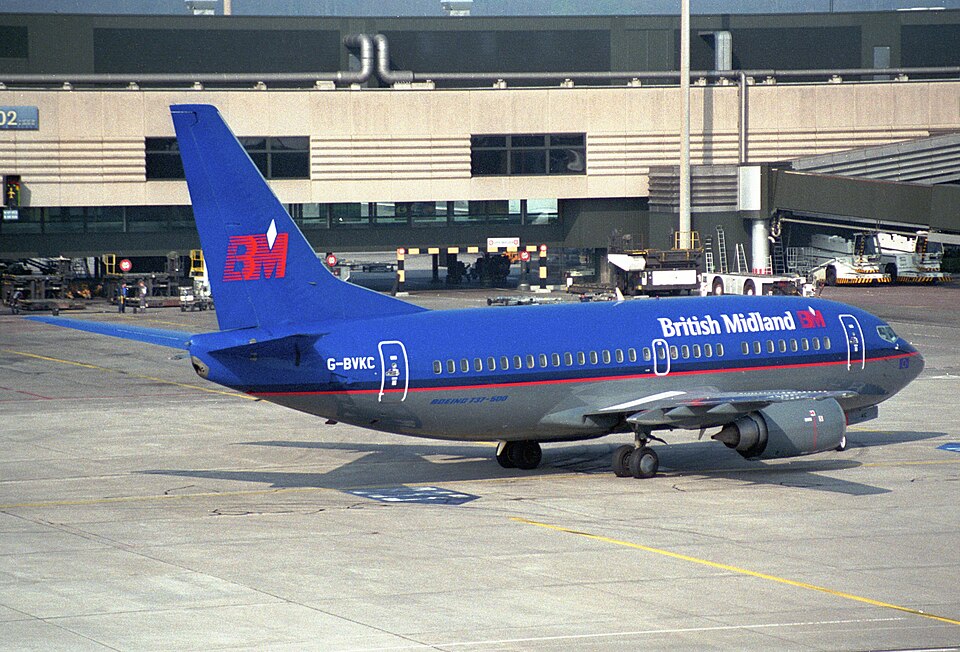
On 21 February 2004 at 2300 UTC, a Boeing 737-59D, registration G-BVKC, operated a public transport passenger flight from Malaga to Cardiff Airport, Wales. The aircraft had two CFM56-3C1 turbofan engines and was manufactured in 1990. The commander, aged 49, held an Airline Transport Pilot's Licence and had 8,160 total flying hours, with 3,800 on type. The crew consisted of 6, with 114 passengers on board. No crew injuries were reported; passenger injury information was not available. The aircraft sustained damage to the left main landing gear.
History of Flight
The approach to Cardiff Airport was uneventful. The crew requested Runway 30 due to turbulence on Runway 12. An ILS approach was flown with anti-skid selected on, autobrake off, and flaps at 30°. The commander, the handling pilot, performed a firm but not heavy touchdown after a short float, without excessive sideways drift. Reverse thrust was selected and manual braking applied immediately. Almost instantly, the crew experienced heavy vibration and a pull to the left. Reducing braking lessened the vibration, but when firm braking was reapplied at approximately 60 kt, extremely heavy vibration recurred, accompanied by a significant lateral acceleration to the left. The vibration was severe enough to cause an overhead locker to unlock. The commander used the tiller to steer and brought the aircraft to a halt on the runway. The Airport Fire Service reported brake unit parts on the runway, and passengers disembarked without incident.
Runway Evidence
Runway markings indicated that the aircraft touched down approximately 754 meters from the threshold of Runway 30, with the left main landing gear tyres initially oscillating sinusoidally. The first oscillation had a wavelength of 4.8 meters and a half-amplitude of 5 to 10 cm, continuing for 183 meters. After a straight section of 609 meters, a second oscillation began with a wavelength of 2.3 meters and a half-amplitude of 15 to 20 cm, persisting for 88 meters until the aircraft stopped. Scrubbed marks suggested contact between the No 2 wheel assembly and the torque link/shimmy damper assembly during peak yaw.
Aircraft Examination
Inspection of the left main landing gear revealed significant damage. The lower torsion link had fractured mid-length due to overload. The damper piston rod was bent, and the apex joint spherical bushings had suffered compression collapse, with bronze material smeared onto the thrust washers. The outboard side of the No 2 wheel, tyre, and brake sustained severe damage, consistent with impact with the damper body and lower shock-strut cylinder. The parts found on the runway originated from these components. Material loss from the inner thrust washer and piston rod shoulder appeared to be pre-existing wear rather than from the shimmy event. No hydraulic fluid leakage was found from the shimmy damper, and the hydraulic supply was normal.
Maintenance Considerations
Maintenance records indicated that the landing gear had been serviced according to manufacturer recommendations. However, the Aircraft Maintenance Manual includes procedures for inspecting the torsion link apex joint to ensure shimmy damper effectiveness. It was considered that these procedures could be difficult to follow. Similar failures had occurred previously, attributed to excessive wear of the apex joint that remained undetected or inadequately rectified. One safety recommendation was made.
Probable Cause
The investigation determined that the shimmying likely resulted from excessive wear of the torsion link apex joint, which reduced the effectiveness of the shimmy damper.