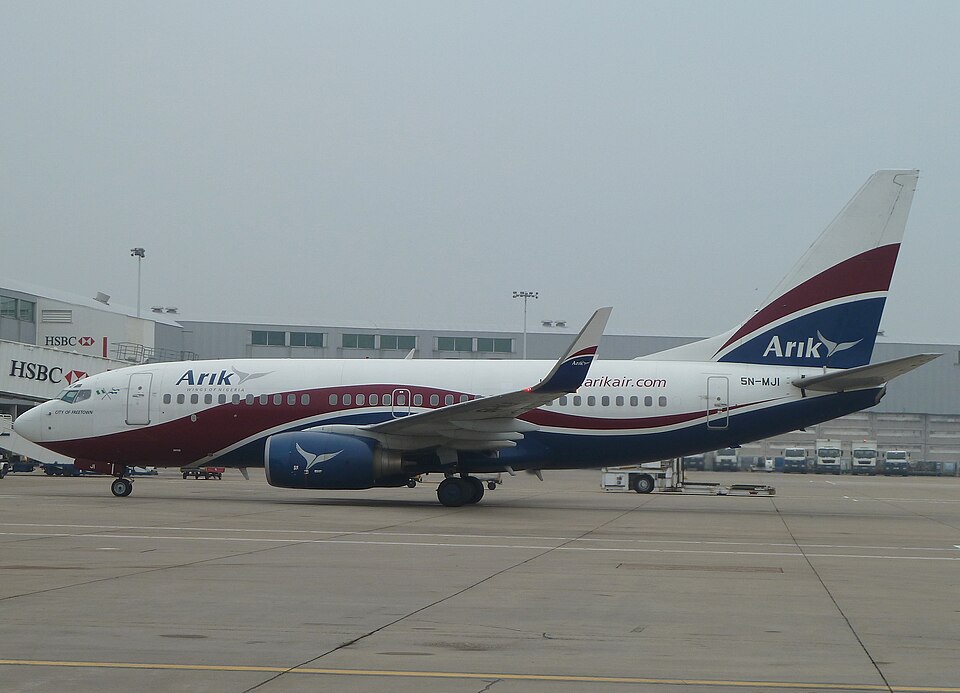
Aircraft and Crew Information
The aircraft, a Boeing 737-76N registration 5N-MJI, was manufactured in 2001 and powered by two CFM56-7 turbofan engines. It was operating a commercial air transport (non-revenue) flight to reposition to Lagos Airport, Nigeria. The crew consisted of two captains, one designated as commander and the other as co-pilot (pilot flying). The commander held an Airline Transport Pilot's Licence, was 43 years old, and had 5,100 total flying hours (3,500 on type). The co-pilot's qualifications were not specified.
History of the Flight
The aircraft had undergone maintenance at Southend Airport. The co-pilot arrived first and began flight planning using documentation that included an Airport Analysis Table for Southend, but he could not locate it. He used the Quick Reference Handbook Performance Dispatch section and prevailing meteorological conditions to calculate takeoff speeds for maximum thrust, per the operator's Standard Operating Procedures (SOPs).
The commander arrived about 90 minutes later due to transport problems, making the flight approximately two hours late. He performed the external pre-flight inspection while the co-pilot programmed the Flight Management Computer (FMC) with weights, speeds, and the planned route for departure from Runway 24. Both pilots reviewed the FMC data and confirmed it correct.
Engines were started and the crew received taxi clearance. During taxi, Air Traffic Control changed the runway in use to Runway 06. The commander taxied the aircraft as instructed and took over radio communications as the co-pilot had difficulties with external communications.
The co-pilot reprogrammed the FMC with some urgency for the new runway. This deleted previously entered performance data, allowing entry of an 'assumed' temperature for reduced thrust takeoff. The co-pilot entered a temperature of approximately 50°C, a value typical for longer runways they normally operated from in Africa. The aircraft was configured with flaps at 5°, engine bleeds ON, anti-ice OFF, and engines rated at 24K (24,000 lbs) maximum thrust.
The crew backtracked on Runway 06 but lined up at the displaced threshold, which was 600 ft from the start of the runway. After completing the before-departure checks, the co-pilot (pilot flying) advanced the thrust levers and engaged the autothrottle. The commander recalled thinking at about 100 kt that acceleration was slow and called for maximum thrust, which he believed the co-pilot applied. At VR speed of 133 kt, rotation was initiated and the aircraft lifted off, climbing away on the programmed departure.
Airport Information
Southend Airport has a single runway oriented 06/24. Runway 06 is 5,264 ft long and 121 ft wide, with an asphalt surface and friction course. There is an arrester bank 85 ft beyond the paved surface, a main railway line 145 ft beyond that, and housing estates further on. The published Take Off Run Available (TORA) is 4,785 ft. By lining up at the displaced threshold, the effective TORA was reduced by 600 ft.
Recorded Data
Flight data recorder analysis showed the aircraft taxied onto Runway 06 and backtracked with flaps at 5° and autothrottle armed. It lined up at the displaced threshold and held for 2 minutes 10 seconds while completing before-takeoff checks. Wind was from 360° at less than 5 kt, OAT 6°C. Before brake release, thrust levers were advanced to 80.9% and 81.9% N1 on left and right engines. Brakes released and autothrottle engaged, accelerating to the reduced thrust setting. Within the first 500 ft, N1 increased to 86.0% and 86.1%, then stabilized at 86.1% and 86.6%. The pilot flying commenced rotation at VR and the aircraft became airborne at V2 of 140 kt, passing through 35 ft screen height after 4,317 ft from brake release. It crossed the threshold of Runway 24 at 150 ft with landing gear retracting, achieving a 21% climb gradient at 2,590 fpm.
Aircraft Performance Analysis
The aircraft manufacturer reviewed performance using the incorrect assumed temperature of 50°C. Results showed that if the crew had rejected the takeoff just before V1, with maximum braking and reverse thrust, the aircraft would have required an additional 656 ft of runway and would have overrun the end at approximately 60 kt. Had an engine failed one second before V1 and the takeoff continued, the aircraft would not have become airborne before the runway end. One second after V1, it would have lifted off before the end but would not have achieved the 35 ft screen height. The maximum suitable assumed temperature for Runway 06 in those conditions was 29°C.
Safety Actions
The operator introduced four safety actions:
- The crew received structured training to return them to line flying.
- Performance and mass balance calculations and takeoff/landing exercises at Southend and similar bases will be incorporated into biannual simulator recurrent training for all Boeing 737 pilots.
- Operations into and out of Southend and similar airfields will be limited to daylight only.
- The Operations Control Centre will include 'Special Briefings' for unusual and limiting airfields, with a Route and Airfield checklist to remind pilots when full thrust takeoff is required.
Discussion
The crew felt time pressure due to the delay caused by the commander's transport problems. Both pilots were unfamiliar with the airport. When the runway change occurred, the co-pilot reprogrammed the FMC but entered an incorrect assumed temperature, and neither pilot noticed. The adherence to SOPs broke down during re-programming. The manufacturer noted that with both engines operating, the aircraft became airborne and achieved screen height by the runway end, but if an engine failed at or near V1, the outcome could have been different.
No safety recommendation was considered necessary in view of the operator's actions.