Introduction
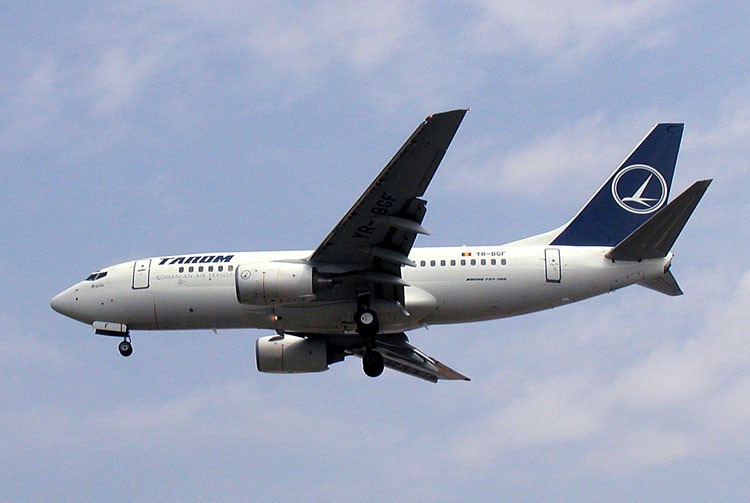
On 4 March 2004, a Boeing 737-78J, registration YR-BGF, operated by a public transport passenger flight from Bucharest, arrived at London Heathrow Airport at 1215 hrs UTC. The aircraft landed uneventfully on Runway 27L and was cleared to taxi to Stand 214. While parking, the upper part of the No 1 engine cowling made contact with the stand's passenger jetty. No injuries were reported among the 8 crew and 61 passengers.
History of the Flight
Upon vacating the runway, the crew received ATC clearance to taxi to Stand 214. At that time, no personnel were immediately available to marshal the aircraft onto the stand, as required by the airport operator for Boeing 737 aircraft. In the absence of a marshaller, the groundcrew had turned on the stand's guidance system. The commander, acting as handling pilot, observed that the AGNIS lateral guidance system was switched on and a groundcrew member was waiting with wheel chocks, indicating to him that parking should be conducted using AGNIS and the mirror.
The aircraft turned onto the stand, and the commander used AGNIS to align with the centreline. Once aligned, he focused on two large mirrors to his left to monitor the nosewheel position relative to the STOP mark. However, he could not see a defined STOP mark. He did see the end of the centreline marking (a T shape) and chocks, and assumed that was the correct stopping point. As he taxied forward, the aircraft encountered resistance, and he saw the emergency STOP light activated. He applied brakes and shut down engines, but the No 1 engine cowling had already contacted the jetty.
Stand Guidance Systems
Stand 214 was equipped with AGNIS (Azimuth Guidance for Nose In Stands) and two mirrors. The system provided lateral guidance via colored lights and a mirror view of the nosewheel relative to a STOP mark on the ground. For Boeing 737 aircraft, the airport operator had determined that a marshaller was required because the correct stopping position was only just visible at the top of the lower mirror. Additionally, a parking space for an aircraft tug adjacent to the stand, when occupied, obscured the left portion of the lower mirror—the exact area where the STOP mark appeared for 737-sized aircraft. This problem had not been previously noticed.
Investigation Findings
The investigation revealed that no procedure existed for the airport operator to notify flight or groundcrew that a marshaller was unavailable. Consequently, both groundcrew and flightcrew mistakenly believed the aircraft should park using AGNIS and mirrors alone. The commander, unable to see the correct STOP mark due to the tug obstruction, identified the end of the centreline marking as the stopping point. The groundcrew activated the emergency stop light, but the commander, focused on the mirrors, did not see it; the co-pilot was looking elsewhere. The aircraft continued until contact occurred.
Safety Recommendations
Five safety recommendations were made to Heathrow Airport Limited (the airport operator) to address the issues identified during the investigation.