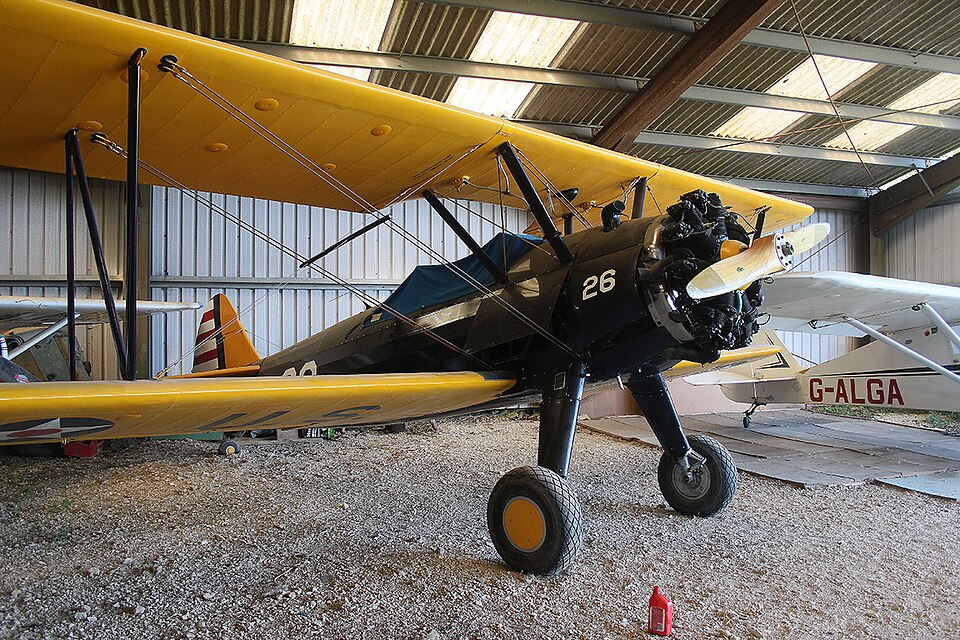
History of the Flight
The pilot completed all pre-flight checks and began the takeoff run from Runway 07, a grass strip. The surface wind was light and variable, the air temperature was +25°C, and the aircraft was about 200 lb below its maximum authorised takeoff weight of 2,950 lb. The field at the end of the runway was covered in dry straw. The pilot reported that acceleration and power indications were normal during the initial takeoff run. The aeroplane became airborne but failed to climb satisfactorily, prompting the pilot to attempt a landing in the field immediately ahead. This field, containing hay, was furrowed across the line of flight, causing the aircraft to lose its undercarriage and nose over onto its back. Fire then broke out around the nose of the aircraft. Both occupants vacated the aircraft without assistance and moved clear. The emergency services attended promptly and extinguished the fire.
Pilot's Assessment
The pilot had flown the same aircraft one hour earlier in the day, in similar weather conditions and from the same runway. On the accident flight, he reported that the tail wheel lifted and the aircraft became airborne at the appropriate speed. The aircraft then failed to gain speed or altitude, despite a stick-forward action lowering the nose. At this point the pilot closed the throttle and set the mixture to the idle cut-off position to attempt the emergency landing.
Witness Accounts
Four witness accounts were subsequently gathered, at least one from an experienced pilot. Two of the three witnesses who observed the initial takeoff stated that the aircraft appeared to become airborne in a 'three-point' attitude, with the main wheels and tail wheel leaving the ground simultaneously. The aircraft then appeared to be flying close to a stall, with each of the witnesses observing the aircraft dropping first one wing, then the other, a number of times. From there, the witness accounts supported the inability of the aircraft to gain altitude and its subsequent descent from around 100 ft agl into the field bordering the airfield, although they observed that the engine sounded as though it was producing full power until the point of impact.
Discussion
The accident bore a strong resemblance to an accident involving a similar aeroplane, registered N55175, in the USA on 13 June 2003. That accident occurred in very similar weather conditions to G-BAVO's accident, and with similar loading, the aircraft failed to gain height after an abnormally long takeoff run, including two bounces on the runway. The pilot twice considered aborting the takeoff and, shortly after leaving the airfield, the aeroplane sank into trees. In both cases, the pilots, with a relatively high number of hours on light aircraft, had recently converted to the Stearman.
G-BAVO's pilot considered that the reflected heat from the dry straw in the field where he was forced to land may have had an adverse effect on the local air density. The possibility of thermal activity in the area was investigated by the AAIB, with a local gliding club reporting that the day was thermic, but not strongly so. As thermals develop, there is a component of horizontal air movement along the ground inwards towards the rising column of air, which can be noticeable on a still day. An aircraft taking off may experience a sudden slight tailwind for this reason. However, this induced wind is normally low speed, in the order of three to four knots, and is present only for a short distance, after which the direction changes to become a headwind component. It was considered possible that this effect may have played a minor part in the accident to G-BAVO, but that this effect would be insignificant in comparison with the high-drag takeoff attitude reported by the eyewitnesses.