Incident Overview
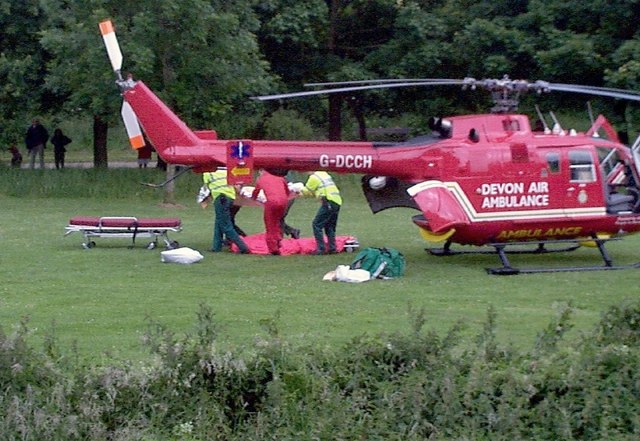
On 20 May 2001 at 1612 hours UTC, a Bolkow BO-105DBS-4 helicopter, registration G-DCCH, was involved in an incident at Dunchideock, near Exeter. The helicopter was on a private flight tasked by Ambulance Control to attend a road traffic accident. The weather at the time included wind from 180° at 8 to 10 knots, visibility in excess of 10 km, few clouds at 3,000 feet, and no precipitation.
Flight Details
The helicopter was crewed by three persons: the pilot and two paramedics. The pilot held an Airline Transport Pilot Licence (Helicopters), was aged 45, and had 6,437 flying hours, of which 2,347 were on the type. The aircraft, manufactured in 1986, was powered by two Allison 250-C20B turboshaft engines.
Sequence of Events
After departing base, the pilot searched for the accident scene in coordination with ground vehicles. Approximately 12 minutes later, the helicopter located the overturned car on a minor road. The pilot began a left-hand orbit to avoid high ground and identify a landing site. A large grass field sloping into a bowl was selected. The landing area had a set of telephone wires along the road and an isolated tree on the western edge. The pilot initiated a slow approach from the northwest at 25-30 knots, descending into the southeast corner of the bowl, passing to the right of the tree.
Due to high radio traffic, the pilot could not make a landing call to Exeter ATC. As the aircraft passed over the road, the pilot noted the overturned car with people looking in. While focusing on finding an access route to the road and responding to ATC, the pilot felt a gust of wind yaw the aircraft tail to the left, followed by a heavy, high-frequency vibration through the tail rotor control pedals. Suspecting a tail rotor strike, the pilot applied right bank and more left pedal, but no yaw correction was available. The tail rotor separated, and the pilot lowered the collective pitch control to prevent a right yaw. The helicopter struck the ground heavily from about 35 feet in a slightly nose-down attitude but remained upright, facing down the slope in a southeasterly direction. The pilot shut down both engines and isolated fuel and electrical systems. All three occupants evacuated through normal exits and were taken to hospital as a precautionary measure.
Damage and Injuries
The helicopter sustained light damage to the tail boom, the tail rotor detached, and the landing gear suffered damage from the heavy landing. All three crew members sustained minor injuries.