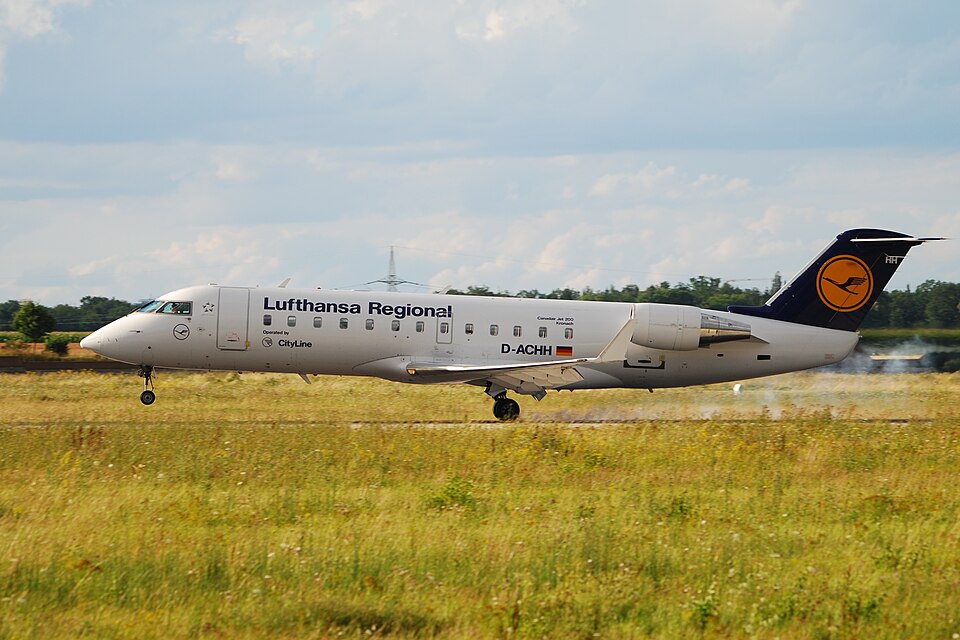
History of the Flight
On 16 March 2005, a Bombardier CL600-2B19 CRJ200, registration D-ACHH, operated a scheduled passenger flight from Cologne to London Heathrow Airport. While cruising at an indicated airspeed of 250 kt, the Engine Instrument and Crew Alerting System (EICAS) issued a “SMOKE CARGO” warning. The flight crew executed the appropriate emergency procedure using the Quick Reference Handbook and briefed the cabin crew and passengers. Air traffic control was notified of the nature of the emergency and coordinated a priority ILS approach to Runway 27L at Heathrow. After vacating the runway, the aircraft stopped to conduct a normal but expeditious disembarkation, with airport fire services in attendance. Fire crew inspected the cargo compartment but found no evidence of smoke, fire, or heat damage.
Investigation
The AAIB investigation reviewed previous occurrences of spurious cargo smoke warnings on CRJ200 aircraft. Joint studies by the aircraft manufacturer and smoke detector manufacturer had identified two likely causes: first, dust or condensation in the detection chamber reflecting light and activating the detector; second, electromagnetic interference from handheld devices such as walkie-talkies and mobile telephones. The studies concluded that the first cause could not be prevented completely and that cargo with high moisture content could contribute to false warnings. Many contaminated detector units had been cleaned, and a service letter recommended annual cleaning. A redesigned smoke detector, intended to reduce susceptibility to dust and electromagnetic interference, was mandated by airworthiness directive TC AD CF-2001-21. D-ACHH, manufactured in 2000, was fitted with the revised detector by December 2002. However, this aircraft subsequently recorded four instances of cargo smoke warnings, the most recent being this incident. Two of the other occurrences were attributed to mobile telephone interference. The AAIB investigation did not determine whether the new design reduced spurious warnings globally but noted that it appeared ineffective on the subject aircraft. The cargo smoke detector on D-ACHH was replaced after this incident, with no further similar reports.
Conclusion
The cargo smoke warning was almost certainly spurious and was probably caused by the smoke detector reacting to dust, condensation, or electromagnetic interference. The revised design of the smoke detector, which was intended to reduce its susceptibility to these factors, appears not to have been effective on the subject aircraft.