Synopsis
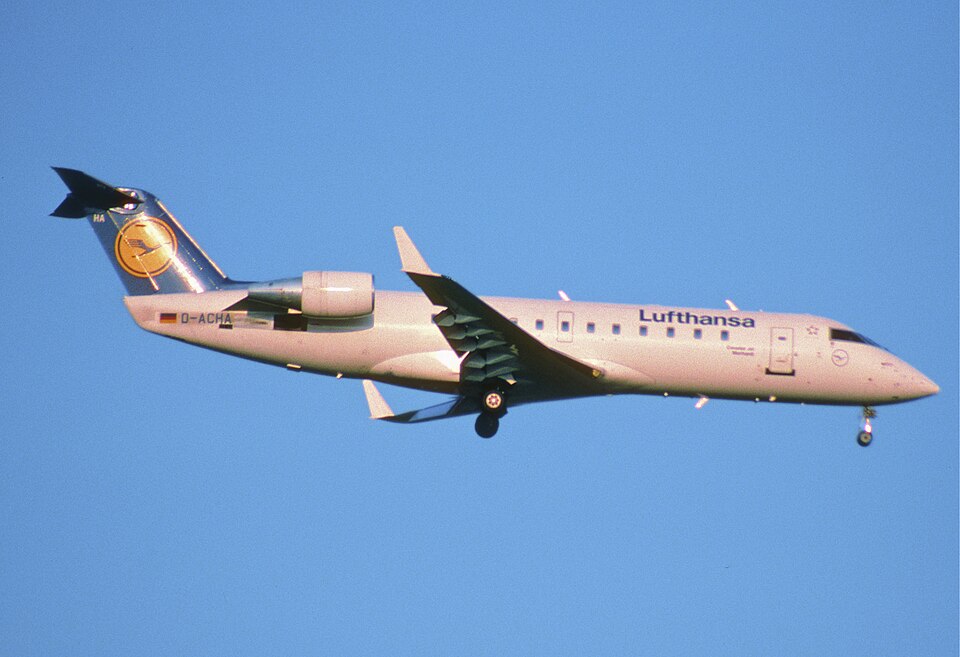
On 13 November 2008, at approximately 0900 UTC, a Bombardier CL600-2B19 CRJ200, registration D-ACHA, was parked at a remote stand at Manchester Airport. The aircraft had no crew or passengers on board. A technician was tasked with replacing a main wheel and performing a five-day maintenance check. While rectifying an under-inflated nose wheel tyre, he used a nitrogen pressure rig with which he was unfamiliar. After pressing the inflator lever several times, the wheel assembly exploded. The technician sustained serious injuries.
Aircraft and Maintenance Task
The aircraft, a Bombardier CRJ200 with two General Electric CF34-3B1 turbofan engines, had been grounded the previous evening after a flight crew discovered a cut in a main-wheel tyre tread. A technician from the operator's base in Germany traveled to Manchester the following morning with a wheel-change kit and a spare main wheel. The spare tyre was inflated to approximately 50 psi. Upon arrival, he was met by staff from a local line maintenance company and taken to the aircraft. A nitrogen pressure rig was also taken to the stand.
The technician chose to perform the five-day maintenance check before the wheel change. This check included verifying all tyre pressures. He found the right nose wheel tyre slightly under-inflated and used the nitrogen rig to replenish it.
The Incident
The technician had difficulty operating the pressure rig. He initially opened the valve of one of the nitrogen bottles using the provided spanner but did not check the pressure gauges or adjust the regulator. He confirmed gas flow from the inflator, then connected the adapter to the tyre valve. He briefly pressed the inflator lever twice and believed no nitrogen entered. He then unscrewed the adapter and measured the tyre pressure again, finding it had decreased by 5 psi. After reconnecting the adapter, he pressed the lever once or twice more, and the wheel burst.
The explosion ejected the outboard wheel-half and shattered the inner wheel-half into fragments. Seven of the eight tie bolts failed due to tensile overload. The tyre itself sustained no significant damage. Wheel fragments were scattered across the apron, and the technician suffered serious injuries. Another company employee, who was in the cabin, heard the explosion and exited to assist.
Wheel and Pressure Rig Details
The nose wheel assembly consisted of two forged halves joined by eight tie bolts. The normal inflation pressure was 163 psi. The wheel design allowed for an optional over-inflation pressure relief valve, but it was not fitted to this aircraft. The wheel manufacturer had performed an over-inflation test on an uninstalled wheel, which failed at 997 psi due to tensile rupture of all eight tie bolts.
The pressure rig's origin could not be established. It comprised a trailer with two nitrogen cylinders, each with a rated pressure of 230 bar (3,335 psi), and a single adjustable regulator capable of delivering up to 1,500 psi. The regulator had no reference markings for pressure setting. The inflator unit had a pressure gauge and a lever-operated valve. The inflator manufacturer stated that the gauge would suffer permanent deformation at applied pressures above 500 psi. The inflator had not been returned for overhaul since its supply in 2005.
Subsequent Examination
Examination of the failed wheel showed that all but one tie bolt had failed via staged tensile rupture near the thread run-out. No pre-existing defects were found in the wheel, tyre, or bolts. The pressure rig's gauges were examined: the supply pressure gauge read 500 psi (previously noted as 700 psi shortly after the explosion), the delivery gauge read zero, and the inflator gauge read 30 psi. The delivery hose failed at both swaged joints. The inflator manufacturer noted that some components and sealants differed from their standard, and the air filter was excessively contaminated.
Safety Recommendations
Two Safety Recommendations were made based on the investigation, though their specifics are not detailed in the source.