History of the Flight
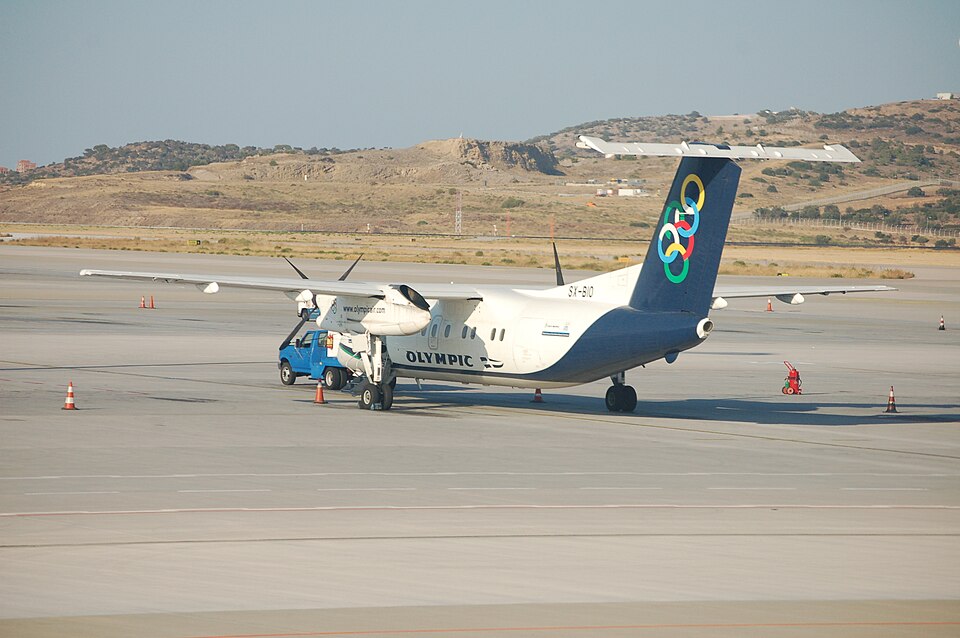
The aircraft, a Bombardier DHC-8-102 registered SX-BIO, had been flown from Greece to Exeter Airport for a C-check maintenance check. During the check, both oil coolers were removed and refitted. On 16 April 2010, the aircraft flew to East Midlands Airport for repainting; the engineer noted oil spots on the ground beneath both engine nacelles upon arrival.
On 24 April 2010, the aircraft was to return to Exeter. The crew performed a ground run, and the engineer added one quart of oil to the right engine. The start-up, taxi, and departure were normal, but photographs taken during taxi showed oil leaking from both engines.
About 10 minutes into the flight at FL100, the commander noticed a fluctuating and decreasing right engine oil pressure. The co-pilot observed a major oil leak from the right engine. The crew shut down the right engine after following the low oil pressure checklist. They declared a PAN and requested vectors to Exeter. Shortly after, the left engine oil pressure began to fluctuate, and the co-pilot observed an oil leak from it. The commander diverted to Bristol International Airport, 25 nm ahead, and landed safely with ATC assistance.
Aircraft Examination
Examination four hours after landing revealed clean oil coating both main landing gear legs and lower surfaces of both engine nacelles and main gear doors. The right side of the fuselage had oil streaks; the left side was clean. The oil coolers were heavily coated in oil on their undersides.
Engine cowlings were removed. The left engine oil cooler showed oil along the lower forward surface and a slow weep from the knurled nut on the inlet pipe. When disconnected, two O-ring seals were found in the pipe groove: a smaller split O-ring and a larger cut O-ring. The larger was correct, but the smaller should not have been fitted. The outlet pipe had an undamaged O-ring.
The right engine oil cooler had oil around the outlet pipe. When removed, the O-ring seal on the outlet pipe was cut with a missing section found in a side cavity. The inlet O-ring was undamaged.
Evidence of over-tightening was found: circlips had grooves from squeezed nuts, and knurled nuts had score marks from grips. The maintenance manual specifies hand-tightening only. Additionally, the inlet and outlet pipes were not perpendicular to the oil cooler but canted outwards, making insertion difficult.
A total of 13.5 litres of oil was drained from the left engine and 11.5 litres from the right. The oil capacity is 19 litres per engine. The left engine lost 3.5 litres and the right lost 5.5 litres during the flight.
Both oil coolers were pressure leak tested with no leaks found. After installing refurbished oil coolers and new O-ring seals, no further leaks were detected.
Maintenance History
The aircraft had been stored from July 2009 to March 2010 after the previous operator ceased trading. Two new engines were fitted in early 2010. On 18 March 2010, it arrived at Exeter for a C-check by a Part-145 approved maintenance organisation. During the C-check, both oil coolers were removed and refitted. The removal was initiated for a bushing repair that could have been done in situ but was deemed to require oil cooler removal by a licensed aircraft engineer. An unlicensed technician (Tech A) completed the removal. The oil coolers were subsequently re-installed, and it is probable that the O-ring seals were damaged during re-installation.
The aircraft had accumulated 29,998 hours and 38,752 cycles at the time of the incident.