Incident Overview
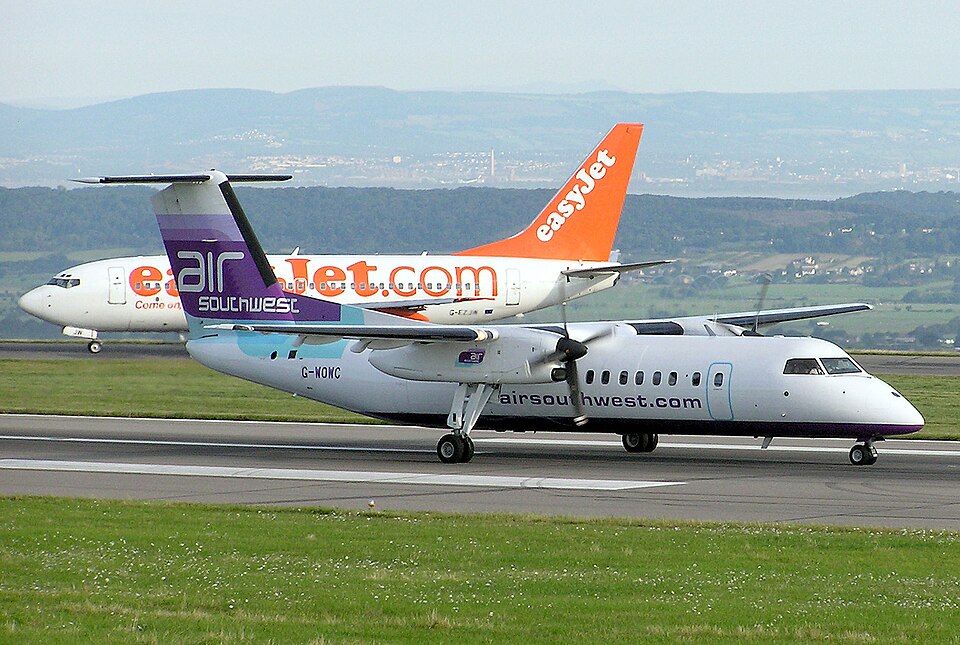
On 11 April 2006, a Bombardier DHC-8-311 Dash 8, registration G-WOWC, operated a commercial passenger flight from London Gatwick Airport to Plymouth Airport. The aircraft, carrying 5 crew and 42 passengers, experienced an incident during landing on Runway 31. The tail strike sensor and its fibreglass cover were damaged; no structural damage or injuries occurred.
Flight Preparation
Before departure, the flight crew reviewed the weather forecast for Plymouth, which indicated strong and gusty southwesterly winds. The Terminal Aerodrome Forecast (TAF) for the period 1000–1900 UTC predicted wind from 240° at 15 kt, gusting to 25 kt. At the incident time, recorded wind was predominantly from 230°, varying between 200° and 280°, at 16 kt gusting to 27 kt. Visibility was 5,000 m in moderate rain and mist, with scattered cloud at 400 ft and broken cloud at 800 ft.
Approach and Landing
The flight crew obtained actual weather from ATC before descent. The commander, who was the pilot flying (PF), briefed the co-pilot on possible windshear and asked him to monitor indicated airspeed and vertical speed. Per company standard operating procedures, the commander added a speed increment to VREF to guard against wind shear: half the wind speed plus the full gust factor, subject to a minimum of 5 kt and maximum of 20 kt. He selected Flap 15 (normal landing configuration) because it allowed a higher crosswind limit than Flap 35.
The landing weight was 39,000 lb. VREF for Flap 15 was 107 kt; the expected approach speed (VAPP) was approximately 125 kt, with touchdown at about 119 kt. The centre of gravity was within the allowable range.
The ILS approach was turbulent. The commander became visual with the runway at approximately 300 ft above airfield level (aal), 100 ft above decision height, and disconnected the autopilot. He lowered the nose to bring the touchdown point closer to the threshold. As the aircraft crossed the runway threshold at about 15 ft aal, both pilots sensed a "sinking feeling." The commander applied a small amount of power and pulled the control column back. No GPWS sink rate warning occurred.
The aircraft landed firmly, and the crew perceived it "bounced slightly." The co-pilot noted the touch runway warning light illuminated. The commander could not recall if the warning occurred after the first or second touchdown. After taxiing to the stand, the commander reported the warning to engineers. Inspection revealed damage only to the tail strike sensor and its fairing.
Flight Data Recorder Analysis
The FDR data showed that after the autopilot was disconnected, the aircraft pitched nose-down to -6° and accelerated to 131 kt, with a descent rate of 750 ft/min, descending below the glideslope. Ten seconds before touchdown, airspeed was 125 kt (VAPP) and reducing; engine torques were 7% and reducing. The pitch attitude during the flare reached +4° for about one second as the aircraft descended below 20 ft agl. The aircraft touched down with a maximum pitch attitude of +8° at 94 kt (31 kt below VAPP, 13 kt below VREF) and a peak vertical acceleration of +2.3 g. The nose gear contacted the ground 1.6 seconds later.
Analysis and Conclusion
The analysis noted that likely windshear reduced the aircraft's indicated airspeed during the final approach. After autopilot disconnect, the aircraft pitched down and descended below glideslope, coinciding with the commander becoming visual and throttles being retarded. The airspeed then fluctuated. At about 90 ft aal, the IAS reduced below VAPP, and throttles were further retarded. The combination of reduced thrust, a heavy aircraft, and possible negative wind shear increased the descent rate. The commander's response—raising the nose to reduce descent rate—led to a pitch attitude exceeding the 6° nose-up limit, causing tail contact. The incident occurred through a combination of turbulence, windshear, and the pilot's inappropriate response to reducing airspeed throughout the final 10 seconds of the approach.