History of Flight
The aircraft operated the second sector of the day, from Birmingham to Edinburgh. During the first sector, the commander noted a slight musky smell upon engine start, which he attributed to recent engine maintenance. A slight oily smell was also noticed on the flight deck during descent on that sector, lasting approximately 30 seconds.
On the second sector, while cruising at FL200, a 'de-ice pressure' caution illuminated when the de-icing system was activated. The caution persisted after completing the relevant checklist, prompting the crew to request a descent to FL120 at 0731 hrs. At around 0736 hrs, Manchester ATC cleared the aircraft to descend to FL160. Shortly after retarding the throttles and passing through FL180, both pilots detected the same oily smell as before. They inquired via interphone with the cabin crew, and almost immediately a white/blue haze appeared on the flight deck, accompanied by the toilet smoke alarm.
The commander initiated the FCOM smoke checklist memory items, donning smoke masks and actioning the items. One step—switching off the recirculation fans—was initially missed but later performed. Smoke goggles were not used as instrument reading remained possible. The cabin crew found the forward toilet filled with whitish smoke and informed the flight crew, whose response was delayed due to checklist actions. The cabin crew then donned smoke hoods.
The commander declared a MAYDAY and received clearance for further descent, requesting vectors to the nearest suitable airport. ATC suggested Leeds Bradford International Airport (LBA), about 45 nm away, which was accepted. After communication delays, ATC provided the required heading, emergency transponder code, and a quiet frequency. At the crew's request, ATC obtained and relayed LBA weather: wind 260°M at 14 kt, visibility 20 km, scattered cloud at 1,100 ft and 1,500 ft aal, temperature 14°C.
The commander assessed the smoke level as unchanged and briefed the cabin crew to prepare for an emergency landing in 10 minutes with a runway evacuation. The cabin crew found cabin smoke thickening until they could no longer see the length of the cabin. They played an emergency announcement tape and made a public address instructing passengers to adopt the brace position. Some passengers asked about breathing protection, but smoke protection for passengers is not required on public transport aircraft.
ATC passed the ILS frequency and runway heading for Runway 14 at LBA, and the aircraft was radar vectored for the approach. About 15 nm from the airport, ATC suggested a frequency change to Leeds Approach, which was accepted. The flight crew prioritized getting the aircraft on the ground; with limited time and high workload, they completed only the first item of the subsequent actions portion of the smoke checklist: 'No 1 Bleed Off and wait up to 1 minute' (Section 4). When power was increased during the approach, smoke level increased significantly. Due to hearing difficulties from the smoke hoods, the cabin crew did not hear the landing calls from the flight deck.
The aircraft landed on Runway 14 at 0748 hrs, about 12 minutes after smoke was first noted. The crew accepted a reported 15 kt tailwind to expedite arrival. A firm landing was made, and the aircraft stopped about two-thirds along the runway. The park brake was applied, engines shut down, and an evacuation ordered. Evacuation was conducted through the left forward exit (using airstairs) and the left and right aft exits. The first officer left to assist passengers while the commander completed shutdown. The evacuation was orderly, with Aerodrome Fire and Rescue Service present, and was completed without injury. The commander confirmed the cabin empty and left the aircraft. AFRS found no signs of fire; the aircraft was towed to a stand.
Engine Findings
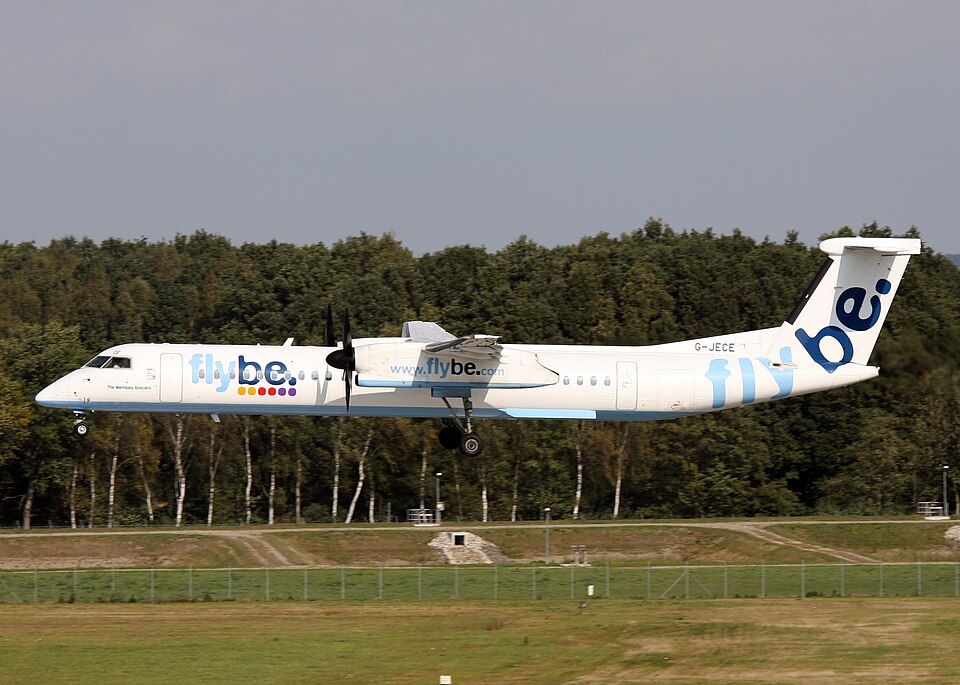
The smoke source was traced to fatigue cracking of a compressor support member (the Inner Compressor Support, ICS) on the No 2 engine. The cracking led to damage of an oil seal (the No 2.5 bearing seal), allowing oil to leak into the bleed air that supplied one of the air conditioning units. Previous cases of material loss from the ICS due to frettage wear had resulted in changes in vibration characteristics and consequent fatigue cracking. The aircraft was a Bombardier DHC-8-400 (G-JECE) with two Pratt & Whitney PW150A turboprop engines, manufactured in 2004.
Crew Communications
After the emergency declaration, high workload prevented the flight crew from communicating with the cabin crew for some time. The cabin crew reported that delays in response to emergency calls caused concern about the flight crew's state. It was suggested that a standard method (e.g., triple activation of the seat belt audio alert) be introduced for the flight crew to confirm they were not incapacitated but busy. The cabin crew also reported that smoke hoods severely hindered communications with passengers, impeding hearing and speech. One cabin crew member removed her hood shortly before landing due to these difficulties.
Checklist Considerations
The smoke checklist in the operator's FCOM included memory items such as oxygen masks on 100%, smoke goggles on, mic switch to MASK, hot mic OFF, headset on, recirculation fans OFF, emergency lights ON, passenger signs ON, descending ASAP checking MSA, and landing immediately at the nearest suitable airport. The subsequent actions involved a systematic trial of shutting off bleed and pack sources. However, due to high workload, only the first item (No 1 Bleed Off) was completed before landing.
Post-Incident Actions
Four safety recommendations were made. Fleet modification action aimed at preventing fatigue cracking of the ICS and improving the affected oil seal was completed on all of the operator's fleet by July 2006. No means of rapidly ascertaining the source of the smoke was available to the crew; carrying out the full checklist would have stopped the smoke supply but the procedure was relatively protracted and could not be completed due to the high workload associated with the diversion.