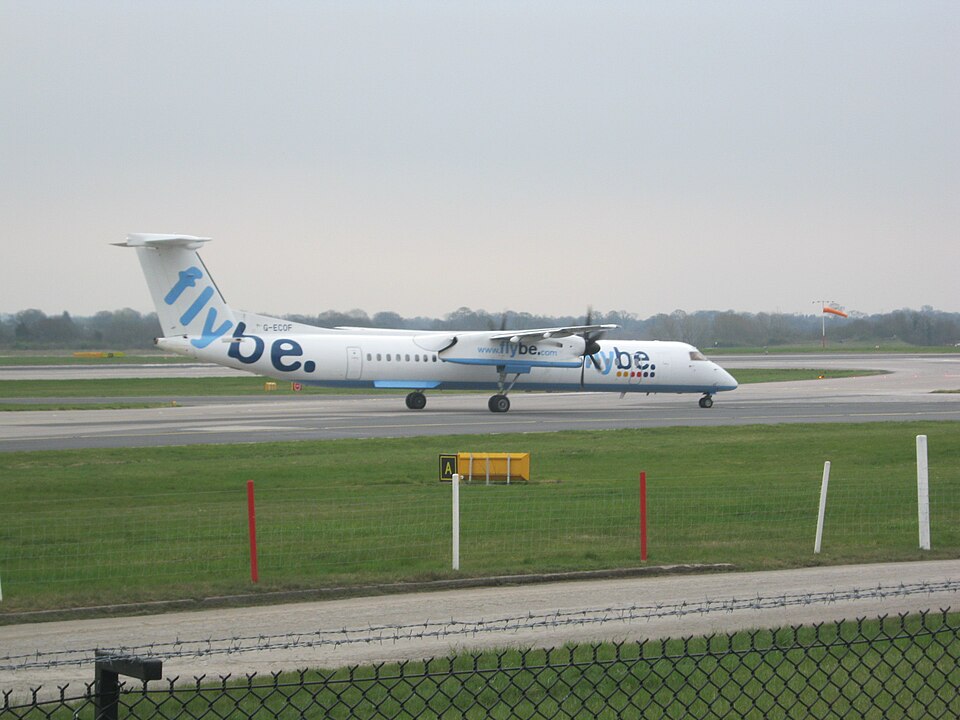
History of the Flight
On 21 July 2011, at 1036 hrs, Bombardier DHC-8-402 Dash 8, registration G-ECOF, was cruising at FL240 approximately 25 nm south-west of Carlisle on a commercial passenger flight from Newquay to Edinburgh. A master warning light, aural warning, and a smoke warning light on the Caution and Warning Panel (CWP) indicated smoke in either the forward or aft baggage compartment. The crew confirmed from the overhead panel that the warning originated from the forward compartment.
The pilots donned oxygen masks and smoke goggles as per the 'SMOKE (Warning light)' drill. The smoke warning extinguished briefly then re-illuminated with the master warning and aural warnings. They pressed the smoke/extg switch for the forward compartment, discharging fire suppressant. The aural warning sounded, the check fire det warning illuminated, and the smoke warning extinguished.
The co-pilot asked the senior cabin crew member (SCCM) to look for smoke in the forward baggage compartment and declared a PAN to ATC, who advised the aircraft was 90 nm from touchdown at Edinburgh. The crew removed oxygen masks and goggles as no fire or smoke was visible in the flight deck. The SCCM reported no smell of smoke.
Consulting the 'FUSELAGE FIRE or SMOKE' checklist, the crew decided to treat the situation as a fire of unknown source. They powered down the aircraft's electrical systems by turning off DC and AC generators, and all batteries. This removed power from the co-pilot's flight displays, autopilot, Instrument Landing System (ILS), transponder, CVR, and FDR, and caused the aircraft to begin depressurising.
The commander flew from the left seat. ATC estimated 55 nm from touchdown at 1047 hrs, but groundspeed was unavailable due to the de-powered transponder. The co-pilot gave a NITS brief to cabin crew, indicating an evacuation after landing. The cabin crew reported insufficient time for passenger briefings (seven minutes estimated, but actual time was 15 minutes). A surveillance radar approach was carried out, and the aircraft landed at 1104 hrs. Power was restored to CVR and FDR on touchdown. The aircraft vacated onto Taxiway L, stopped near fire vehicles, and the commander ordered an evacuation.
Evacuation
All 47 passengers and 4 crew evacuated through four cabin doors. Steps were used at the front left door; the other doors had no steps or slides. Some passengers collected belongings; exit rate slowed at the rear due to the 1.6 m drop. One passenger refused to jump and was helped down by rescue services. One person fell but had no injuries. No fire or smoke was found. Passengers gathered at the airport operations vehicle then moved to the airline's business lounge approximately three hours after the evacuation.
Information from the Pilots
The crew decided to continue to Edinburgh (90 nm) rather than divert to closer airports (Newcastle, Durham Tees Valley, Isle of Man at 60–65 nm) because they had already briefed for arrival at Edinburgh. After pressing the smoke/extg switch, the smoke warning extinguished, leading them to believe there was smoke, but it later re-illuminated permanently. They considered a possible re-ignition or incorrect wiring and consulted the fuselage fire/smoke checklist, even though no smoke had been reported. They began with the electrical section, not assuming the warning was spurious. They elected to evacuate because "fire was in the equation". The commander taxied clear of the runway based on experience from an airport training exercise.
Investigation Findings
The investigation revealed that the spurious smoke warning was probably caused by an intermittent short-circuit in a smoke detector connector as a result of moisture ingress.