Aircraft and Crew
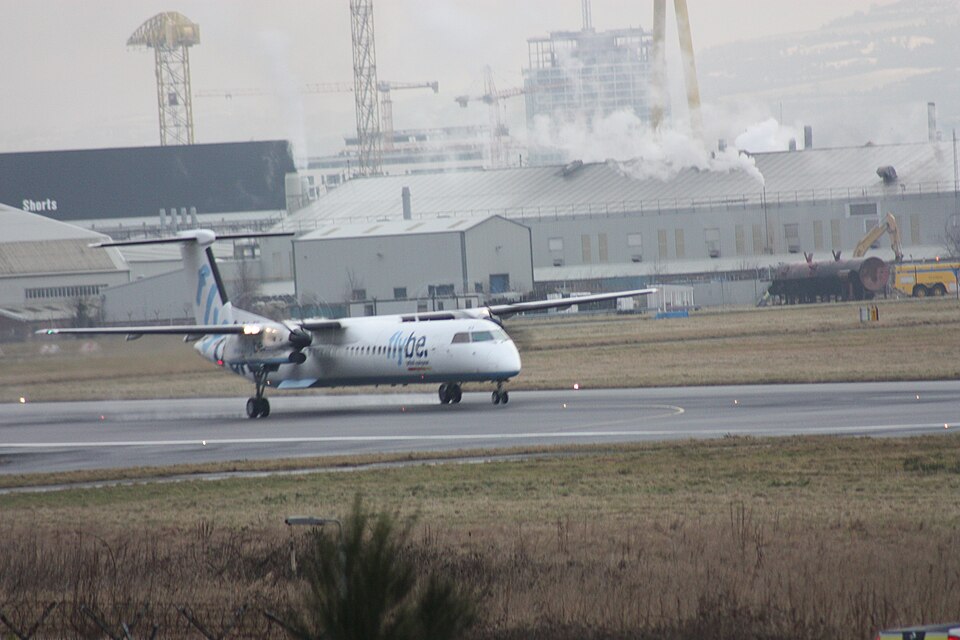
A Bombardier DHC-8-402 (registration G-JECI) was involved in a ground incident at Manchester Airport on 9 January 2007. The aircraft was manufactured in 2005 and powered by two PW150A turboprop engines. The flight was a commercial air transport (passenger) operation. There were 4 crew and 48 passengers on board; no injuries were reported. The commander held an Airline Transport Pilot's Licence and was 44 years old with 4,678 hours total flying experience, including 820 hours on type.
Incident Description
The aircraft landed on Runway 24R at Manchester Airport and vacated onto the rapid exit Taxiway KC, which is 46 m wide. Weather conditions were clear and it was dark, 50 minutes before sunrise. The commander stopped the aircraft at the first junction along Taxiway KC, the intersection with Taxiway K, and awaited taxi instructions. Air Traffic Control (ATC) cleared the aircraft to taxi via Taxiway C and hold at C1.
The commander taxied ahead and at the next junction, where he expected to turn right onto Taxiway C, he saw a sign board to his right indicating Taxiway A ahead. The commander had some knowledge of the airport and knew that Taxiway A was beyond Taxiway C. Confused by the sign board and believing he had somehow passed Taxiway C, the commander advised the co-pilot that he had missed the taxiway and turned hard right to get back to where he thought it to be. While turning, ATC issued further taxi instructions, which the co-pilot needed to write down, taking his attention away from monitoring the aircraft's position.
The commander estimated that during the turn the nose gear had cleared the edge of the paved area by about 2 m and, believing the aircraft was now safely round, he reduced the turning angle. ATC then advised the crew that the aircraft had taken a wrong turn onto Taxiway B, so the commander brought the aircraft to a stop. ATC instructed the aircraft to proceed, but as the commander applied power he realised the aircraft was stuck: the left main gear had sunk into the edge of the grass between Taxiway B and Taxiway C.
Airport Layout and Signage
The intersection of Taxiways KC, C, and B is complex. The airport operator faces difficulty in providing clear sign boards. Additionally, the runway exit taxiway, KC, is wider than a normal taxiway. Although the sign boards alongside are located at the recommended distance from the edge of the taxiway, they are further from the taxiway centreline than would be the case for a normal width taxiway. At the time of the incident, the airport was undertaking a trial of surface markings as a supplement to the existing signs and was also reviewing the positioning of the sign boards.
Outcome
The aircraft sustained no damage. No injuries were reported among crew or passengers.