Incident Overview
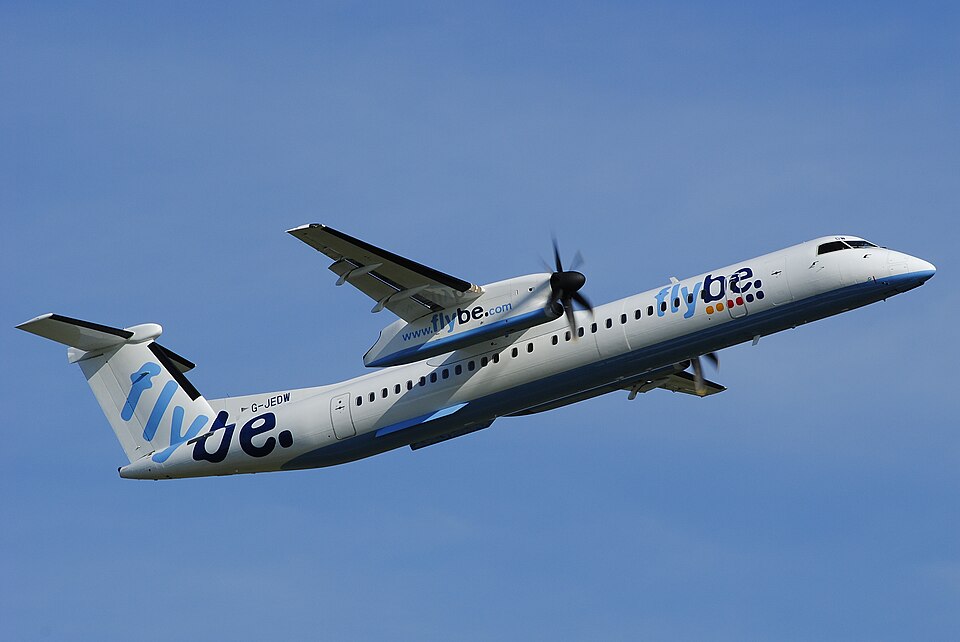
On 20 October 2005 at 0810 UTC, a Bombardier DHC-8-402 (Q400) registered G-JEDW was conducting a practice CAT II ILS approach to Runway 32 at Leeds Bradford International Airport. The aircraft, powered by two Pratt & Whitney Canada PW150A turboprop engines, had 4 crew and 60 passengers on board. No injuries were reported. The only damage was abrasion to the composite fairing covering the 'runway touched' sensor.
Flight History
The crew reported for duty at Belfast City Airport (BHD) at 0515 hrs. The co-pilot needed to complete six practice CAT II approaches to obtain company authorisation for operations below CAT I minima. He asked the commander, who was not a training captain, if he could practice a CAT II approach into Leeds Bradford; the commander agreed.
The aircraft departed BHD at 0640 hrs. The climb and cruise were uneventful. During the descent, the co-pilot briefed for a practice CAT II approach using an aide memoire from the quick reference handbook. He noted that while standard procedure called for the commander to land, he would land on this occasion.
The approach controller instructed a heading of 070° for base leg, then 350° to intercept the localiser. Both pilots set these headings on their respective heading selectors. The commander observed the aircraft turning left and realised it was flying through the localiser on a heading of 035°, set by the co-pilot's selector. When alerted, the co-pilot corrected to 350°. The approach controller asked if they could reposition without radar assistance; the commander replied they could.
The aircraft was flown with the autopilot engaged until shortly before touchdown. After intercepting the localiser and glide slope, the aircraft maintained a stable final approach with landing gear down and 15° of flap. The co-pilot called for flap 35, but the commander reminded him that CAT II landings use flap 15. The co-pilot set approximately 17% torque to achieve VREF of 120 kt.
At about 650 ft agl, the commander switched off both bleed air selectors. Standard CAT II calls of '100 above' and 'Decide' at DH were not made. At approximately 80 ft agl, the commander called 'disconnect', and the co-pilot disengaged the autopilot. Almost simultaneously, the co-pilot retarded both power levers. The commander said, 'don't pull the power back…you pulled all the power back….' The co-pilot flared positively to reduce the high descent rate, and both pilots advanced power, but the aircraft touched down heavily and the tail contacted the runway.
Post-Inspection and Aircraft Information
The commander noted the red master warning light and 'touched runway' warning caption. The aircraft taxied to a stand; passengers disembarked without incident. Cabin crew reported the landing felt hard but were unaware of the tail contact. The left rear passenger door was difficult to open from outside, but an engineer judged this due to a handle fault, not damage.
Engineering inspection found the 'touched runway' sensor fairing abraded but no other damage. The operator later dispatched engineers and another crew to fly the aircraft to its maintenance base.
The DHC-8-Q400 is a stretched derivative with high-wing twin turboprop design. Its propeller wash provides significant lift at low speeds, which can be affected if power is reduced before touchdown. The power levers operate via FADEC units; sensitivity increases at low torque settings, making fine adjustments challenging.
Heading selections on G-JEDW could be made on two rotary selectors on the central flight guidance control panel. The left selector controlled the commander's HSI; the right selector controlled the co-pilot's HSI. When the right HSI was selected as master, the autopilot followed the co-pilot's heading bug. This independence meant heading selections by one pilot could only be monitored by looking across to the other's display.
Flight Recorder Findings
Both the FDR and CVR were successfully replayed. The FDR recorded the entire flight; the CVR captured the approach and landing. A quick access recorder (QAR) was also replayed but not used as it recorded the same data as the FDR. FDR data showed that after the heading selection error, the aircraft turned to 035°, then corrected to 350° with the autopilot engaging localiser mode. The aircraft then turned left, overshot the localiser, corrected right, and finally captured the localiser at about 2,500 ft with glideslope engagement.