History of the Flight
The incident occurred on 12 November 2003 at Ronaldsway Airport, Isle of Man. The weather was: surface wind 270°/10 kt, visibility greater than 10 km, no significant weather, few clouds at 1,200 feet, temperature +11°C, dew point +7°C.
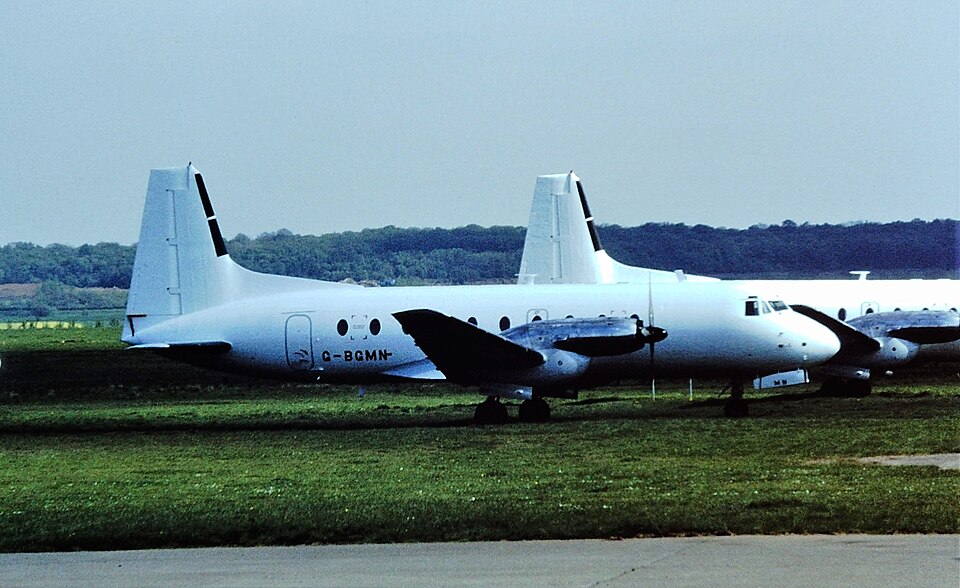
A British Aerospace HS.748 Series 2A (registration G-BGMN) was conducting pilot training. The commander, an experienced training captain with 7,800 hours total (2,800 on type), was performing the instrument section of a Licence Proficiency Check for a First Officer who had 1,100 hours on type. To simulate an engine failure after take-off (EFATO), Runway 21 was used instead of the duty Runway 26, to avoid congested areas. The HS.748 taxied to Holding Point Echo 1 via Taxiway Echo. Take-off procedure: the training captain set power and maintained directional control using the tiller until 60 KIAS, then passed control to the First Officer. Training V1 was 90 kt, Vr 100 kt.
A Piper PA-31-350 Navajo Chieftain (registration G-LIDE) was parked near Hangar 2. The commander, aged 27 with 969 hours (588 on type), was to operate an IFR charter flight to Liverpool with two passengers and 100 kg freight. He copied the ATIS (Runway 26 duty) and expected a taxi clearance via Taxiway A for Runway 26. He received clearance: "TAXI TO ALPHA 4 VIA 17 AND ALPHA" and read it back correctly. The HS.748 commander, already cleared to backtrack and line up on Runway 21, monitored this clearance. The PA-31 commander did not monitor any RT between the HS.748 and ATC. While taxiing past Hangar 2, he noticed a light aircraft with its baggage door apparently open. He continued onto Taxiway Alpha, then heard that light aircraft receive a taxi clearance.
The HS.748 was cleared for take-off on Runway 21 and commenced its roll with landing lights on. The PA-31 commander, distracted by the light aircraft's baggage door, looked left to check it, then looked into the cockpit to select VOR frequencies. When he looked out again, he realized he had taxied past the Alpha 4 holding point and stopped immediately, about 20-30 feet from Runway 21. The HS.748 commander had been monitoring the PA-31 and estimated his aircraft passed abeam the PA-31 at about 80 kt. The HS.748 continued its take-off; the PA-31 remained stationary until cleared to continue to Alpha 1.
Analysis
The investigation identified three main human factors:
- Expectation: From the ATIS, the PA-31 commander knew Runway 26 was duty. No specific ATC information was transmitted regarding the HS.748 departure on Runway 21. The take-off clearance to the HS.748 was not fully monitored by the PA-31 commander, who assumed the aircraft cleared for take-off was departing Runway 26.
- Distraction: Concern about the light aircraft's baggage door caused the PA-31 commander to look away from the taxiway to visually inspect it.
- Priorities: Taxiing towards an active runway, the commander's concern for the baggage door likely displaced the requirement to hold at Alpha 4. Approaching the holding point, he set navigation aids, suggesting he had forgotten the limits of his taxi clearance and reverted to his routine of proceeding to Alpha 1 or 2.
Conclusion
The PA-31 commander understood his taxi clearance and intended to stop at Alpha 4. However, after switching on his radios following the HS.748 commander's acknowledgement of the line-up clearance, he was unaware Runway 21 was in use. His expectations combined with the distraction caused by the light aircraft's baggage door caused him temporarily to forget the limit of his clearance to the Alpha 4 holding point. Only when he looked up from tuning navigation aids did he remember to stop, becoming aware of the HS.748 as it passed in front of him.