History of the Flight
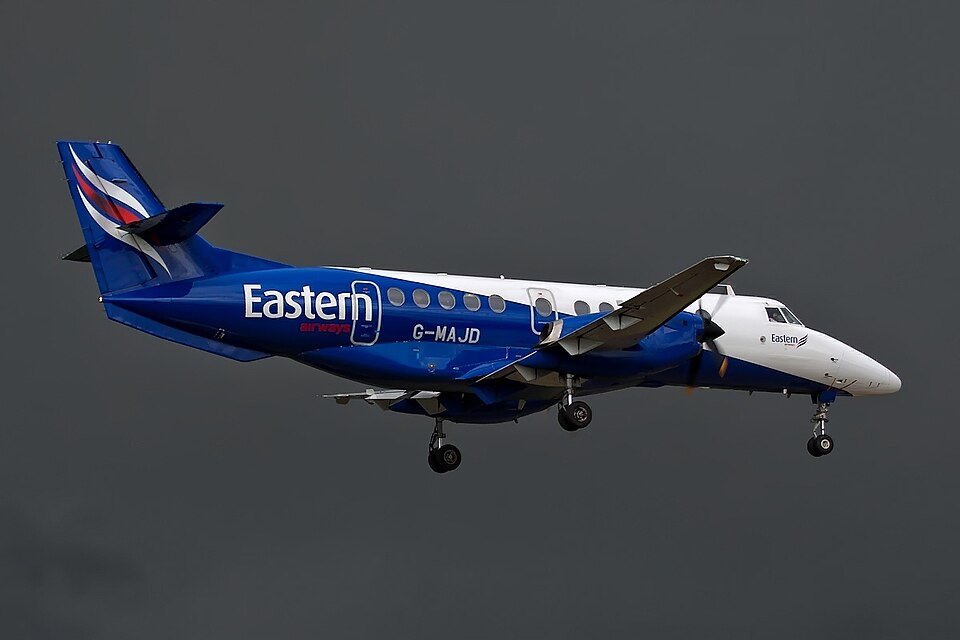
The aircraft, a British Aerospace Jetstream 41 registered G-MAJD, was operating a scheduled passenger service from Teeside to Southampton with a transit stop at Leeds/Bradford Airport. The crew consisted of two pilots, one cabin attendant, and five passengers. They commenced duty at 1615 hrs. The flight was the first of their duty period.
As the aircraft neared Leeds/Bradford, the crew received ATIS code 'G' (valid from 1829 hrs), which reported surface wind from 250° at 29 kt gusting 46 kt, visibility 20 km, and runway 32 damp. The aircraft's maximum demonstrated crosswind value was 35 kt. After a holding period, the crew elected to make an approach while monitoring reported wind. The commander was the handling pilot.
A flap 15 landing was planned (normal flap setting was 25) due to strong winds. The approach was reported quite steady until the latter stages when it became destabilised and the aircraft descended below the glideslope. The commander initiated a go-around, during which the main gear briefly made light contact with the runway surface.
For the second approach, the crew decided to use flap 25. During the final stages, the Tower controller passed wind reports of 250° at 45 kt and later 270° at 33 kt on short finals, at which point the decision to land was made. The commander recalled the touchdown was not heavy, but as the aircraft slowed, directional control difficulties arose. The aircraft yawed right, then the nose swung further left than intended before regaining the runway track. The aircraft vacated the runway normally, but damage to the left main landing gear was discovered on stand.
Meteorological Conditions
Anemometer data from Leeds/Bradford Airport showed wind direction averaging between 240° and 250° during the two approaches, with occasional variations between 210° and 270°. Variations became more frequent during the second approach, with a single variation to 277° near landing time. Wind speeds over 30-second periods ranged from about 10 kt to 50 kt. Instantaneous wind reports passed by ATC are shown in Figure 1 of the original report.
Recorded Data
Radio telephony recordings revealed the crew were informed of an average wind of 240° at 30 kt, maximum 42 kt, while holding. They indicated the maximum permissible wind for landing would be 37 kt if direction remained steady from 250°. The controller replied instantaneous wind was 240° at 25 kt. During the first approach, instantaneous wind reports varied between 26 kt and 32 kt. The second approach, at 1916 hrs, had a reported wind of 240° at 28 kt gusting 42 kt. The penultimate report of 250° at 45 kt was made when the aircraft was about 1.6 nm from the runway; the final report of 270° at 33 kt at about 1.1 nm.
Flight data recorder (FDR) information showed two approaches with autopilot coupled to the ILS. On the first approach, the aircraft had more than 20° of drift, reducing to about 15° before going around. On the second approach, drift angle just prior to landing was about 15°, equating to a crosswind component of approximately 34 kt. The FDR recorded a peak normal acceleration of 1.6 g at touchdown, with the aircraft slightly rolling left. Subsequently, the main gears were no longer sufficiently compressed to register as on the ground, while the nose gear remained on ground. The aircraft yawed right before being brought back left, coincident with a peak lateral acceleration of 0.6 g and a normal acceleration spike of 1.3 g.
Examination of the Aircraft
Examination on the night of the event revealed the left main landing gear (MLG) was leaning outwards. The outboard trunnion pin was broken. The trunnion pin is a fusible link designed to fail at a descent rate at touchdown of approximately 10 ft/s. The trunnion housing was resting against the outboard rib (Rib 8), which was damaged but supporting the MLG leg at a splayed angle. The MLG doors were open because the trunnion pin, attached to a bellcrank, actuates the doors; with the pin failed, the doors dropped under gravity. No propeller strike occurred, and aside from small fuel leaks, damage was limited to the MLG assembly and Rib 8.
The fractured pin and broken Rib 8 were metallurgically examined. The report showed the pin had no pre-existing material defects and failed primarily in overload shear. A crack propagated rapidly from the lower surface around the pin until full rupture, with remaining material bending and fracturing in tension. There were no signs of significant lateral loads; the failure was due to purely upward loading on the outboard wheel.
Conclusion
The trunnion pin failed in overload due to upward loading on the outboard wheel.