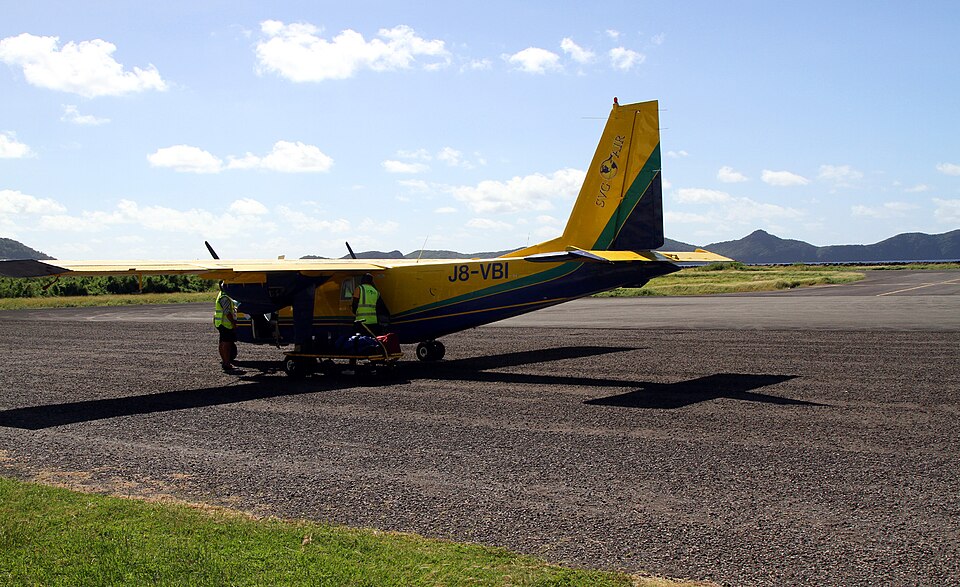
Accident Details
After an uneventful return flight to Barbuda, the aircraft departed Antigua at 2114 hrs (1714 local) for John A. Osborne Airport, Montserrat, with the pilot and six passengers on board. The aircraft cruised at 2,000 ft en route, and the pilot recalled good visual meteorological conditions throughout the 19-minute flight. Upon arriving at Montserrat, no other aircraft were operating in the vicinity of the airport. The pilot positioned the aircraft visually on a downwind leg for Runway 10.
The pilot reported commencing the approach at an airspeed of 65 kt, reducing to 60 kt as the aircraft touched down. The runway surface was dry, and the pilot described the landing as “smooth.” After the main landing gear touched down, but before the nosewheel contacted the runway, the pilot applied the brakes. He reported that the left brake felt “spongy” and did not seem to act, while the right brake felt normal. The pilot was unable to maintain directional control; the aircraft veered to the right two seconds after touchdown and departed the runway three seconds later. It continued across an adjacent grassed area before impacting an embankment close to the runway.
After the aircraft came to a stop, the pilot shut down the engines using the normal shutdown procedure. The left main landing gear had collapsed, rendering the left cabin exit unusable. The pilot evacuated through the flight deck door on the left side. The six passengers were able to evacuate through the right cabin exit. The airport fire service arrived at the aircraft less than one minute after the accident.
Probable Cause
The investigation identified the probable cause as a combination of factors. On landing at John A. Osborne Airport, Montserrat, the pilot was unable to maintain directional control of the aircraft, later reporting the left brake felt “spongy.” The aircraft veered off the right side of the runway and came to rest in an adjacent drainage ditch. An inspection of the aircraft’s braking system revealed a slight brake fluid leak from one of the pistons in the left outboard brake calliper. This would have prevented full brake pressure from being achieved on the left brakes, resulting in an asymmetric braking effect. Difficulty in maintaining directional control was compounded by the use of an incorrect braking technique on landing. Additionally, the investigation identified shortcomings with the operator’s manuals, procedures, and regulatory oversight.