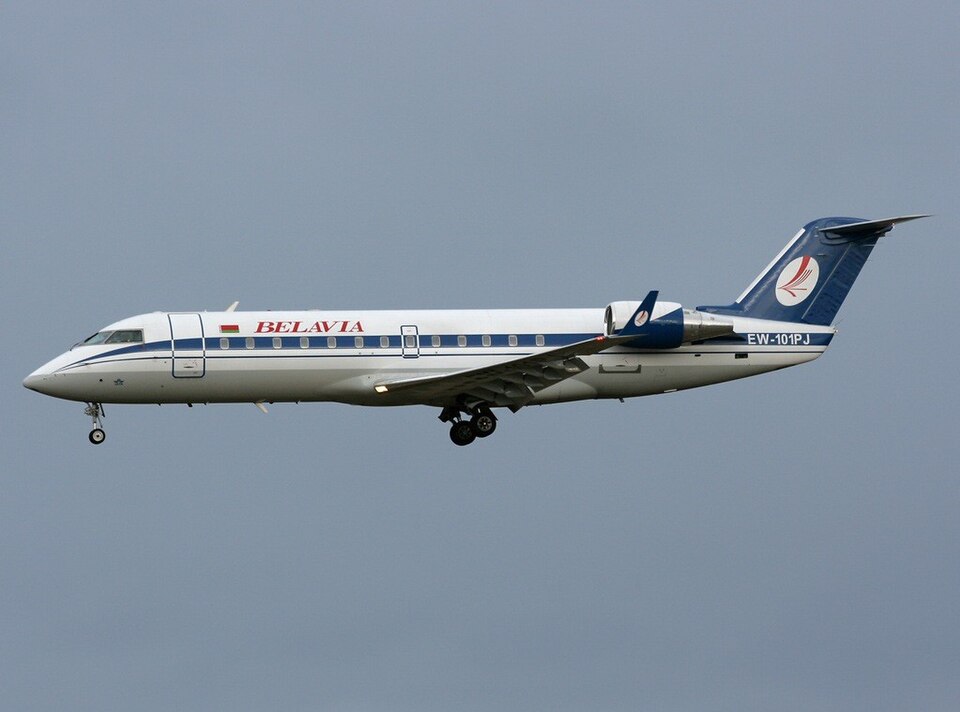
Accident Overview
On an unspecified date, a Belavia-operated Canadair CRJ-100LR, registration EW-101PJ, was destroyed when it crashed and caught fire during takeoff from Yerevan-Zvartnots Airport (EVN), Armenia. All three crew members and eighteen passengers survived the accident.
Pre-Flight and Weather
The aircraft had arrived as flight BRU1833 from Minsk-2 International Airport (MSQ), Belarus at 02:05. Refueling was carried out for the return flight, and the crew conducted flight planning. After refueling, the pilot performed a tactile and visual inspection of all critical wing surfaces and a visual inspection of the tail assembly; all surfaces were reported clean and dry.
Weather reported for 04:00 was: wind 110° at 1 m/s, visibility 3500 meters, haze, small clouds, vertical visibility 800 meters, scattered clouds at 3000 m, temperature minus 3°C, dew point minus 4°C, pressure 1019 hPa.
Departure and Accident Sequence
At 04:08, both engines were started. The engine air intake heating (cowl anti-ice) was switched on, but the wing anti-icing system was not activated. The crew taxied to runway 27 and received clearance for departure. During takeoff, the airplane progressively banked left until the left wing tip contacted the runway. The aircraft then went off the side of the runway, rolling onto its right side. The right wing broke off, and spilled fuel ignited. The airplane came to rest upside down.
Probable Cause
The official investigation determined that the accident was the result of an asymmetric loss of lift of the wing during takeoff, which led to the toppling of the aircraft immediately after liftoff, the left wing tip contacting the ground, and subsequent destruction and fire. The loss of lift was caused by frost contamination on the wing surface, given the actual weather conditions. The formation of frost was most likely due to fuel icing while the aircraft was parked and during taxiing for the return flight, resulting from a temperature difference between the surrounding air and cold fuel in the tanks after the previous flight. The situation may have been aggravated when the angular velocity during nose wheel lift exceeded values recommended by the operations manual for takeoff with contaminated wings, a parameter that cannot be instrumentally monitored. Existing procedural methods for inspecting aerodynamic surfaces before departure, along with the inefficiency of the stall protection system due to increased wing sensitivity to even slight leading-edge contamination, cannot fully guarantee prevention of similar accidents in the future. An Airworthiness Directive requiring activation of wing anti-icing systems during the final stage of taxiing under such weather conditions was issued by Transport Canada after the accident; this directive probably could have prevented the accident.