History of the Flight
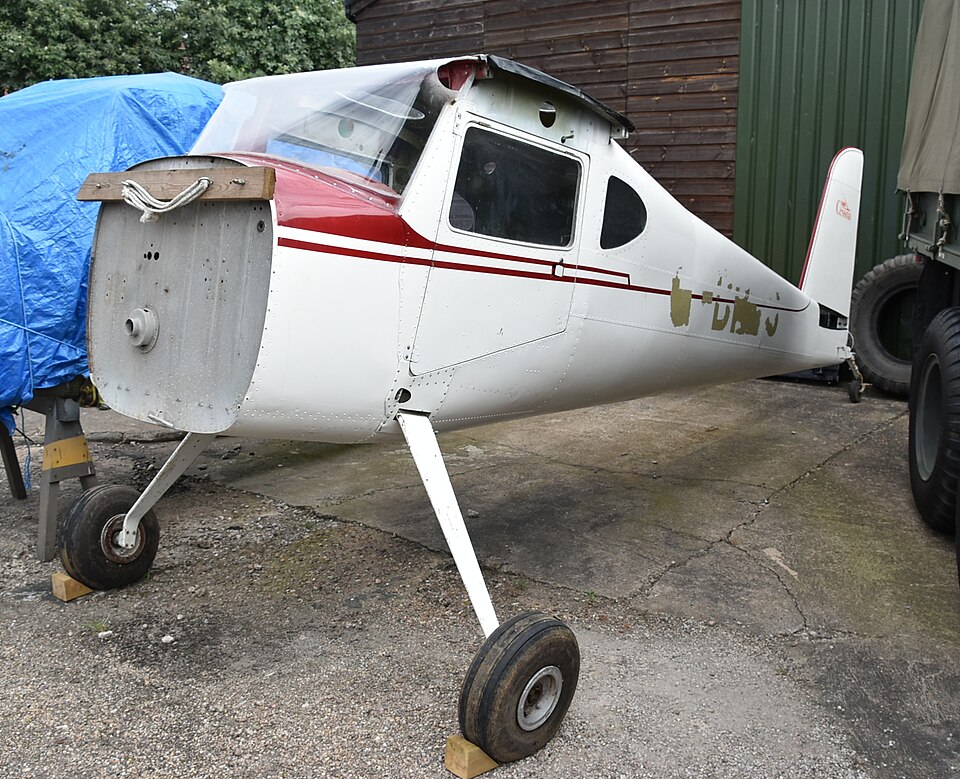
The aircraft, a Cessna 120 registered G-BRJC, was being flown for pleasure from Old Buckenham Airfield to Cromer Airfield. The runway in use at Cromer was 18, which has a grass surface, a length of 493 metres and a 1.8° downslope. The pilot reported the wind at the time was southerly, at 8 to 10 kt, providing a direct headwind for this runway.
The Landing and Accident
The pilot considered that he allowed the aircraft to become rather 'low and slow' and that late in the approach he saw what appeared to be a hedge and small embankment on the threshold of the runway. He immediately applied power and when he thought he had cleared the hedge, he reduced power to land. Immediately after touch-down the aircraft tipped right wing low and slid along the ground, coming to rest some 80 feet into the airfield, just to the left of the runway centre line. The pilot and passenger left the aircraft without difficulty through the doors.
It was immediately clear that the right landing gear leg had fractured and that the stub of the leg had supported the aircraft during its slide. The initial concern was that the aircraft had hit the embankment but there were no marks to confirm this impact and there were ground marks indicating that both wheels were still in place when the aircraft touched down on the runway.
Examination of the Landing Gear Leg
Each main landing gear leg of the Cessna 120 is formed from a single plate of high tensile steel attached to the lower fuselage structure at the upper end and to the wheel and brake assembly at the lower end. Each leg has a simple fabricated step at about its mid-point, attached to the leg by two bolts passing through holes perpendicular to the plate. The fracture line of the plate was parallel to the longitudinal axis of the aircraft and passed through the upper of these two holes.
The surface of the fracture was examined by an independent metallurgist, who detected areas of fatigue crack initiation within the lower end of the bolt hole, in each case associated with corrosion damage within this hole. These areas extended only about 0.7 mm into the plate material but were sufficient, in this type of high tensile steel, to initiate an overload failure through the material. The failure itself was a simple bending mechanism, consistent with the repeated application of tensile landing loads into this lower surface of the leg. There was also substantial corrosion in the area of contact between the step assembly and the landing gear leg.
Examination of a prepared cross-section of the leg material indicated that the steel was a hardened and tempered low-alloy steel. There was, however, evidence of surface decarburisation, possibly occurring during the heat treatment of the material. Vickers hardness tests suggested that the depth of this layer was about 0.8 mm and would have led to a substantial reduction in the tensile strength of this layer. The aircraft's records show that it was manufactured in 1946 and indicate that there had not been a change of landing gear leg during the aircraft's life.
Manufacturer Information
The aircraft manufacturer provided information regarding a similar accident to a Cessna 140A, N666TC, at Greeley, Colorado, in April 2001, where the right main landing gear leg failed on a full-stall landing. Metallurgical analysis at the manufacturer's laboratory confirmed that the leg was made of 6150M steel and that there was a layer of decarburisation of about 0.015 inches. The failure, principally through ductile overload, was through the plane of the upper bolt for the step, with a small area of fatigue.
The manufacturer also provided two Service Letters: S.L.N-67 (5 November 1947) and 63-14 (5 March 1963), both advising inspection of the area around the step's rivet holes due to reports of landing gear leg failures on Cessna 120 and 140 aircraft. The manufacturer referred to the 100 Series Service Information Manual as an acceptable guide for maintenance on these older models.
The sensitivity of this area to damage is illustrated by the fact that the owners of G-BRJC, who had clearly been careful and conservative with the maintenance of the aircraft, had cleaned, inspected and repainted this area only about five years prior to the accident. In view of the landing gear leg's 57 year service life and the manufacturer's earlier Service Letters, the AAIB made no safety recommendation.