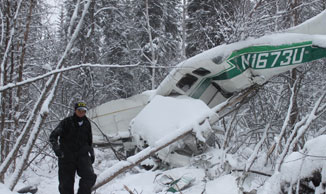
Synopsis
A pilot departed on a positioning flight during dark night in marginal visual meteorological conditions. A witness waiting at the destination airport reported that shortly after the pilot-controlled airport lighting activated, a snow squall passed over the airport, greatly reducing visibility. The airplane never arrived, and a search was initiated. The wreckage was discovered the next morning in a wooded area about 2 miles from the destination.
Flight Details
Review of archived ADS-B data showed that after departure, the airplane climbed to about 700 feet above ground level, maintained that altitude for about 3 minutes, then entered a shallow right-hand descending turn until impact with terrain.
Investigation
On-site examination of the airframe and engine revealed no preaccident mechanical anomalies that would have precluded normal operation. The cockpit area was extensively fragmented, rendering postaccident cockpit and instrument findings unreliable. Structural damage to the airframe precluded determination of flight control continuity. Examination of the engine and recovered components found no evidence of mechanical malfunction.
Witness accounts indicated worsening weather conditions at the airport just before the accident. The lack of mechanical anomalies suggests the pilot encountered heavy snow and instrument meteorological conditions while approaching the airport, likely leading to spatial disorientation.
Probable Cause
The National Transportation Safety Board determined that the probable cause was the pilot’s loss of situational awareness after an inadvertent encounter with instrument meteorological conditions, which resulted in an in-flight collision with tree-covered terrain.