Flight Summary
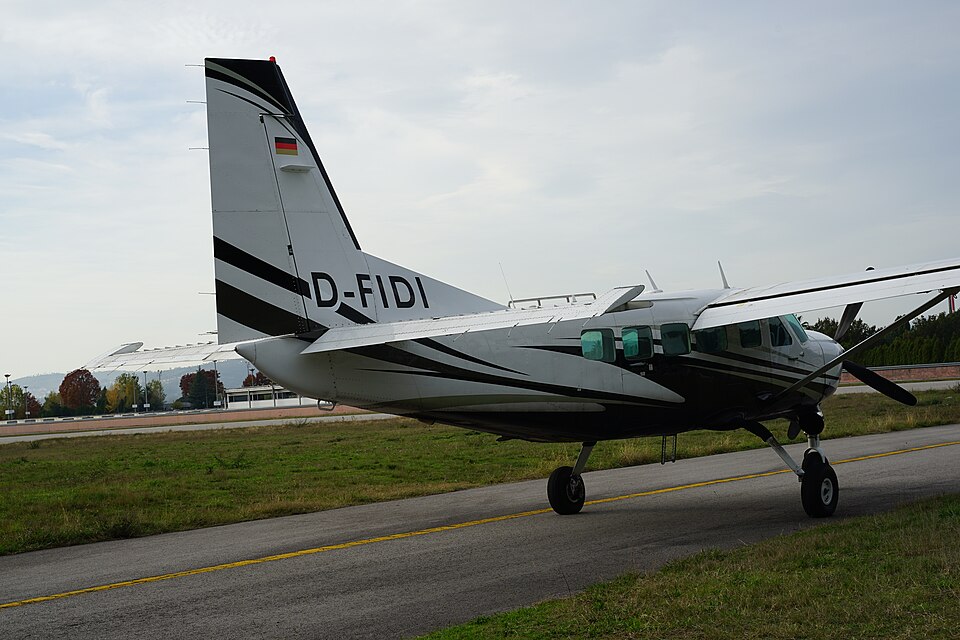
At 1448 hours, the pilot departed from Gransee Special Airfield in a Cessna 208 Caravan for a commercial visual flight rules (VFR) flight. On board were the pilot and 15 skydivers, who were dropped at flight level 130. The pilot had already conducted three previous skydiving flights that day, totaling 48 minutes of flight time.
Accident Sequence
After dropping the skydivers during the fourth flight, the aircraft was last captured by radar at 1505:49 hours while approaching to land at the airfield, near the accident site at approximately 550 feet above mean sea level (AMSL). At that time, ground speed was 168 knots and heading was 330°.
The Flugleiter (airfield supervisor) reported observing the final phase of the approach. The aircraft was in a left-hand turn with a bank angle of up to 90° close to the ground. The Flugleiter assumed the pilot may have overshot the extended centerline of runway 29 when entering final approach from the south. The aircraft then disappeared behind trees. The pilot did not transmit any emergency call.
Observations from Previous Flight
The Flugleiter also stated that a similar maneuver was observed during the previous flight. Radar data for the third flight ended at 1417:54 hours with a recorded altitude of about 1,400 feet above ground level (AGL), ground speed of 168 knots, and heading of 355°. During both the third and fourth flights, skydivers were dropped at flight level 130 at a heading of about 300° south of the airfield. After the drops, at 1415:07 hours and 1502:52 hours respectively, the aircraft entered a descent with a very high rate of descent and flew in a wide left-hand turn back to the airfield. During the third flight, a right-left-hand turn with bank angles of about 50° to 60° occurred during descent.
Probable Cause and Contributing Factors
The official investigation determined the air accident was due to a risky flight maneuver close to the ground, resulting in a controlled impact with the ground. The approach speed exceeded the aircraft's operational limitations, and the approach was not stabilized. Contributing human factors included recurrent acceptance of risky flight maneuvers by the pilot (routine violations), overconfidence, and insufficient risk assessment. Contributing operational factors included unsuitable wording in the operations manual regarding approaches after dropping skydivers.