Incident Overview
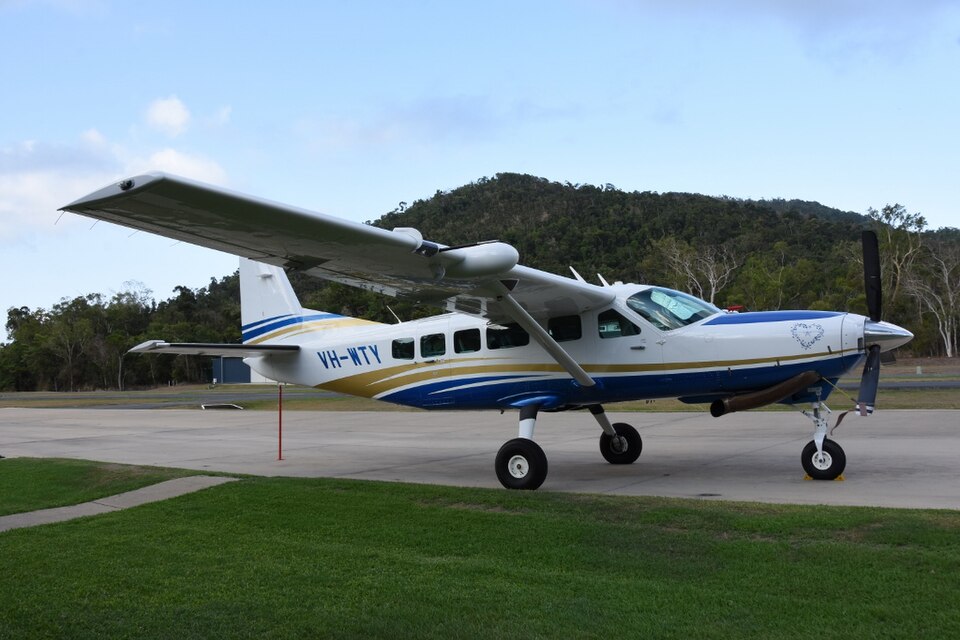
On 28 January 2016, a Cessna Aircraft Company Caravan 208 amphibian, registered VH-WTY, was performing charter flights in the Whitsunday region of Queensland. On the third flight of the day, the aircraft departed Hamilton Island Airport at about 1415 Eastern Standard Time with ten passengers and one pilot. The tour included a scenic flight over the Great Barrier Reef lasting about 50 minutes, followed by a water landing at Chance Bay, on the southeast tip of Whitsunday Island, approximately 11 km northeast of Hamilton Island Airport. The group was to spend 90 minutes at the beach before returning to Hamilton Island. Originally, the landing was planned at Whitehaven Beach, but wind conditions necessitated a change to Chance Bay.
Sequence of Events
Radar data showed VH-WTY approaching Whitsunday Island from the north, orbiting about 2 km north of Whitehaven Beach at around 1510, then flying over the southern end of Whitehaven Beach and the land strip separating it from Chance Bay. At about 1515, after crossing Chance Bay beach in a southerly direction, the aircraft descended below radar coverage. The pilot reported conducting a visual pre-landing check by flying over the western end of the main beach, noting positions of moored vessels and observing the sea state and wind gusts. He then initiated a right downwind turn toward the landing area, approaching from the south to land in a suitable spot and taxi to the beach.
According to the pilot, he set up for landing at about 50 ft above the water but delayed touchdown to fly through a wind gust. Passenger video footage showed that during the landing, the aircraft bounced three times on the water surface. After the second bounce, with the aircraft nearing the beach and terrain, the pilot increased engine power and began a go-around. The third bounce, occurring almost immediately after the second, was the most pronounced, rebounding the aircraft about 30 to 50 ft above the water. The pilot perceived the torque indicator showing red, suggesting an over-torque for the propeller configuration. Noticing less-than-expected climb performance with flaps at 30°, he reduced flap to 20° and continued climbing straight ahead toward a saddle. Still unsatisfied with climb performance and assessing that VH-WTY would not clear the terrain, he turned right to avoid rising ground. During this turn, the aircraft clipped trees before colliding with terrain and coming to rest in dense scrub about 150 m from the eastern end of the main beach, near the top of the ridge.
Aftermath
The pilot promptly instructed passengers to exit and move away from the aircraft. All 11 occupants evacuated quickly; some suffered minor injuries. There was no post-impact fire. The aircraft's fixed emergency beacon activated upon impact and was detected by the Australian Maritime Safety Authority (AMSA), prompting a search and rescue response from the Joint Rescue Coordination Centre (JRCC) Australia. The pilot also reported activating his personal locator beacon, but AMSA did not detect it. Additionally, the pilot used the company satellite phone to inform the operator of the occurrence and the status of those on board. Meanwhile, witnesses at Chance Bay reached the aircraft and assisted everyone down to the beach. A tourist boat transferred the pilot and passengers to Hamilton Island, arriving at about 1600. From there, one passenger was taken by helicopter to Mackay for further treatment.
Findings
The official investigation identified contributing factors: the aircraft's initial touches with water were past the nominated decision point and beyond the northern boundary of the designated landing area, reducing safety margins for a successful water landing or go-around. The pilot initiated a go-around without using all available power and optimal speed, turned towards higher terrain, and placed the aircraft in a down-wind situation, leading to the collision with terrain. Other findings noted that the lap-sash seatbelts likely reduced injury, and the use of emergency beacons and satellite phone facilitated a timely response.